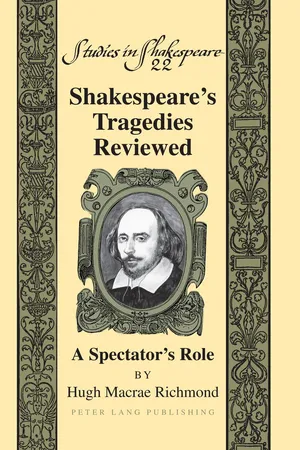
Shakespeare's Tragedies Reviewed explores how the recognition of spectator interests by the playwright has determined the detailed character of Shakespeare tragedies. Utilizing Shakespeare's European models and contemporaries, including Cinthio and Lope de Vega, and following forms such as Aristotle's second, more popular style of tragedy (a double ending of punishment for the evil and honor for the good), Hugh Macrae Richmond elicits radical revision of traditional interpretations of the scripts. The analysis includes a major shift in emphasis from conventionally tragic concerns to a more varied blend of tones, characterizations, and situations, designed to hold spectator interest rather than to meet neoclassical standards of coherence, focus, and progression. This reinterpretation also bears on modern staging and directorial emphasis, challenging the relevance of traditional norms of tragedy to production of Renaissance drama. The stress shifts to plays' counter-movements to tragic tones, and to scripts' contrasting positive factors to common downbeat interpretations – such as the role of humor in King Lear and the significance of residual leadership in the tragedies as seen in the roles of Malcolm, Edgar, Cassio, and Octavius, as well as the broader progressions in such continuities as those within Shakespeare's Roman world from Julius Caesar and Antony and Cleopatra to Cymbeline. It becomes apparent that the authority of the spectator in such Shakespearean titles as What You Will and As You Like It may bear meaningfully on interpretation of more plays than just the comedies.
- 224 pages
- English
- PDF
- Available on iOS & Android
eBook - PDF
About this book
Information
Table of contents
- Cover
- Contents
- Acknowledgments
- Chapter One: Introduction: The Spectator and the Dramatists
- Chapter Two: Renaissance Dramaturgy
- Chapter Three: Richard III as “a Tragedy with a Happy Ending”
- Chapter Four: A Spectator’s View of Shakespeare’s Romeo and Juliet and Lope de Vega’s Castelvines y Monteses
- Chapter Five: Interlude: Mixed Modes Throughout Shakespeare
- Chapter Six: Julius Caesar and Neoclassicism
- Chapter Seven: Hamlet: The Spectator as Detective
- Chapter Eight: Othello: Iago’s Audience
- Chapter Nine: Macbeth: Satisfying the Spectator
- Chapter Ten: Coriolanus: The Spectator and Aristotelianism
- Chapter Eleven: Enjoying King Lear
- Chapter Twelve: Antony and Cleopatra: Comical/Historical/Tragical
- Chapter Thirteen: Cymbelene as Resolution: Tragical-Comical-Historical-Pastoral
- Chapter Fourteen: Epilogue: Henry VIII and The Two Noble Kinsmen
- Appendix I
- Appendix II
- References
- Index
Trusted by 375,005 students
Access to over 1.5 million titles for a fair monthly price.
Study more efficiently using our study tools.
Frequently asked questions
Yes, you can cancel anytime from the Subscription tab in your account settings on the Perlego website. Your subscription will stay active until the end of your current billing period. Learn how to cancel your subscription
No, books cannot be downloaded as external files, such as PDFs, for use outside of Perlego. However, you can download books within the Perlego app for offline reading on mobile or tablet. Learn how to download books offline
Perlego offers two plans: Essential and Complete
- Essential is ideal for learners and professionals who enjoy exploring a wide range of subjects. Access the Essential Library with 800,000+ trusted titles and best-sellers across business, personal growth, and the humanities. Includes unlimited reading time and Standard Read Aloud voice.
- Complete: Perfect for advanced learners and researchers needing full, unrestricted access. Unlock 1.5M+ books across hundreds of subjects, including academic and specialized titles. The Complete Plan also includes advanced features like Premium Read Aloud and Research Assistant.
We are an online textbook subscription service, where you can get access to an entire online library for less than the price of a single book per month. With over 1.5 million books across 990+ topics, we’ve got you covered! Learn about our mission
Look out for the read-aloud symbol on your next book to see if you can listen to it. The read-aloud tool reads text aloud for you, highlighting the text as it is being read. You can pause it, speed it up and slow it down. Learn more about Read Aloud
Yes! You can use the Perlego app on both iOS and Android devices to read anytime, anywhere — even offline. Perfect for commutes or when you’re on the go.
Please note we cannot support devices running on iOS 13 and Android 7 or earlier. Learn more about using the app
Please note we cannot support devices running on iOS 13 and Android 7 or earlier. Learn more about using the app
Yes, you can access Shakespeares Tragedies Reviewed by in PDF and/or ePUB format, as well as other popular books in Literature & Drama. We have over 1.5 million books available in our catalogue for you to explore.