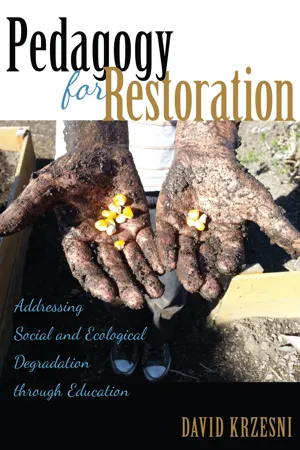
Pedagogy for Restoration seeks to understand the conditions leading to the destruction of Earth in order to discover pedagogy for restoration. As we degrade the planet we degrade ourselves and as we degrade ourselves we degrade the planet. Moral development and socialization significantly influence our participation in, construction of, or resistance to the systems of oppression that degrade us. The process of restorative education recognizes that humans are fundamentally good and moral and seeks to promote healthy moral development. We must help students meet their basic needs, center their own identities and experience, and simultaneously emphasize community and relationships to help them find a sense of purpose. These efforts facilitate social and ecological restoration by allowing students to reach a physical and emotional place that is conducive to learning and self-efficacy so that they may engage with whatever issues they find important in their own way and on their own terms.
eBook - PDF
Pedagogy for Restoration
Addressing Social and Ecological Degradation through Education
- 257 pages
- English
- PDF
- Available on iOS & Android
eBook - PDF
Pedagogy for Restoration
Addressing Social and Ecological Degradation through Education
About this book
Information
Table of contents
- Cover
- Contents
- Preface
- Acknowledgments
- Introduction
- Part I: The Status Quo
- Part II: Empathy and Morality
- Part III: Pedagogy for Restoration
- Conclusion
- Notes
- References
- Index
Trusted by 375,005 students
Access to over 1.5 million titles for a fair monthly price.
Study more efficiently using our study tools.
Frequently asked questions
Yes, you can cancel anytime from the Subscription tab in your account settings on the Perlego website. Your subscription will stay active until the end of your current billing period. Learn how to cancel your subscription
No, books cannot be downloaded as external files, such as PDFs, for use outside of Perlego. However, you can download books within the Perlego app for offline reading on mobile or tablet. Learn how to download books offline
Perlego offers two plans: Essential and Complete
- Essential is ideal for learners and professionals who enjoy exploring a wide range of subjects. Access the Essential Library with 800,000+ trusted titles and best-sellers across business, personal growth, and the humanities. Includes unlimited reading time and Standard Read Aloud voice.
- Complete: Perfect for advanced learners and researchers needing full, unrestricted access. Unlock 1.5M+ books across hundreds of subjects, including academic and specialized titles. The Complete Plan also includes advanced features like Premium Read Aloud and Research Assistant.
We are an online textbook subscription service, where you can get access to an entire online library for less than the price of a single book per month. With over 1.5 million books across 990+ topics, we’ve got you covered! Learn about our mission
Look out for the read-aloud symbol on your next book to see if you can listen to it. The read-aloud tool reads text aloud for you, highlighting the text as it is being read. You can pause it, speed it up and slow it down. Learn more about Read Aloud
Yes! You can use the Perlego app on both iOS and Android devices to read anytime, anywhere — even offline. Perfect for commutes or when you’re on the go.
Please note we cannot support devices running on iOS 13 and Android 7 or earlier. Learn more about using the app
Please note we cannot support devices running on iOS 13 and Android 7 or earlier. Learn more about using the app
Yes, you can access Pedagogy for Restoration by David Krzesni in PDF and/or ePUB format, as well as other popular books in Education & Education General. We have over 1.5 million books available in our catalogue for you to explore.