- 256 pages
- English
- PDF
- Available on iOS & Android
About this book
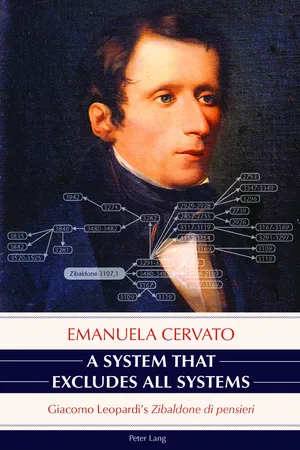
For many decades Giacomo Leopardi's Zibaldone di pensieri has been seen as a collection of temporary thoughts and impressions whose final expression is to be found in the published poems (the Canti ) and satirical dialogues (the Operette morali ). The conceptual consistency of the work was thereby denied, privileging Leopardi the poet over Leopardi the thinker.
This book shows that such a perceived lack of coherence is merely illusory. The Zibaldone is drawn together by an intricate web of references centring around topics such as the ambivalent concept of nature; the Heraclitean «union of opposites» (ancients and moderns, poetry and philosophy, reason and imagination); and the tension between the desire for happiness and the impossibility of its realization. Largely unknown to the English-speaking world until its translation in 2013, the Zibaldone is Leopardi's intellectual diary, the place where dialogue with the ancient classical traditions evolves into modern encyclopaedism and what has been described as «thought in movement». It establishes Leopardi as one of the most original and radical thinkers of the nineteenth century.
Frequently asked questions
- Essential is ideal for learners and professionals who enjoy exploring a wide range of subjects. Access the Essential Library with 800,000+ trusted titles and best-sellers across business, personal growth, and the humanities. Includes unlimited reading time and Standard Read Aloud voice.
- Complete: Perfect for advanced learners and researchers needing full, unrestricted access. Unlock 1.4M+ books across hundreds of subjects, including academic and specialized titles. The Complete Plan also includes advanced features like Premium Read Aloud and Research Assistant.
Please note we cannot support devices running on iOS 13 and Android 7 or earlier. Learn more about using the app.
Information
Table of contents
- Cover
- Contents
- Acknowledgements
- Note on the Text
- A Book of Philosophical Sketches?
- Chapter 1: From Poet to Philosopher
- Chapter 2: âA System that Excludes All Systemsâ
- Chapter 3: âTo Know Is None Other than To Feelâ
- Chapter 4: âTurning Reason into Passionâ
- Chapter 5: âMorality Is None Other than Proprietyâ
- Bibliography
- Index