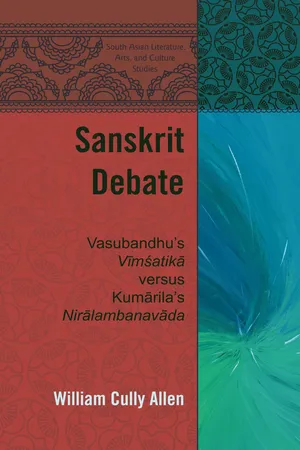
Sanskrit Debate: Vasubandhu's 'V?m?atik?' versus Kum?rila's 'Nir?lambanav?da' illustrates the rules and regulations of classical Indian debate literature (pram?na??stra) by introducing new translations of two Sanskrit texts composed in antithesis to each other's tradition of thought and practice. In the third century CE, Vasubandhu, a Buddhist philosopher-monk, proposed that the entire world of lived experience is a matter of mind only through his V?m?atik? (Twenty Verses). In the seventh century CE, Kum?rila, a Hindu philosopher-priest, composed Nir?lambanav?da (Non-Sensory Limit Debate) to establish the objective reality of objects by refuting Vasubandhu's claim that objects experienced in waking life are not different from objects experienced in dreams. Kum?rila rigorously employs formal rules and regulations of Indian logic and debate to demonstrate that Vasubandhu's assertion is totally irrational and incoherent.
V?m?atik? ranks among the world's most misunderstood texts but Kum?rila's historic refutation allows V?m?atik? to be read in its own text-historical context. This compelling, radically revolutionary re-reading of V?m?atik? delineates a hermeneutic of humor indispensable to discerning its medicinal message. In V?m?atik?, Vasubandhu employs the form of professional Sanskrit logic and debate as a guise and a ruse to ridicule the entire enterprise of Indian philosophy. Vasubandhu critiques all Indian theories of epistemology and ontology and claims that both how we know and what we know are acts of the imagination.
- 152 pages
- English
- PDF
- Available on iOS & Android
eBook - PDF
About this book
Information
Table of contents
- Cover
- Table of Contents
- Acknowledgments
- 1 Classical Indian Philosophy
- 2 Vimśatikā and Auto-Commentary in Text-Historical Context
- 3 Translation of Vimśatikā and Auto-Commentary
- 4 Nirālambanavāda in Text-Historical Context
- 5 Translation of Nirālambanavāda
- 6 The Verdict
- References
- Bibliography of Sources Cited
- Index
Trusted by 375,005 students
Access to over 1.5 million titles for a fair monthly price.
Study more efficiently using our study tools.
Frequently asked questions
Yes, you can cancel anytime from the Subscription tab in your account settings on the Perlego website. Your subscription will stay active until the end of your current billing period. Learn how to cancel your subscription
No, books cannot be downloaded as external files, such as PDFs, for use outside of Perlego. However, you can download books within the Perlego app for offline reading on mobile or tablet. Learn how to download books offline
Perlego offers two plans: Essential and Complete
- Essential is ideal for learners and professionals who enjoy exploring a wide range of subjects. Access the Essential Library with 800,000+ trusted titles and best-sellers across business, personal growth, and the humanities. Includes unlimited reading time and Standard Read Aloud voice.
- Complete: Perfect for advanced learners and researchers needing full, unrestricted access. Unlock 1.5M+ books across hundreds of subjects, including academic and specialized titles. The Complete Plan also includes advanced features like Premium Read Aloud and Research Assistant.
We are an online textbook subscription service, where you can get access to an entire online library for less than the price of a single book per month. With over 1.5 million books across 990+ topics, we’ve got you covered! Learn about our mission
Look out for the read-aloud symbol on your next book to see if you can listen to it. The read-aloud tool reads text aloud for you, highlighting the text as it is being read. You can pause it, speed it up and slow it down. Learn more about Read Aloud
Yes! You can use the Perlego app on both iOS and Android devices to read anytime, anywhere — even offline. Perfect for commutes or when you’re on the go.
Please note we cannot support devices running on iOS 13 and Android 7 or earlier. Learn more about using the app
Please note we cannot support devices running on iOS 13 and Android 7 or earlier. Learn more about using the app
Yes, you can access Sanskrit Debate by in PDF and/or ePUB format, as well as other popular books in Theology & Religion & Philosophy History & Theory. We have over 1.5 million books available in our catalogue for you to explore.