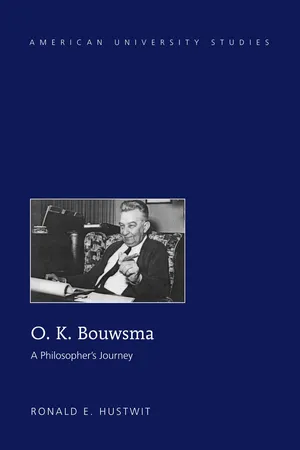
O. K. Bouwsma was, with J. L. Austin and J. O. Wisdom, the best known of the «Ordinary Language» philosophers of the mid-twentieth century. In 1950, he initiated the prestigious John Locke Lectures at Oxford as a representative of that school of philosophers, who developed the implications of Wittgenstein's later philosophy. Bouwsma, a friend of Wittgenstein and oriented by the latter's work, grasped its implications for his own work. Already possessing a keen sensitivity to ordinary usages, Bouwsma developed a unique and humorous style aimed at philosophy's seemingly intractable problems. While Wittgenstein provided a method for attacking philosophical tangles, Bouwsma actually applied the method of assembling reminders of everyday language for contrast to the generalized abstractions of philosophers. Passing beyond an attraction to G. E. Moore's common sense refutations of philosophical skepticism, Bouwsma developed analytic techniques based on the realization that the test of sense in philosophical theorizing lay in the grammar of established usage of language.
An avid reader of Kierkegaard, Bouwsma found in him a clue to understanding the language of religious belief. That language is to be understood in the lives of people who actually practice faith rather than in metaphysical or epistemological systems meant to explain faith's rationality. To that end, Bouwsma wrote essays on religious themes. In addition to such essays, he also wrote on aesthetics aimed at understanding philosophical language about poetry and music. Directed to any of these areas, his essays are among the finest writings in the British-American philosophical tradition. They flow without technical language, are pointedly humorous, and make delightful reading.
eBook - PDF
About this book
Information
Table of contents
- Cover
- Table of Contents
- Preface
- Chapter 1. A Sketch of the Journey
- Chapter 2. The Young Professor in Nebraska, 1928–1939
- Chapter 3. Finding Oneself in a Woods, 1939–1949
- Chapter 4. Midway upon the Journey, 1949–1951
- Chapter 5. Coming to Oneself Where the Right Way Was Lost, 1951–1965
- Chapter 6. Knowing How to Go on in Texas, 1965–1978
- Notes
- Bibliography
- Index
Trusted by 375,005 students
Access to over 1.5 million titles for a fair monthly price.
Study more efficiently using our study tools.
Frequently asked questions
Yes, you can cancel anytime from the Subscription tab in your account settings on the Perlego website. Your subscription will stay active until the end of your current billing period. Learn how to cancel your subscription
No, books cannot be downloaded as external files, such as PDFs, for use outside of Perlego. However, you can download books within the Perlego app for offline reading on mobile or tablet. Learn how to download books offline
Perlego offers two plans: Essential and Complete
- Essential is ideal for learners and professionals who enjoy exploring a wide range of subjects. Access the Essential Library with 800,000+ trusted titles and best-sellers across business, personal growth, and the humanities. Includes unlimited reading time and Standard Read Aloud voice.
- Complete: Perfect for advanced learners and researchers needing full, unrestricted access. Unlock 1.5M+ books across hundreds of subjects, including academic and specialized titles. The Complete Plan also includes advanced features like Premium Read Aloud and Research Assistant.
We are an online textbook subscription service, where you can get access to an entire online library for less than the price of a single book per month. With over 1.5 million books across 990+ topics, we’ve got you covered! Learn about our mission
Look out for the read-aloud symbol on your next book to see if you can listen to it. The read-aloud tool reads text aloud for you, highlighting the text as it is being read. You can pause it, speed it up and slow it down. Learn more about Read Aloud
Yes! You can use the Perlego app on both iOS and Android devices to read anytime, anywhere — even offline. Perfect for commutes or when you’re on the go.
Please note we cannot support devices running on iOS 13 and Android 7 or earlier. Learn more about using the app
Please note we cannot support devices running on iOS 13 and Android 7 or earlier. Learn more about using the app
Yes, you can access O. K. Bouwsma by in PDF and/or ePUB format, as well as other popular books in Philosophy & Modern Philosophy. We have over 1.5 million books available in our catalogue for you to explore.