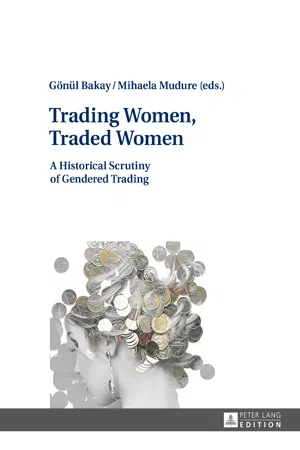
For the scholarly reader it is a truism that trade, in its widest sense (exchange, interchange, deal) is the basis of human society, it is part of the human interaction which is the very texture of society. The French anthropologist Claude Lévi-Strauss demonstrated in his seminal essay «The Elementary Structures of Kinship» that human society relies on the exchange of women by men. But women are not only the passive object of this trade among men. They also try and often succeed in trading goods, ideas, and changing their subject position by getting the upper hand in this crucial exchange. Little attention has been given to genderizing the connection between trade and the British Enlightenment and to its subsequent influence on women's history and/or literary or visual representations of women by women or men. The contributors in this collection focus on women as physical or symbolic traded objects, as subversive women trading in spite of cultural and social stereotypes, and as women empowered in the cultural, political, and social trade.
eBook - PDF
Trading Women, Traded Women
A Historical Scrutiny of Gendered Trading
- 394 pages
- English
- PDF
- Available on iOS & Android
eBook - PDF
About this book
Information
Table of contents
- Cover
- Contents
- Acknowledgments
- Foreword (Gönül Bakay / Mihaela Mudure)
- Before and during the Long Eighteenth Century
- Beyond the Long Eighteenth Century
- Notes on Contributors
Trusted by 375,005 students
Access to over 1.5 million titles for a fair monthly price.
Study more efficiently using our study tools.
Frequently asked questions
Yes, you can cancel anytime from the Subscription tab in your account settings on the Perlego website. Your subscription will stay active until the end of your current billing period. Learn how to cancel your subscription
No, books cannot be downloaded as external files, such as PDFs, for use outside of Perlego. However, you can download books within the Perlego app for offline reading on mobile or tablet. Learn how to download books offline
We are an online textbook subscription service, where you can get access to an entire online library for less than the price of a single book per month. With over 1.5 million books across 990+ topics, we’ve got you covered! Learn about our mission
Look out for the read-aloud symbol on your next book to see if you can listen to it. The read-aloud tool reads text aloud for you, highlighting the text as it is being read. You can pause it, speed it up and slow it down. Learn more about Read Aloud
Yes! You can use the Perlego app on both iOS and Android devices to read anytime, anywhere — even offline. Perfect for commutes or when you’re on the go.
Please note we cannot support devices running on iOS 13 and Android 7 or earlier. Learn more about using the app
Please note we cannot support devices running on iOS 13 and Android 7 or earlier. Learn more about using the app
Yes, you can access Trading Women, Traded Women by Gönül Bakay, Mihaela Mudure in PDF and/or ePUB format, as well as other popular books in Literature & World History. We have over 1.5 million books available in our catalogue for you to explore.