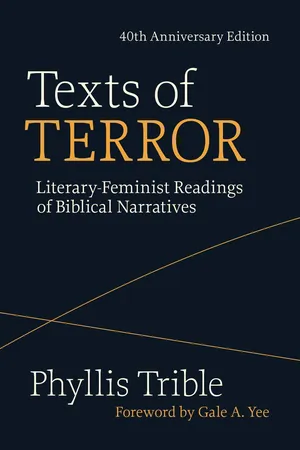
In this seminal work of biblical studies, renowned scholar Phyllis Trible focuses on four variations on the theme of terror in the Bible. By combining the discipline of literary criticism with the hermeneutics of feminism, she reinterprets the tragic stories of four women in ancient Israel: Hagar, Tamar, an unnamed concubine, and the daughter of Jephthah. In highlighting the silence, absence, and opposition of God, as well as human cruelty, Trible shows how these neglected stories--interpreted in memoriam--challenge both the misogyny of Scripture and its use in church, synagogue, and academy.
- 128 pages
- English
- ePUB (mobile friendly)
- Available on iOS & Android
eBook - ePub
About this book
Information
Topic
Theology & ReligionSubtopic
Feminist Literary CriticismChapter 1
Hagar
The Desolation of Rejection
Genesis 16:1–16; 21: 9–21
Though Abraham prevails in scripture as the symbol of faith, his story pivots on two women, Sarah and Hagar, who shape and challenge faith. Their own stories diverge to give Sarah the better portion. Wife of a wealthy herdsman (Gen. 13:2), she holds privilege and power within the confines of patriarchal structures.1 To be sure, on two occasions Abraham betrays her, passing her off as his sister to protect himself (12:10–20; 20:1–19),2 but each time God comes to her rescue. Without effort, this woman along with her husband enjoys divine favor. Yet her exaltation poses major tension in Abram’s story because “Sarai is barren; she has no child” (11:30, RSV*).3 Moreover, “it has ceased to be with Sarah after the manner of women” (18:11, RSV*; cf. 17:17). Her situation would seem to thwart the divine promise of an heir for Abram.4 Hence, Sarai plans to secure a child through her maid Hagar, who becomes the other woman in Abram’s life.
As one of the first females in scripture to experience use, abuse, and rejection, Hagar the Egyptian slave claims our attention. Knowledge of her has survived in bits and pieces only, from the oppressor’s perspective at that, and so our task is precarious: to tell Hagar’s story from the fragments that remain.
These fragments come from separate scenes in the Abrahamic saga.5 The first (16:1–16) precedes by several chapters and the second (21:9–21) just follows the birth of the child God eventually gives to Sarah herself.6 Similar structures and subjects order the scenes. In both, narrative introductions and conclusions surround two episodes. The opening episodes, located in Canaan, highlight Sarah as she deals with Hagar and Abraham; the closing ones, located in the wilderness, feature Hagar encountering the deity. Besides providing continuity, these structural and content parallels between the scenes highlight their differences. For Hagar, the plot of the first story is circular, moving from bondage to flight to bondage, while the action of the second is linear, proceeding from bondage to expulsion to homelessness.7
A Circle of Bondage
Scene One: Genesis 16:1–16
A. Introduction, 16:1. The opening sentence of scene one emphasizes Sarai. Reversing the usual Hebrew word order, it places before the verb her name as subject. “Now Sarai, wife of Abram, did not bear a child to him” (16:1). The statement of the problem leads in the second half of the sentence to an answer. “But to her [was] an Egyptian maid whose name was Hagar.”8 Beginning with Sarai and ending with Hagar, the narrated introduction opposes two women around the man Abram. Sarai the Hebrew is married, rich, and free; she is also old and barren. Hagar the Egyptian is single, poor, and bonded;9 she is also young and fertile. Power belongs to Sarai, the subject of action; powerlessness marks Hagar, the object.
B. Episode One, 16:2–6. From the introduction the story moves to its first episode. At the beginning, Sarai speaks in the imperative mood.10 Dialogic order and verb construction match content to present this woman as the commanding figure. While confirming the problem and solution that the storyteller has reported, she makes subtle changes:
And Sarai said to Abram,
“Because Yahweh has prevented me
from bearing children,
go to my maid.
Perhaps I shall be built up from her.”
(16:2a)
Unlike the narrator, Sarai speaks of building up herself through Hagar rather than of bearing a child to Abram (cf. 16:1, 15). In a man’s world, the woman’s voice sounds a different emphasis.11 Further, unlike the narrator, she attributes her barren plight to Yahweh and thus seeks to counter divine action with human initiative. What the deity has prevented, Sarai can accomplish through the maid whose name she never utters and to whom she never speaks.12 For Sarai, Hagar is an instrument, not a person. The maid enhances the mistress.
Sarai’s words effect obedience. Abram makes no attempt to halt the plan; instead, he yields so passively that the storyteller must answer for him. “And Abram heard [obeyed] the voice of Sarai” (16:2b). Continuing to underline his acquiescence, the narrated discourse reports her action:*
Sarai, wife of Abram, took Hagar the Egyptian, her maid,
after Abram had dwelt ten years in the land of Canaan,
and gave her to Abram her husband, to him for a wife.
(16:3)
Again in the structure of a sentence, two females encircle Abram (cf. 16:1). And they are unequally matched. As subject of the verbs take and give, Sarai exercises power over Hagar, the object. Though her actions relate the two women, the absence of dialogue maintains distance between them. Repeated use of the relational language wife, maid, husband, and wife accents the growing opposition. In making Hagar Abram’s wife, not his concubine,13 Sarai has diminished her own status in relationship to this servant. But she still retains full control over Abram. As he first obeyed her voice in a narrated sentence of few words, so now he fulfills her command, “Go (bō’), then, into (’el) my maid” (16:2). “And he went (bō’) into (’el) Hagar” (16:4a, RSV).14 No mighty patriarch is Abram, but rather the silent, acquiescent, and minor figure in a drama between two women.
Sarai has spoken; Abram has agreed. Sarai has acted; Abram has obeyed. Next the plot shifts to Hagar, the one through whom Sarai wishes to be built up. Making the maid subject, not object, the narrator reports, “She conceived” (16:4b). Although this result is what Sarai wants, it prompts an insight on Hagar’s part that her mistress has not anticipated. “When she [Hagar] saw that she had conceived, her mistress was slight in her eyes” (16:4c). Hagar is other than a tool; for that difference Sarai has failed to allow.
The Hebrew expression “her mistress was slight (or trifling) in her eyes” inspires various interpretations. Many translators alter the syntax to make Hagar the subject of the verb. They also attribute to the verb (qll) the legitimate, though not necessary, meaning of contempt or disdain. Accordingly, one reads, “When she knew she was with child, she despised her mistress” (NEB); or “when she saw that she had conceived, she looked with contempt on her mistress” (RSV).15 Yet the verb with its correct subject also offers the less harsh reading that is present in the translation, “Her mistress was lowered in her esteem” (NJV).
Although strife between barren and fertile wives is a typical motif in scripture,16 in this study the typical yields to the particular. Seeing, that is, perceiving her conception of a child, Hagar acquires a new vision of Sarai. Hierarchical blinders disappear. The exalted mistress decreases while the lowly maid increases. Not hatred but a reordering of the relationship is the point. Unwittingly, Sarai has contributed to Hagar’s insight. By giving Hagar to Abram for a wife, Sarai hoped to be built up. In fact, however, she has enhanced the status of the servant to become herself correspondingly lowered in the eyes of Hagar.
This unexpected twist provides an occasion for mutuality and equality between two females, but it is not to be. If Hagar has experienced new vision, Sarai remains within the old structures.17 Still in charge, she speaks to Abram, faulting him for the outcome of her plan and appealing to Yahweh for judgment. While she uses the same vocabulary as the narrator to describe Hagar’s response, the words on her lips have a pejorative meaning:18
And Sarai said to Abram,
“May the wrong done to me be upon you!
I (’anōkî) gave my maid to your embrace
but when she saw that she had conceived,
then I was slight in her eyes.
May Yahweh judge between you and me!”
(16:5, RSV*)
The mistress wants returned the superior status that she unintentionally relinquished in using Hagar. Further...
Table of contents
- Cover
- Title Page
- Copyright Page
- Dedication
- Contents
- Foreword
- Abbreviations
- Preface
- Introduction: On Telling Sad Stories
- 1. Hagar: The Desolation of Rejection
- 2. Tamar: The Royal Rape of Wisdom
- 3. An Unnamed Woman: The Extravagance of Violence
- 4. The Daughter of Jephthah: An Inhuman Sacrifice
- Indexes
Trusted by 375,005 students
Access to over 1.5 million titles for a fair monthly price.
Study more efficiently using our study tools.
Frequently asked questions
Yes, you can cancel anytime from the Subscription tab in your account settings on the Perlego website. Your subscription will stay active until the end of your current billing period. Learn how to cancel your subscription
No, books cannot be downloaded as external files, such as PDFs, for use outside of Perlego. However, you can download books within the Perlego app for offline reading on mobile or tablet. Learn how to download books offline
Perlego offers two plans: Essential and Complete
- Essential is ideal for learners and professionals who enjoy exploring a wide range of subjects. Access the Essential Library with 800,000+ trusted titles and best-sellers across business, personal growth, and the humanities. Includes unlimited reading time and Standard Read Aloud voice.
- Complete: Perfect for advanced learners and researchers needing full, unrestricted access. Unlock 1.5M+ books across hundreds of subjects, including academic and specialized titles. The Complete Plan also includes advanced features like Premium Read Aloud and Research Assistant.
We are an online textbook subscription service, where you can get access to an entire online library for less than the price of a single book per month. With over 1.5 million books across 990+ topics, we’ve got you covered! Learn about our mission
Look out for the read-aloud symbol on your next book to see if you can listen to it. The read-aloud tool reads text aloud for you, highlighting the text as it is being read. You can pause it, speed it up and slow it down. Learn more about Read Aloud
Yes! You can use the Perlego app on both iOS and Android devices to read anytime, anywhere — even offline. Perfect for commutes or when you’re on the go.
Please note we cannot support devices running on iOS 13 and Android 7 or earlier. Learn more about using the app
Please note we cannot support devices running on iOS 13 and Android 7 or earlier. Learn more about using the app
Yes, you can access Texts of Terror by Phyllis Trible in PDF and/or ePUB format, as well as other popular books in Theology & Religion & Feminist Literary Criticism. We have over 1.5 million books available in our catalogue for you to explore.