The way most people think about religion and politics is only loosely linked to empirical reality, argues Ryan P. Burge in 20 Myths about Religion and Politics in America. Instead, our thinking is based on anecdotes, a quick scan of news headlines, or worse, flat-out lies told by voices trying to push a religious or political agenda on a distracted public.
Burge sees this fundamentally flawed understanding of the world around us and our misperceptions about where we fit into the larger fabric of society as caustic for the future of American politics and religion. Without an accurate picture of our society, when we subscribe to only caricatures of what our country looks like, we never really address the problems facing us.
Striving to be an impartial referee, Burge describes with accessible and engaging prose--and illustrates with dozens of clear, helpful graphs--what the data says. Step by step, he debunks twenty myths, using rigorous data analysis and straightforward explanations. He gives readers the resources to adopt an empirical view of the world that can help all of us, religious and nonreligious alike, get past at least some of the unsupported beliefs that divide us.
Every few years, a national media outlet publishes a story about the inevitable decline of American religion. It all began with that famous Time magazine cover from April 1966. Three words in a bolded red font stood against a solid black background, “Is God Dead?” Of course, the editors were borrowing this idea from the famous German philosopher Friedrich Nietzsche, who wrote, “God is dead. God remains dead. And we have killed him.” Nietzsche was making a point that the era of the Enlightenment and its push for scientific reasoning had eliminated a need for God, but most Americans did not know the full context of the quote. They just saw the magazine cover at the supermarket checkout stand, and many of them got angry. A retrospective on the piece noted that Time magazine received 3,241 letters from readers upon its publication. One of those letters stated, “Your ugly cover is a blasphemous outrage.”6 Significant portions of the United States were devoutly religious in the 1960s, and to say that God was dead was an affront to their entire worldview.
Discussion surrounding the supposed death of religion, including evangelical Christianity in the United States, has only picked up steam since then. There seems to be a never-ending drumbeat of stories declaring the end of American religion. The Atlantic ran a piece titled “Three Decades Ago, America Lost Its Religion. Why?,”7 and just a few months later the Week published an article with the headline “The Coming End of Christian America.”8 That the country is becoming less religious as each day passes seems to be the highest-profile story in American religious demography. The American church is on a death spiral and will look like Western Europe’s in the next few decades.
True, the story is not entirely manufactured or without some empirical merit. Ample evidence from a variety of data sources points to a continuing rise of the so-called nones in American society. The Pew Research Center noted that the nones were 16 percent of the US population in 2007, 23 percent in 2014, and 26 percent in 2019. I wrote a book about the topic myself, noting that the share of Americans with no religious affiliation may be as high as 30 percent, a finding I reached using a survey methodology different from Pew’s.9 No matter how the numbers are crunched, though, we can say that those without a religious affiliation are a larger share of America than ever before. Still, we need to keep in mind that the nones increasing doesn’t necessarily mean all religious traditions are on the decline.
I do not blame the American public for believing that religion is in its twilight in our society. However, I think most people arrive at that conclusion by extrapolating a bit too much from the headlines they glance at as they scroll through the titles of books on Amazon, a news app, or their social media feed. They see, for instance, The End of White Christian America, a tremendous book written by Robert P. Jones, the CEO of the Public Religion Research Institute.10 Or they notice Pew headlining its most recent report “In U.S., Decline of Christianity Continues at Rapid Pace.”11 No matter the source, they conclude that Christianity, writ large, is on its deathbed.
What they miss is that both Jones and the team at Pew lay out a very nuanced and careful story that highlights how certain types of American religion, not all of Christianity, are in decline. The story of what is happening to American Christianity is much more complicated than any headline could ever really capture and, in my opinion, is even more interesting. The real story of American Christianity is that those who are intensely religious have not changed in any meaningful way in the past fifty years.
Dozens of stories written in the past few years claim the opposite. Headlines like “The Deepening Crisis in Evangelical Christianity” 12 and “Blame Evangelicals for the Decline in Christian Faith”13 reinforce a narrative that evangelicalism has become poisonous to the average American and pews are emptier now than ever before. Observers point to this demise especially in those churches that are more conservative on theological and political matters.
Yet when I read those stories and look at the data, I just can’t help but think that for many critics of evangelicalism, the decline of the movement is nothing more than wishful thinking. No matter which dataset I use or how I define “evangelical,” I am unable to find strong and consistent evidence that evangelicals are a less significant part of the population today than they were forty years ago.
The General Social Survey (GSS) has been asking questions about religious affiliation since 1972 and is considered the only authoritative source for tracking the composition of American religion over a long time horizon. Thus, it makes sense to start there when trying to understand what has happened to evangelicals over the past forty years.
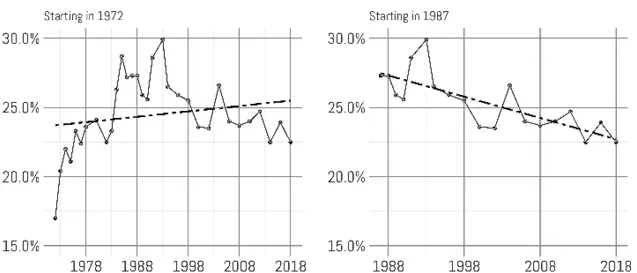
When the trend line for evangelicals is illustrated in the GSS, an interesting interpretation puzzle emerges. The left plot in figure 1.1 displays the data all the way back to the inception of the survey—1972. The right plot truncates that time horizon to the peak of American evangelicalism, which occurred in the late 1980s and early 1990s. As the dashed line indicates in the plot on the left, the trend for American evangelicals in the United States is a slightly upward one over forty-six years. They were just under 24 percent of the population in the early 1970s and rose to just over 25 percent in 2018.
Figure 1.1. Share of Americans Who Are Evangelical by Tradition—Two Different Starting Points
Data from the General Social Survey, a project of the independent research organization NORC at the University of Chicago, with principal funding from the National Science Foundation, https://gss.norc.org/Get-The-Data
Despite this slightly upward trend, many people focus on what has happened to evangelicals since their peak around 1993, shown by the trend line in the right panel. If we begin our analysis in 1987, the slope of the line is clearly negative. In statistical terms, nearly 28 percent of Americans were evangelical in 1987 and that has dropped about five percentage points in the past thirty years.
But that second narrative ignores two key pieces of relevant evidence. The first is that evangelicals today are the same percentage of the US population in 2018 that they were in 1982—a fact that does not support the “evangelicals are dying” hypothesis. The other is that the decline of evangelicalism has basically stopped since 2000. In that year, evangelicals were 23.6 percent of the sample. In 2018, they were 22.5 percent. That drop of one percentage point is not statistically significant, nor is it substantively noteworthy, because the share of evangelicals has see-sawed between 23 and 24 percent in the past several years.
Instead of claiming a decline in evangelicalism, the more objective perspective is that the period from the late 1980s through the late 1990s was an aberration in the history of American religion. Because of a confluence of a number of religious, cultural, and political shifts, evangelicalism saw a significant but relatively short-lived burst in popularity. The more honest reading of the data is that evangelicals constitute just slightly less than a quarter of Americans in an average year, and there is little reason to think that this will substantially shift in the next decade.
However, there’s another way to measure the size of evangelicalism over time—self-identification. The prior analysis did not rely on a survey respondent saying they were an evangelical. Instead, they told the survey administrator what denomination the church they attended belongs to, and social scientists sorted them into the evangelical camp based on just that information. However, many surveys have begun to include an additional question about religious identification: “Do you consider yourself to be a born-again or evangelical Christian, or not?” The person hearing the question determines their religious attachment.
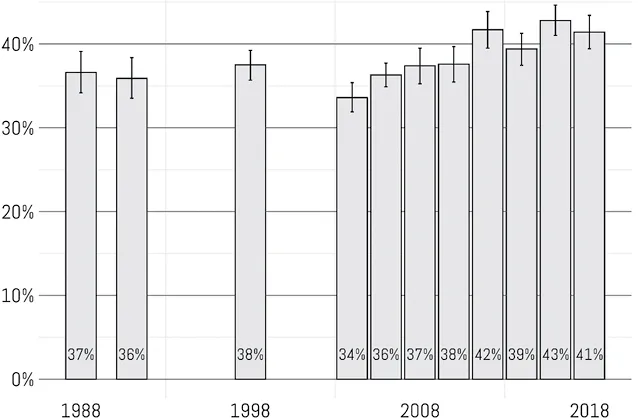
To that end, since 1988 the GSS has been asking this question, “Would you say you have been ‘born-again’ or have had a ‘born-again’ experience—that is, a turning point in your life when you committed yourself to Christ?” The results of those responses are shown in figure 1.2 and show a slow upward trajectory in the past three decades. About 37 percent of Americans said in 1988 that they had had a born-again experience, but by 2004 that had dropped by about three percentage points. From that point forward there has been a slow and steady climb in the share of Americans who say they have had a born-again experience. The born-again portion of the sample jumped by four percentage points between 2004 and 2010 and then has increased just about four percentage points again from 2010 to 2018. In the most recent data available, the share of Americans who say they have had a born-again experience is 41 percent. There’s definitely no sign of evangelical decline from that angle.
Figure 1.2. The Share of Americans Who’ve Had a Born-Again Experience
Data from the General Social Survey, a project of the independent research organization NORC at the University of Chicago, with principal funding from the National Science Foundation, https://gss.norc.org/Get-The-Data
However, that question is not perfect for measuring the current size of the evangelical population in the United States for two reasons. One is based on the wording of the question: “Have you ever had a born-again experience?” Someone could have gone forward during an altar call at a high school church camp but since become an avowed atheist. They would still answer that question affirmatively, although they clearly aren’t an evangelical today. The other issue is that the question doesn’t specifically mention the term “evangelical,” although it does clearly refer to a conversion experience that is closely linked to the evangelical experience. Still, some survey respondents may not make the connection between being born-again and embracing an evangelical identity on their own.
Both using religious denomination to classify evangelicals and asking about a born-gain experience obviously are problematic. However, there’s a more straightforward way to assess evangelicalism in the public: just ask people directly if they identify as an evangelical Christian. If the term “evangelical” has become somewhat radioactive for a wide swath of the American population and has led to the decline of evangelicalism, using it clearly in a survey question would reveal that aversion. Indeed, respondents’ reluctance to identify themselves as evangelical might be expected in our current climate. As the linkage between the Republican Party and evangelical Christianity has grown closer over the past few years, the connection may have turned off a few more politically moderate Protestant Christians. Additionally, the election and widespread support of Donald Trump by white evangelicals during his time in the White House could have made the term more caustic in the eyes of the American public. But when people are asked directly if they are evangelicals, we see no evidence of the “evangelicals are in decline” hypothesis.
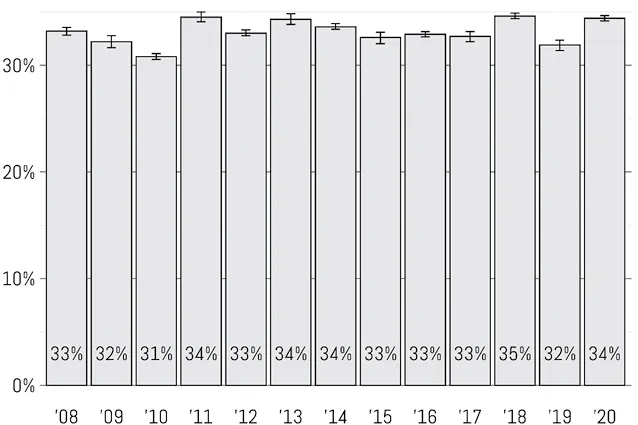
The Cooperative Election Study (CES) has been asking the evangelical self-identification question in every survey it has administered since 2008, and the results are remarkably consistent, as can be seen in figure 1.3. In 2008, exactly one-third of respondents said they that were born-again or evangelical. That number has held steady in nearly every wave of their study. That figure has gone as high as 34.6 percent and as low as 30.8 percent, but the overall average is 33.1 percent, and most years’ findings deviate from that average by less than one percentage point. What makes this finding even more noteworthy is how large the sample size is for the CES. The smallest wave is 14,000 respondents, and the largest is nearly 65,000. When numbers in a survey get that large, conclusions come into sharper focus: the term “evangelical” was no more or less poisonous after three years of a Trump presidency than it was the year Barack Obama won the White House.
Figure 1.3. The Share of Population That Identifies as Born-Again/Evangelical
Data from Cooperative Election Study. Stephen Ansolabehere, Brian F. Schaffner, and Sam Luks, Cambridge, MA: Harvard University, http://cces.gov.harvard.edu
Conclusions
If evangelicalism is demarcated by religious tradition, the evidence clearly indicates that evangelicals are the same...
Table of contents
Cover
Title Page
Copyright Page
Dedication
Contents
Preface
Introduction
Myth 1: Evangelicalism is in decline
Myth 2: Donald Trump wasn’t the choice of religiously devout Republicans
Myth 3: Most Americans have strong views about abortion—but are willing to change their minds about it
Myth 4: Researchers are biased toward Christians
Myth 5: College leads young people away from religion
Myth 6: Nondenominational Christians are rare
Myth 7: Born-again experiences are common and dramatically change a person’s life
Myth 8: You have to go to church frequently to be an evangelical
Myth 9: The personal faith of a presidential candidate can activate part of the electorate
Myth 10: People return to religion late in life
Myth 11: Abortion is the most important issue for evangelical voters
Myth 12: White evangelicals agree with the Republican party only on social issues
Myth 13: Most Catholics and evangelicals do not support women in leadership
Myth 14: White Christians have always been conservative Republicans
Myth 15: The growth of the nones is largely from people leaving church
Myth 16: America is much less religious today than a few decades ago
Myth 17: Black Protestants are political liberals
Myth 18: Mainline Protestants are politically liberal
Myth 19: Young evangelicals are more politically moderate than older evangelicals
Myth 20: Pastors often discuss politics from the pulpit
Conclusion: A Better Path
Appendix: Data Sources
Notes
Trusted by 375,005 students
Access to over 1.5 million titles for a fair monthly price.
Study more efficiently using our study tools.
Frequently asked questions
Yes, you can cancel anytime from the Subscription tab in your account settings on the Perlego website. Your subscription will stay active until the end of your current billing period. Learn how to cancel your subscription
No, books cannot be downloaded as external files, such as PDFs, for use outside of Perlego. However, you can download books within the Perlego app for offline reading on mobile or tablet. Learn how to download books offline
Perlego offers two plans: Essential and Complete
Essential is ideal for learners and professionals who enjoy exploring a wide range of subjects. Access the Essential Library with 800,000+ trusted titles and best-sellers across business, personal growth, and the humanities. Includes unlimited reading time and Standard Read Aloud voice.
Complete: Perfect for advanced learners and researchers needing full, unrestricted access. Unlock 1.5M+ books across hundreds of subjects, including academic and specialized titles. The Complete Plan also includes advanced features like Premium Read Aloud and Research Assistant.
Both plans are available with monthly, semester, or annual billing cycles.
We are an online textbook subscription service, where you can get access to an entire online library for less than the price of a single book per month. With over 1.5 million books across 990+ topics, we’ve got you covered! Learn about our mission
Look out for the read-aloud symbol on your next book to see if you can listen to it. The read-aloud tool reads text aloud for you, highlighting the text as it is being read. You can pause it, speed it up and slow it down. Learn more about Read Aloud
Yes! You can use the Perlego app on both iOS and Android devices to read anytime, anywhere — even offline. Perfect for commutes or when you’re on the go. Please note we cannot support devices running on iOS 13 and Android 7 or earlier. Learn more about using the app
Yes, you can access 20 Myths about Religion and Politics in America by Ryan P. Burge in PDF and/or ePUB format, as well as other popular books in Theology & Religion & Christianity. We have over 1.5 million books available in our catalogue for you to explore.