An examination of how modern art was impacted by the concept of prehistory and the prehistoric
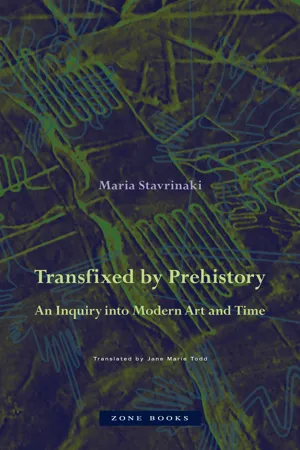
Prehistory is an invention of the late nineteenth century. In that moment of technological progress and acceleration of production and circulation, three major Western narratives about time took shape. One after another, these new fields of inquiry delved into the obscure immensity of the past: first, to surmise the age of the Earth; second, to find the point of emergence of human beings; and third, to ponder the age of art. Maria Stavrinaki considers the inseparability of these accounts of temporality from the disruptive forces of modernity. She asks what a history of modernity and its art would look like if considered through these three interwoven inventions of the longue durée. Transfixed by Prehistory attempts to articulate such a history, which turns out to be more complex than an inevitable march of progress leading up to the Anthropocene. Rather, it is a history of stupor, defamiliarization, regressive acceleration, and incessant invention, since the "new" was also found in the deep sediments of the Earth. Composed of as much speed as slowness, as much change as deep time, as much confidence as skepticism and doubt, modernity is a complex phenomenon that needs to be rethought. Stavrinaki focuses on this intrinsic tension through major artistic practices (Cézanne, Matisse, De Chirico, Ernst, Picasso, Dubuffet, Smithson, Morris, and contemporary artists such as Pierre Huyghe and Thomas Hirschhorn), philosophical discourses (Bataille, Blumenberg, and Jünger), and the human sciences. This groundbreaking book will attract readers interested in the intersections of art history, anthropology, psychoanalysis, mythology, geology, and archaeology.
eBook - ePub
Transfixed by Prehistory
An Inquiry into Modern Art and Time
- English
- ePUB (mobile friendly)
- Available on iOS & Android
eBook - ePub
About this book
Trusted by 375,005 students
Access to over 1.5 million titles for a fair monthly price.
Study more efficiently using our study tools.
Information
Topic
ArtSubtopic
History of ArtNotes
INTRODUCTION
- 1. See Paolo Rossi, The Dark Abyss of Time: The History of the Earth and the History of Nations from Hooke to Vico (Chicago: University of Chicago Press, 1987).
- 2. In his manuscript for the new edition of Les époques de la nature, Buffon, who had initially given the earth’s age as 75,000 years, hesitated between a few hundreds of thousands and a few millions of years. Was it easy, he wrote, or even possible “to form an idea of the whole or of the parts of such a long series of centuries?” His response was no. In the definitive version of Les époques de la nature, he returned to his first hypothesis of 75,000 years, which he justified in his introduction: “Is it not, one might ask, ‘adding a new cause of obscurity to the difficult things that you claim to explain, when such large numbers and inappropriate lengths of duration are used?’” Quoted in Jacques Roger, Buffon: A Life in Natural History, ed. L. Pearce Williams, trans. Sarah Lucille Bonnefoi (Ithaca: Cornell University Press, 1997), p. 412.
- 3. See Claude Blanckaert, “Nommer le préhistorique au XIXe siècle: Linguistique et transferts lexicaux,” Organon 49 (2017), pp. 57–103.
- 4. Michel Foucault, The Order of Things: An Archaeology of the Human Sciences (London: Routledge, 2005), p. 347.
- 5. Immanuel Kant, Anthropology from a Pragmatic Point of View, ed. and trans. Robert B. Loudon (Cambridge: Cambridge University Press, 2006), p. 120. [The distinction between “discovery” and “invention,” découverte and invention, is less clear-cut in French than it is in English — trans.]
- 6. Édouard Lartet, “Nouvelles recherches sur la coexistence de l’homme et des grands mammifères fossiles,” Annales des sciences naturelles, 4th series, 15, Zoologie (Paris: Victor Masson et Fils, 1861), pp. 177–253.
- 7. Patrick Paillet, “Le mammouth de la Madeleine (Tursac, Dordogne),” PALEO 22 (2011), pp. 223–70. But Paillet’s consideration of the first discovery of Paleolithic art is treated with the same axiomatic neutrality that characterizes the writings of the first prehistorians, with no analysis of its epistemological, much less ontological, meanings.
- 8. Édouard Lartet and Henri Christy, Cavernes du Périgord: Objets gravés et sculptés des temps pré-historiques dans l’Europe occidentale (1864; Whitefish: Kessinger Legacy Reprints, 2010).
- 9. Jean-François de Nadaillac, Les premiers hommes et les temps préhistoriques, 2 vols. (Paris: Éditions G. Masson, 1881), vol. 1, p. 6.
- 10. John Lubbock, Pre-Historic Times as Illustrated by Ancient Remains and the Manners and Customs of Modern Savages, 6th rev. ed. (New York: D. Appleton, 1900), p. 319.
- 11. Marcelino Sanz de Sautuola, Breves apuntes sobre algunos objectos prehistóricos de la Provincia de Santander (Santander: Telesforo Martínez, 1880).
- 12. Vitruvius, De architectura, bk. 6, chap. 5 in Vitruvius: The Ten Books on Architecture, trans. Morris Hicky Morgan (Cambridge, MA: Harvard University Press, 1914), p. 212; André Chastel, Le grotesque (Paris: Le Promeneur, 1991); Philippe Morel, Les grotesques: Les figures de l’imaginaire dans la peinture italienne de la fin de la Renaissance (Paris: Flammarion, 1997).
- 13. Leonard Barkan, Unearthing the Past: Archaeology and Aesthetics in the Making of Renaissance Culture (New Haven: Yale University Press, 1999), p. 25.
- 14. The Theaetetus of Plato, trans. F. A. Paley (London: George Bell & Sons, 1875), 155d, p. 26.
- 15. René Descartes, The Passions of the Soul, trans. Stephen Voss (1649; Indianapolis: Hackett, 1989), art. 70.
- 16. Ibid., arts. 76 and 73, translation modified.
- 17. The mechanism behind this duality and the reasons for it — a duality that allowed modern consciousness to move from denial to appropriation, even obsession — have been neglected in interpretations seeking to explain the hesitancy that marks the reception of parietal art, for example, Ulrich Pfisterer, “Altamira — oder: Die Anfänge von Kunst und Kunstwissenschaft,” in Martin Mosebach, ed., Die Gärten von Capri (Berlin: Akademie-Verlag, 2007), pp. 13–80.
- 18. Bruno Latour, We Have Never Been Modern, trans. Catherine Porter (Cambridge, MA: Harvard University Press, 1993).
- 19. Reinhart Koselleck, Futures Past: On the Semantics of Hist...
Table of contents
- Cover Page
- Title Page
- Copyright Page
- Dedication
- Contents
- Introduction
- I. “We Slip Away from Ourselves” : The Discovery and Internalization of the Earth’s Age (Eighteenth to Twentieth Centuries)
- II. Reconstituting the Antiquity of Humankind and of Art
- III. The Artificiality of Prehistory: A Disjunctive Genealogy of Art
- IV. The Paradox of the Neolithic: Rupture and Permanence, Order and Disorder
- V. Prehistory in the Atomic Age
- Conclusion: Terra Incognita
- Acknowledgments
- Notes
- Bibliography
- Index
Frequently asked questions
Yes, you can cancel anytime from the Subscription tab in your account settings on the Perlego website. Your subscription will stay active until the end of your current billing period. Learn how to cancel your subscription
No, books cannot be downloaded as external files, such as PDFs, for use outside of Perlego. However, you can download books within the Perlego app for offline reading on mobile or tablet. Learn how to download books offline
Perlego offers two plans: Essential and Complete
- Essential is ideal for learners and professionals who enjoy exploring a wide range of subjects. Access the Essential Library with 800,000+ trusted titles and best-sellers across business, personal growth, and the humanities. Includes unlimited reading time and Standard Read Aloud voice.
- Complete: Perfect for advanced learners and researchers needing full, unrestricted access. Unlock 1.5M+ books across hundreds of subjects, including academic and specialized titles. The Complete Plan also includes advanced features like Premium Read Aloud and Research Assistant.
We are an online textbook subscription service, where you can get access to an entire online library for less than the price of a single book per month. With over 1.5 million books across 990+ topics, we’ve got you covered! Learn about our mission
Look out for the read-aloud symbol on your next book to see if you can listen to it. The read-aloud tool reads text aloud for you, highlighting the text as it is being read. You can pause it, speed it up and slow it down. Learn more about Read Aloud
Yes! You can use the Perlego app on both iOS and Android devices to read anytime, anywhere — even offline. Perfect for commutes or when you’re on the go.
Please note we cannot support devices running on iOS 13 and Android 7 or earlier. Learn more about using the app
Please note we cannot support devices running on iOS 13 and Android 7 or earlier. Learn more about using the app
Yes, you can access Transfixed by Prehistory by Maria Stavrinaki, Jane Marie Todd in PDF and/or ePUB format, as well as other popular books in Art & History of Art. We have over 1.5 million books available in our catalogue for you to explore.