eBook - ePub
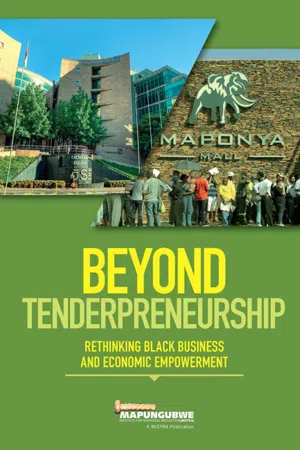
Beyond Tenderpreneurship
Rethinking Black Business and Economic Empowerment
- 410 pages
- English
- ePUB (mobile friendly)
- Available on iOS & Android
eBook - ePub
About this book
Black Economic Empowerment (BEE) policies have been a central pillar of attempts to overcome the economic legacy of apartheid. Yet, more than two decades into democracy, economic exclusion in South Africa still largely re?ects the fault-lines of the apartheid era. Current discourse often con?ates BEE with the so-called ëtenderpreneurshipí referred to in the title, namely the reliance of some emergent black capitalists on state patronage. Authors go beyond this notion to understand BEEís role from a unique perspective. They trace the history of black entrepreneurship and how deliberate policies under colonialism and its apartheid variant sought to suppress this impulse. In the context of modern South Africa, authors interrogate the complex dynamics of class formation, economic empowerment and redress against the backdrop of broader macroeconomic policies. They examine questions relating to whether B-BBEE policies are informed by strategies to change the structure of the economy. These issues are explored against the backdrop of the experiences of other developing countries and their journeys of industrialisation. The relevant black empowerment experiences of countries such as the United States are also discussed. The authors identify policy and programmatic interventions to forge the non-racial future that the constitution enjoins South Africans to build.
Section Two
The State and Economic Empowerment: International and Domestic Experiences
FIVE
The developmental state and Black Economic Empowerment
Lessons from East Asian capitalist models
KHWEZI MABASA
INTRODUCTION
THE TERM ‘DEVELOPMENTAL STATE’ features prominently in South Africa’s political economy discourse. It is embedded in salient macroeconomic policy documents such as the National Development Plan (NDP) and the New Growth Path (NGP). This concept was coined by comparative political economy scholars who were reflecting on rapid industrialisation and structural change in East Asian economies (Evans, 1995; Leftwich, 1995; Mkandawire, 2001). Gumede describes this phenomenon as ‘one of the greatest industrialisation transformations of the modern era’ (Gumede, 2009: 4). South African policymakers have engaged with this literature and attempted to apply its central lessons in the domestic context (ANC, 2017; COSATU, 2012; Edigheji, 2010). These efforts are largely centred on bureaucratic reform and restructuring the economy through macroeconomic policy interventions. There is substantial research on the successes and challenges encountered by South Africa’s government in its quest to build a post-apartheid developmental state (Chang, 2011; Edigheji, 2007; Mabasa, 2015; Marais, 2011; Qobo, 2009).
This chapter expands the discourse by linking debates about developmental state policy to Black Economic Empowerment (BEE). It specifically examines the state’s role in creating a black cohort of the capitalist class, which contributes to national socioeconomic interests and structural change in the political economy. This investigation is premised on documented literature that explores how 20th century East Asian states created nationalistic capitalist classes (Evans, 1995; Leftwich, 1995; Mkandawire, 2001). The African National Congress (ANC), which draws on Marxian analytical tools, describes this class as a patriotic bourgeoisie (ANC, 1996; ANC, 1998; ANC, 2017; Mbeki, 1999).
I address three central questions in the chapter. First, has the BEE model produced black entrepreneurs who contribute to long-term economic restructuring and national development? Second, are developmental state policy prescripts integrated into BEE policy evolution? And third, which policy instruments were employed by developmental states in creating nationalist capitalist classes? This chapter’s theoretical framework is anchored in heterodox political economy and development sociology literature. It will draw from prominent developmental state scholars in both these fields. These authors’ political economy approach places emphasis on both market and non-market institutions in assessing economic development. Their research illustrates the importance of transcending market-led economic growth paradigms, which are advanced by orthodox political economists. They argue that market coordination, structural change and state intervention are essential for attaining higher national development levels (Chang, 2003; Evans, 1995; Weiss, 1998; Mkandawire, 2001).
The chapter begins with the main arguments and a brief synopsis of transformation in South Africa. Then it proceeds to discuss two central themes in BEE literature: structural reform and state-business relations. Thereafter, the main features of state and business relations in East Asian development models are explored. The main aim is to draw lessons from these experiences and apply them in the South African context. Concluding sections propose political economy interventions for addressing shortcomings outlined in the central arguments explained in the next section.
THE POLITICAL ECONOMY OF BLACK ECONOMIC EMPOWERMENT
This chapter argues that the post-apartheid BEE model has not created black entrepreneurs who systemically contribute to economic restructuring and national development. Furthermore, synergies between BEE and developmental state policy strategies are weak. This is exemplified in shortcomings cited by various scholars assessing BEE implementation over the past 25 years (Cargill, 2010; Iheduru, 2004; Iheduru, 2008; Southall, 2006; Southall, 2010). The chapter attributes these trends to the following three factors: First, post-apartheid BEE policy measures prioritise representation and integration into existing economic market structures. This approach has largely overlooked the structural effects of these transactions in specific sectors and the broader economy (Cargill, 2010; Ponte et al., 2007). Structural reform in this context is defined as a process which alters production, investment, and resource allocation trends on a macroeconomic level. It is primarily aimed at reconfiguring the economic base through innovation and institutional change within a political economy structure (Chang, 2003; Chang, 2006; Mkandawire, 2012; Wade, 1990). The link between BEE and structural evolution in the South African economy has received minimal attention.
Second, South Africa’s government has not integrated developmental state policy interventions in BEE programmes adequately. The empowerment model is mostly reliant on limited state functions to achieve BEE-related socioeconomic goals in various sectors. Government’s role has been reduced to four primary activities: procurement, partial privatisation, regulation and legislative formulation (Acemoglu et al., 2007; Iheduru, 2004; Iheduru, 2008; Southall, 2006; Southall, 2010). This is different from policy practices in developmental states, which support emerging indigenous capitalists with interventions that transcend or question some functions listed above (Edigheji, 2007; Johnson, 1982; Weiss, 1998). The state’s regulatory mandate within BEE strategy has been prioritised over its capacity to develop black entrepreneurs through deeper strategic support interventions.
Third, complexities in the composition of post-apartheid black entrepreneurs have subverted efforts to pursue and define national interests (Mondi, 2017: 15–17). This chapter and other sections in the book highlight shortcomings in monolithic conceptions of black business. These ignore historical specificity, differentiated access to capital markets, and most importantly, relations with large, established transnational corporations. The state has had limited success in comprehending and aligning these varied interests to strategic national socioeconomic objectives. This has subsequently weakened the social compact between government and black entrepreneurs. Furthermore, policy mechanisms for holding black enterprises accountable in implementing broader BEE measurements are not prioritised. The focus has been on transforming large entities to create black entrepreneurs, without proposing clear policy instruments to ensure that beneficiaries contribute toward wider national developmental goals such as:
• employment creation;
• transforming South Africa’s economic structural base through industrial diversification;
• decreasing the exclusion of black youth, women, unemployed and rural citizens from formal economic activity; and
• eliminating racialised poverty and income inequality.
Amsden’s (2001: 141) account of the successes of developmental states emphasises ‘reciprocal control mechanisms’. These were introduced to ensure that firms complied with both industry-specific and national policy standards. Support for entrepreneurs and businesses from state authorities was accompanied by policy instruments designed to hold beneficiaries accountable. This essential dimension is largely overlooked in South Africa’s BEE strategy, which has had minimal positive impact on national development. The trend is illustrated in various arguments and evidence presented in the chapter’s subsequent discussions.
STATE OF TRANSFORMATION
The literature on South Africa’s post-apartheid development trajectory primarily assesses economic growth, income, inequality and unemployment. This data highlights race, gender and age disparities within these various development measurements (DPME, 2014; IDC, 2017; StatsSA, 2017). It concludes that South Africa is the most unequal society on the globe; and draws attention to the intersecting relationship between racialised unemployment and insufficient access to income (Isaacs, 2016; StatsSA, 2015; SPII, 2017). This information provides valuable insights into socioeconomic development trends over the past 25 years. However, it does not explore the phenomenon of racialised wealth inequality sufficiently. The World Bank’s (2018: 15) diagnostic report attempts to address this shortcoming through its investigation into factors driving racialised wealth inequality in the nation. According to the World Bank, ‘South Africa inherited an economy that made it difficult for historically disadvantaged entrepreneurs to accumulate wealth by competing in the country’s rigid product markets’ (2018: 15). This trend has persisted in the post-apartheid era and is exacerbated by exclusion in ‘South Africa’s capital and product markets’ (World Bank, 2018: 15). Black citizens and entrepreneurs have less access to wealth-generating income or assets. This, in turn, reproduces high levels of race-based wealth inequality as illustrated in studies on the nation’s wealth Gini-coefficient, which stood at 0.81 in 2017 (World Bank, 2018: 18).
Direct black ownership in the top hundred listed enterprises stood at 10 per cent by 2013 and accounted for only 13 per cent of institutional fund investments (National Treasury, 2017: 20). The 2018 Broad-Based Black Economic Empowerment Commission report on transformation points out that black ownership in Johannesburg Stock Exchange (JSE)-listed corporations decreased from 33 per cent in 2015 to 27 per cent in 2017 (B-BBEE Commission, 2018: 33). Furthermore, gendered analysis revealed a decline in black female ownership, which fell from 11 to 9 per cent between 2015 and 2017. The listed companies also underperformed in essential measurements such as management control, supplier capacity-building and skills development (B-BBEE Commission, 2018: 33). South Africa’s employment equity report also reveals limited success in labour market transformation. It found that white citizens occupied 67 per cent of top management positions while their black counterparts accounted for 14 per cent (DOL, 2018: 18). These disparities are also prevalent in an analysis of skill differentiation, which shows that black people make up 83 per cent of the unskilled labour segment (DOL, 2018: 38).
Those crafting Black Economic Empowerment policy have aimed to alter these trends. They integrated various changes over the past 25 years to address societal concerns regarding the socioeconomic impact and inclusiveness of BEE (Patel & Graham, 2012: 195). These interventions are examined in detail in other BEE research and policy studies. The following section will focus on two key areas which are useful for answering the chapter’s main research questions. It commences with a structural change analysis and then proceeds to examine state-business relations in BEE.
BLACK ECONOMIC EMPOWERMENT AND STRUCTURAL REFORM
The discussion on the sector composition of BEE transactions provides insights into the relationship between BEE and economic structural transformation. Research indicates that mining, finance, telecommunications and energy sectors account for most large-scale transformation deals (Chabane et al., 2006; Cargill, 2010; Iheduru, 2004; Southall, 2006; Southall, 2010; Zalk, 2017; Chapter 9 in this publication). This trend is attributed to the continued dominance of the minerals-energy complex (MEC) in South Africa’s post-apartheid development (DPME, 2014; Mohamed, 2010; World Bank, 2018). Fine and Rustomjee (1996: 71), who coined this term, describe the MEC as ‘mining and energy sectors and a number of associated sub-sectors of manufacturing, which have constituted and continue to constitute the core site of accumulation in the South African economy’. The nation’s finance industry also emerged around the MEC, which required large amounts of capital investment. Private banks and the JSE played a crucial role in securing finance for mining activity (World Bank, 2018: 16).
The MEC’s structural dominance is illustrated in the disaggregated data on economic growth in post-apartheid South Africa. Mining, financial services and telecommunication sectors grew faster than other parts of the economy between 1994 and 2012 (DPME, 2014: 87). Furthermore, mining value chains produced more than half of South African exports between 1994 and 2014 (DMPE, 2014: 87). However, the country’s economic structure has experienced a slight shift in recent years characterised by expanded financialisaton, and a decline in both manufacturing and mining sectors (Ashman et al., 2013; Mohamed, 2010). Ashman et al. (2013: 2) argue that ‘financialisaton has reshaped the South African economic growth path over the past two decades as capital was directed to finance and consumption and the sectors with strong linkages to these activities. This perspective is substantiated by the growing contribution of financial and related business services sectors to Gross Domestic Product (GDP) (IDC, 2017). The finance sector accounted for 22 per cent of GDP in 2017 (IDC, 2017: 4).
Several authors and researchers cite various socioeconomic challenges associated with the finance-led MEC structural developmental path (Ashman et al., 2013; Bond, 2010; Hausmann, 2008). The most pressing one is continued deindustrialisation and minimal industrial diversification in the country’s economic base. Financialisaton favours short-term investment ‘associated with privatisation, mergers and acquisitions’ (Mabasa, 2015: 77). This corresponds with a decline in ‘long-term productive capital’, which is a prerequisite for expanding an economy’s productive capacity (Ashman et al., 2013: 390). Manufacturing share of GDP declined from 21 per cent in 1994 to 13 per cent by 2016, and the country’s pre-global economic crisis growth rates were dependent on mineral-related exports (DPME, 2014; IDC, 2017). The job losses in manufacturing amounted to 500 000 between 1997 and 2017 (Manufacturing Circle, 2017: 3). This exacerbates the unemployment challenge in the country and locks South Africa into a primary resource-based accumulation trajectory (Ashman et al., 2013; Bond, 2010; Hausmann, 2008; Hofmeyer, 2012; Marais, 2011; Mohamed, 2010). Various research reports highlight the importance of manufacturing in addressing South Africa’s persistent unemployment problem. According to the Manufacturing Circle (2017), one million direct jobs can be created in this sector in a decade. These would be accompanied by additional indirect employment opportunities produced through multiplier effects associated with the industry (Manufacturing Circle, 2017; TIPS, 2017; SEDA, 2016).
These analysts also highlight the persistence of another MEC structural feature: economic concentration or market dominance across various sectors (MISTRA, 2014: 49). This is attributed to financial liberalisation, withdrawal of state support and decreased regulation informed by neo-classical policy prescripts (Ashman et al., 2013; Makhaya & Roberts, 2013). The fundamental political economy question raised in MEC debates is the unequal distribution of wealth and income among racial groups. It has been explored by various scholars, researchers and activists since the 19th century. A few black-owned institutions and individuals have been integrated into the MEC since 1994, but the structure still displays racial inequities in all measurements (DPME, 2014; Isaacs, 2016; MISTRA, 2014; StatsSA, 2015; StatsSA, 2017; Terreblanche, 2012).
South Africa’s BEE policy model is based on integration into the existing finance-led MEC structure. It is centred on perpetuating the dominance of traditional mining, energy and financial sectors in South Africa’s economy. This, in turn, reproduces negative structural features such as deindustrialisation, financialisaton, limited economic diversification and market dominance. There is a strong correlation between racialised socioec...
Table of contents
- Cover Page
- Title Page
- Copyright Page
- Contents
- Preface
- Acknowledgements
- Contributors
- Acronyms and Abbreviations
- Introduction: The future of Black Economic Empowerment and entrepreneurship
- SECTION ONE HISTORICAL CONTEXT: CLASS FORMATION AND POLICY DEBATES
- SECTION TWO THE STATE AND ECONOMIC EMPOWERMENT: INTERNATIONAL AND DOMESTIC EXPERIENCES
- SECTION THREE CHALLENGES AND PROSPECTS FOR INCLUSIVE EMPOWERMENT: WORKERS, EMPOWERMENT TRANSACTIONS AND THE INFORMAL ECONOMY
- SECTION FOUR RETHINKING ENTREPRENEURSHIP: LESSONS FROM CASE STUDIES
- Conclusion: Reimagining Black Economic Empowerment and black entrepreneurship
- Index
Trusted by 375,005 students
Access to over 1.5 million titles for a fair monthly price.
Study more efficiently using our study tools.
Frequently asked questions
Yes, you can cancel anytime from the Subscription tab in your account settings on the Perlego website. Your subscription will stay active until the end of your current billing period. Learn how to cancel your subscription
No, books cannot be downloaded as external files, such as PDFs, for use outside of Perlego. However, you can download books within the Perlego app for offline reading on mobile or tablet. Learn how to download books offline
Perlego offers two plans: Essential and Complete
- Essential is ideal for learners and professionals who enjoy exploring a wide range of subjects. Access the Essential Library with 800,000+ trusted titles and best-sellers across business, personal growth, and the humanities. Includes unlimited reading time and Standard Read Aloud voice.
- Complete: Perfect for advanced learners and researchers needing full, unrestricted access. Unlock 1.5M+ books across hundreds of subjects, including academic and specialized titles. The Complete Plan also includes advanced features like Premium Read Aloud and Research Assistant.
We are an online textbook subscription service, where you can get access to an entire online library for less than the price of a single book per month. With over 1.5 million books across 990+ topics, we’ve got you covered! Learn about our mission
Look out for the read-aloud symbol on your next book to see if you can listen to it. The read-aloud tool reads text aloud for you, highlighting the text as it is being read. You can pause it, speed it up and slow it down. Learn more about Read Aloud
Yes! You can use the Perlego app on both iOS and Android devices to read anytime, anywhere — even offline. Perfect for commutes or when you’re on the go.
Please note we cannot support devices running on iOS 13 and Android 7 or earlier. Learn more about using the app
Please note we cannot support devices running on iOS 13 and Android 7 or earlier. Learn more about using the app
Yes, you can access Beyond Tenderpreneurship by MISTRA MISTRA,MISTRA in PDF and/or ePUB format, as well as other popular books in Economics & Development Economics. We have over 1.5 million books available in our catalogue for you to explore.