From the Nobel Prize–winning writer, a new collection of literary and personal essays
Old Truths and New Clichés collects nineteen essays—most of them previously unpublished in English—by Isaac Bashevis Singer on topics that were central to his artistic vision throughout an astonishing and prolific literary career spanning more than six decades. Expanding on themes reflected in his best-known work—including the literary arts, Yiddish and Jewish life, and mysticism and philosophy—the book illuminates in new ways the rich intellectual, aesthetic, religious, and biographical background of Singer's singular achievement as the first Yiddish-language author to be awarded the Nobel Prize for Literature.
Like a modern Montaigne, Singer studied human nature and created a body of work that contributed to a deeper understanding of the human spirit. Much of his philosophical thought was funneled into his stories. Yet these essays, which Singer himself translated into English or oversaw the translation of, present his ideas in a new way, as universal reflections on the role of the artist in modern society. The unpublished essays featured here include "Old Truths and New Clichés," "The Kabbalah and Modern Times," and "A Trip to the Circus."
Old Truths and New Clichés brims with stunning archival finds that will make a significant impact on how readers understand Singer and his work. Singer's critical essays have long been overlooked because he has been thought of almost exclusively as a storyteller. This book offers an important correction to the record by further establishing Singer as a formidable intellectual.
eBook - ePub
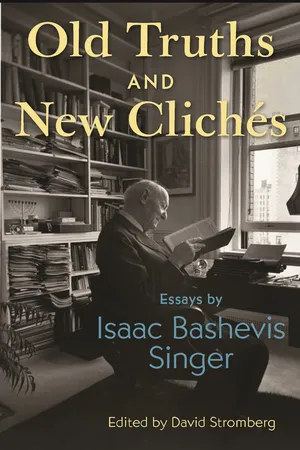
Old Truths and New Clichés
Essays by Isaac Bashevis Singer
- 264 pages
- English
- ePUB (mobile friendly)
- Available on iOS & Android
eBook - ePub
About this book
Information
Publisher
Princeton University PressYear
2022Print ISBN
9780691259239
9780691217635
eBook ISBN
9780691238982
INDEX
- abstract art, 50
- Acosta, Uriel, 107
- Adam, 67, 88, 183
- Adler, Alfred, 46, 192
- Adler, Celia, 124
- Adler, Jacob, 124
- Adler, Julius, 124
- Adler, Luther, 124
- Adler, Stella, 124
- advertising, 59
- Agudas Yisroel, 106–7
- Akdamut, 163, 170
- Aleichem, Sholem, 125, 137, 191, 204
- Alexander II, Tsar, 123
- Alfred A. Knopf, 4
- Andreyev, Leonid, 21
- animals, 86, 143, 173
- Ansky, S., The Dybbuk, 126
- Anti-Defamation League, 97
- antisemitism, 95–97, 104, 115, 191, 192
- Aramaic, 116, 130
- Aristotle, 44, 54–55, 87
- Aryeh de Modena, Rabbi, 85
- Asch, Sholem, God of Vengeance, 125
- Ashkenazi Jews, 114, 116, 132
- assimilation: Enlightenment encouragement of, 103, 112, 133–34; literature and, 132, 133, 157; natural inclination toward, 103; Polish Jewry and, 184; resistance to, 103–5; Yiddish spurned by advocates of, 126; Zionism and, 133–34
- Augustine, Saint, 142
- authors: anger of, 49; faith of, 48–49, 127, 201; originality of, 45, 51–52, 69; readers’ relationship to, 39–40; relationship of, to God, 41, 42, 48–49, 73; relationship of, to money, 59; role of, in writing fiction, 22, 193; talent of, 40–42, 68–69; unique viewpoints of, 55–56
- Axenfeld, Israel, The First Jewish Recruit, 122
- Baal Shem Tov, 79, 80, 142, 147, 190
- Balfour Declaration, 113
- Balzac, Honoré de, 27, 139
- beauty, 40, 42, 50, 72–73, 84, 166, 170
- Beliefs and Opinions, 78
- Ben-Ami, Jacob, 124
- Bergelson, Dovid, 137
- Bible: animals in, 86; character and behavior of heroes of, 109–10; Hebrew language of, 28; history of the Jews as portrayed in, 111; interpretations of, 77–78; Kabba...
Table of contents
- Cover
- Title Page
- Copyright
- Dedication
- Contents
- Preface
- Writers Don’t Write for the Drawer: An Introduction to the Essays of Isaac Bashevis Singer
- The Literary Arts
- Yiddish and Jewish Life
- Personal Writings and Philosophy
- Singer the Editor: An Afterword on the Editorial Process
- Acknowledgments
- Notes
- Bibliography
- Index
Trusted by 375,005 students
Access to over 1.5 million titles for a fair monthly price.
Study more efficiently using our study tools.
Frequently asked questions
Yes, you can cancel anytime from the Subscription tab in your account settings on the Perlego website. Your subscription will stay active until the end of your current billing period. Learn how to cancel your subscription
No, books cannot be downloaded as external files, such as PDFs, for use outside of Perlego. However, you can download books within the Perlego app for offline reading on mobile or tablet. Learn how to download books offline
Perlego offers two plans: Essential and Complete
- Essential is ideal for learners and professionals who enjoy exploring a wide range of subjects. Access the Essential Library with 800,000+ trusted titles and best-sellers across business, personal growth, and the humanities. Includes unlimited reading time and Standard Read Aloud voice.
- Complete: Perfect for advanced learners and researchers needing full, unrestricted access. Unlock 1.5M+ books across hundreds of subjects, including academic and specialized titles. The Complete Plan also includes advanced features like Premium Read Aloud and Research Assistant.
We are an online textbook subscription service, where you can get access to an entire online library for less than the price of a single book per month. With over 1.5 million books across 990+ topics, we’ve got you covered! Learn about our mission
Look out for the read-aloud symbol on your next book to see if you can listen to it. The read-aloud tool reads text aloud for you, highlighting the text as it is being read. You can pause it, speed it up and slow it down. Learn more about Read Aloud
Yes! You can use the Perlego app on both iOS and Android devices to read anytime, anywhere — even offline. Perfect for commutes or when you’re on the go.
Please note we cannot support devices running on iOS 13 and Android 7 or earlier. Learn more about using the app
Please note we cannot support devices running on iOS 13 and Android 7 or earlier. Learn more about using the app
Yes, you can access Old Truths and New Clichés by Isaac Bashevis Singer, David Stromberg in PDF and/or ePUB format, as well as other popular books in Literature & Literary Essays. We have over 1.5 million books available in our catalogue for you to explore.