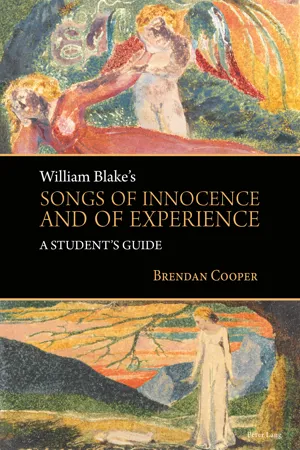
- 122 pages
- English
- PDF
- Available on iOS & Android
About this book
William Blake (1757ā1827) is one of the most significant figures in the history of English poetry. He is also one of the most mysterious, most challenging, and most frequently misunderstood. His Songs of Innocence and of Experience, on the surface so simple, are laden with mysteries that seem to deepen on every reading.
In this book, aimed at A Level and undergraduate students, Brendan Cooper explores the subtleties and contradictions of the Songs, avoiding formulaic readings by asking key questions about Blake's life and art. What are the Songs about? What does Blake mean by «Innocence» and «Experience»? Why are they called «Songs»? Was Blake a genius, or a madman?
This engaging and accessible introduction to Blake's work will help students to navigate its complexities and develop their own critical responses to the text.
Frequently asked questions
- Essential is ideal for learners and professionals who enjoy exploring a wide range of subjects. Access the Essential Library with 800,000+ trusted titles and best-sellers across business, personal growth, and the humanities. Includes unlimited reading time and Standard Read Aloud voice.
- Complete: Perfect for advanced learners and researchers needing full, unrestricted access. Unlock 1.4M+ books across hundreds of subjects, including academic and specialized titles. The Complete Plan also includes advanced features like Premium Read Aloud and Research Assistant.
Please note we cannot support devices running on iOS 13 and Android 7 or earlier. Learn more about using the app.
Information
Table of contents
- Cover
- Contents
- Acknowledgements
- Figures
- Chronology
- 1 Introduction
- 2 What Are the Songs About?
- 3 The Meaning of āInnocenceā in the Songs
- 4 The Meaning of āExperienceā in the Songs
- 5 Nature and the Pastoral
- 6 The Role of Childhood
- 7 Blakeās Visual Images
- 8 Why Are They Called āSongsā?
- 9 Could Blake Spell?
- 10 Was Blake a Romantic Poet?
- 11 Was Blake a Genius or a Madman?
- Appendices
- Bibliography
- Index