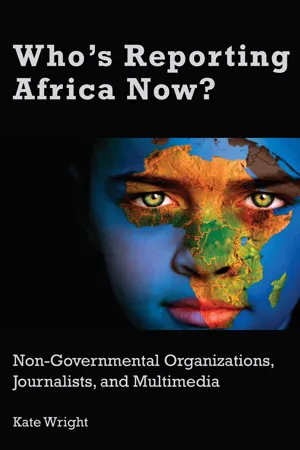
Who's Reporting Africa Now?
Non-Governmental Organizations, Journalists, and Multimedia
- 280 pages
- English
- PDF
- Available on iOS & Android
About this book
As news organizations cut correspondent posts and foreign bureaux, non-governmental organizations (NGOs) have begun to expand into news reporting. Why and how do journalists use the photographs, video, and audio that NGOs produce? What effects does this have on the kinds of stories told about Africa? And how have these developments changed the nature of journalism and NGO-work?
Who's Reporting Africa Now?: Non-Governmental Organizations, Journalists, and Multimedia is the first book to?address these questions—using frank interviews and internal documents to shed light on the workings of major news organizations and NGOs, collaborating with one another in specific news production processes. These contrasting case studies are used to illuminate the complex moral and political economies underpinning such journalism, involving not only NGO press officers and journalists but also field workers, freelancers, private foundations, social media participants, businesspeople, and advertising executives.
Frequently asked questions
- Essential is ideal for learners and professionals who enjoy exploring a wide range of subjects. Access the Essential Library with 800,000+ trusted titles and best-sellers across business, personal growth, and the humanities. Includes unlimited reading time and Standard Read Aloud voice.
- Complete: Perfect for advanced learners and researchers needing full, unrestricted access. Unlock 1.4M+ books across hundreds of subjects, including academic and specialized titles. The Complete Plan also includes advanced features like Premium Read Aloud and Research Assistant.
Please note we cannot support devices running on iOS 13 and Android 7 or earlier. Learn more about using the app.
Information
Table of contents
- Cover
- Table of Contents
- List of Illustrations
- Preface
- Acknowledgements
- Chapter 1. Introduction
- Chapter 2. NGOs, News Organizations, and Freelancers : An Overview
- Chapter 3. “Good” Journalism and Moral Economies
- Chapter 4. Photojournalism, Professionalism, and Print Newspapers: The Independent on Sunday and Christian Aid
- Chapter 5. War Crimes, Witnessing, and Public Service Television: Channel 4 News and Human Rights Watch
- Chapter 6. Online Slideshows, “Selling In”, and Moral Education: BBC News Online and Save the Children
- Chapter 7. Digital Dialogue, International Development, and Blogging: The Guardian and Internews
- Chapter 8. African Self-Help, Corporate Social Responsibility, and Positive Features: The Observer and the Kenyan Paraplegic Organization
- Chapter 9. Conclusion
- Index