This is an open access book available on www.peterlang.com and www.oapen.org. All content published can be shared under the terms of the Creative Commons Attribution-NonCommercial-NoDerivatives 4.0 International License (CC-BY-NC-ND 4.0).
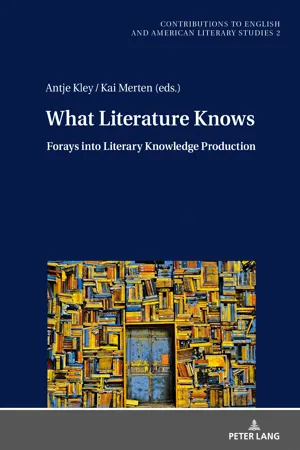
eBook - PDF
What Literature Knows
Forays into Literary Knowledge Production
- 344 pages
- English
- PDF
- Available on iOS & Android
eBook - PDF
What Literature Knows
Forays into Literary Knowledge Production
About this book
Table of contents
- Cover
- Contents
- What Literature Knows: An Introduction (Antje Kley)
- “His ignorance were wise”: Gendered Knowledge in Love’s Labour’s Lost (1594/95) (Kai Merten)
- “The pleasing visions I had formed”: Natural Knowledge and Self-Awareness in Jonathan Swift’s Satires (Richard Nate)
- Access Denied: English Experiences in Karl Philipp Moritz’s Travel Report of 1782 (Albert Meier)
- Fothergill’s Web: Transnational Quaker Networks and the Pennsylvania Medical Library (Marcel Hartwig)
- Wordsworth, The Excursion (1814), and the Crisis of Knowledge (Anthony John Harding)
- Romanticism and Anoetic Knowledge (Justus Conrad Gronau)
- Curious to Know: John Clare’s “The Nightingale’s Nest” (1832) (Philipp Erchinger)
- Negotiating Authority: Literary and Medical Configurations of Knowledge in 19th-Century America (Maria Kaspirek)
- The Fourth Dimension and Impossible Knowledge in Edwardian Speculative Fiction (Cord-Christian Casper)
- What Nancy Knew, What Carol Knew: Mass Literature and Knowledge (Aleksandra Boss / Martin Klepper)
- Scientific Knowledge and the Display Function of Literature: The White Hotel (1981) and Freud’s Megalomania (2000) (Matthias Bauer)
- The Art of Deception: Knowledge Distribution in English Literature (Daniel Schäbler)
- “We are only what we know”: Knowledge in David Mitchell’s Cloud Atlas (2004) (Ann Spangenberg)
- Eden Robinson’s Monkey Beach (2000) as Multi-Narrative: The Dialogic Relation of Indigenous and Western World Views (Jutta Zimmermann)
- “Useless, off-beat information!”: Knowledge and Successiveness in Brian Friel’s Molly Sweeney (1994) (André Schwarck)
- Historiography and the Production of Knowledge: The Mongol Period (Anja Pistor-Hatam)
- List of Contributors
Trusted by 375,005 students
Access to over 1.5 million titles for a fair monthly price.
Study more efficiently using our study tools.
Frequently asked questions
Yes, you can cancel anytime from the Subscription tab in your account settings on the Perlego website. Your subscription will stay active until the end of your current billing period. Learn how to cancel your subscription
No, books cannot be downloaded as external files, such as PDFs, for use outside of Perlego. However, you can download books within the Perlego app for offline reading on mobile or tablet. Learn how to download books offline
Perlego offers two plans: Essential and Complete
- Essential is ideal for learners and professionals who enjoy exploring a wide range of subjects. Access the Essential Library with 800,000+ trusted titles and best-sellers across business, personal growth, and the humanities. Includes unlimited reading time and Standard Read Aloud voice.
- Complete: Perfect for advanced learners and researchers needing full, unrestricted access. Unlock 1.5M+ books across hundreds of subjects, including academic and specialized titles. The Complete Plan also includes advanced features like Premium Read Aloud and Research Assistant.
We are an online textbook subscription service, where you can get access to an entire online library for less than the price of a single book per month. With over 1.5 million books across 990+ topics, we’ve got you covered! Learn about our mission
Look out for the read-aloud symbol on your next book to see if you can listen to it. The read-aloud tool reads text aloud for you, highlighting the text as it is being read. You can pause it, speed it up and slow it down. Learn more about Read Aloud
Yes! You can use the Perlego app on both iOS and Android devices to read anytime, anywhere — even offline. Perfect for commutes or when you’re on the go.
Please note we cannot support devices running on iOS 13 and Android 7 or earlier. Learn more about using the app
Please note we cannot support devices running on iOS 13 and Android 7 or earlier. Learn more about using the app
Yes, you can access What Literature Knows by Christoph Ehland, Antje Kley, Kai Merten in PDF and/or ePUB format, as well as other popular books in Literature & English Language. We have over 1.5 million books available in our catalogue for you to explore.