eBook - ePub
Available until 23 Dec |Learn more
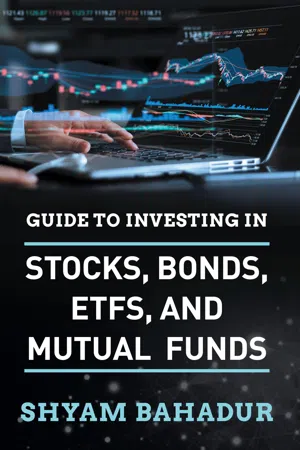
Guide to investing in Stocks, Bonds, ETFS and Mutual Funds
A Beginner's Guide to Building Wealth
This book is available to read until 23rd December, 2025
- English
- ePUB (mobile friendly)
- Available on iOS & Android
eBook - ePub
Available until 23 Dec |Learn more
Guide to investing in Stocks, Bonds, ETFS and Mutual Funds
A Beginner's Guide to Building Wealth
About this book
The reader is not expected to have prior knowledge of investing. The book guides the reader to build wealth with modest earnings.
The highlights of the topics covered in the book are:
- Concept of stocks and stock market, terminology, financial reports, stock selection and analysis with practical examples
- Concept of mutual funds, selection and analysis
- Concept of exchange traded funds, selection and analysis
- Discussion of bonds, fundamentals and selection
- Portfolio development in light of asset allocation, tax considerations and rebalancing
- Evaluation of market levels and strategies for bear market
Frequently asked questions
Yes, you can cancel anytime from the Subscription tab in your account settings on the Perlego website. Your subscription will stay active until the end of your current billing period. Learn how to cancel your subscription.
At the moment all of our mobile-responsive ePub books are available to download via the app. Most of our PDFs are also available to download and we're working on making the final remaining ones downloadable now. Learn more here.
Perlego offers two plans: Essential and Complete
- Essential is ideal for learners and professionals who enjoy exploring a wide range of subjects. Access the Essential Library with 800,000+ trusted titles and best-sellers across business, personal growth, and the humanities. Includes unlimited reading time and Standard Read Aloud voice.
- Complete: Perfect for advanced learners and researchers needing full, unrestricted access. Unlock 1.4M+ books across hundreds of subjects, including academic and specialized titles. The Complete Plan also includes advanced features like Premium Read Aloud and Research Assistant.
We are an online textbook subscription service, where you can get access to an entire online library for less than the price of a single book per month. With over 1 million books across 1000+ topics, we’ve got you covered! Learn more here.
Look out for the read-aloud symbol on your next book to see if you can listen to it. The read-aloud tool reads text aloud for you, highlighting the text as it is being read. You can pause it, speed it up and slow it down. Learn more here.
Yes! You can use the Perlego app on both iOS or Android devices to read anytime, anywhere — even offline. Perfect for commutes or when you’re on the go.
Please note we cannot support devices running on iOS 13 and Android 7 or earlier. Learn more about using the app.
Please note we cannot support devices running on iOS 13 and Android 7 or earlier. Learn more about using the app.
Yes, you can access Guide to investing in Stocks, Bonds, ETFS and Mutual Funds by Shyam Bahadur in PDF and/or ePUB format, as well as other popular books in Business & Stocks. We have over one million books available in our catalogue for you to explore.
Information
Chapter 1
Investments as the Key to Wealth
1.1 Introduction
This chapter stresses the need for the accumulation of wealth and so provides the motivation for investing. It introduces the types of investments that are available. It encourages investing as early as possible by introducing the magic of compounding. It prompts the reader to invest on a regular basis so as to benefit from dollar cost averaging. It discusses the need for insurance, cash reserves, and investing in the framework of budget. It provides an introduction to tax-deferred accounts and emphasizes the benefits of these accounts.
1.2 Managing Your Money
Would you want to be a millionaire? Who wouldn’t?
The question then is how to become a millionaire. Well, you could win a lottery, but what are the odds? Alternatively, you could land a high-paying job like that of a CEO in a company. But then how many people have the qualifications and the luck to reach that level? In reality, a person with modest income can achieve financial prosperity only through regular savings and investing those savings in a prudent manner. This approach will help you in achieving the goal of decent living and prepare you for a comfortable retirement. Your success in this endeavor will depend upon your personal situation governed by the needs of your family and your regular income. The important thing to note here is that you will need to motivate yourself to set aside a part of your income for investing and then invest this money prudently. The latter requires that you learn the basic investing principles which are covered in this book.
Most people have checking accounts in banks or credit unions. These are meant to facilitate the deposit of checks and payment of bills. The interest in a checking account is negligible, and so this is not suitable as an investment. You can earn a slightly higher interest in a savings account or a money market account, but these interest rates are also fairly small. The certificates of deposit (CDs) issued by the banks and the credit unions are much better in terms of the return, but unlike the above accounts, the money is locked for a specified period. These are safe because they carry FDIC (Federal Deposit Insurance Corporation) guarantee and have provided decent returns in the past (with some exceptions as since 2009). The certificates of deposit are ideal for investment when the money is intended to be used in a specific time frame such as the down payment on a home or the educational expenses of a child.
Other forms of investments involve risk. These are described in the next section. The objective of these investments is to enable your money to grow by a reasonable amount over a period of time, even accounting for the income taxes and inflation. The understanding of these strategies and the associated risks is necessary for prudent investing.
1.3 Types of Investments
The term investment refers to the commitment of funds in instruments that will help to prevent the loss of purchasing power of money from inflation over a period of time. This is amply demonstrated by the fact that a car that cost $3,000 in the year 1975 would cost today in excess of $20,000. Similarly, a home that cost $25,000 then would cost more than $100,000 today. Thus if you have $10,000 today saved for retirement, its purchasing power at the time of your retirement forty to fifty years later would be much less and certainly not enough to take care of your needs in retirement. The only solution to the loss of your purchasing power of money over a period of time is investing it for appreciation.
The major instruments for investments are bonds, common stocks, mutual funds, and exchange traded funds which will be discussed in detail in the following chapters. In order to integrate them in our discussion, the simple explanations of these terms are provided below:
- Bonds – These are issued by various agencies such as the US treasury and other federal agencies, state governments, municipal entities, and corporations. These agencies in effect borrow funds from the investors by selling bonds with the obligation to pay interest on the bonds as well as the principal on maturity. Because of the borrowing nature, bonds are called debt obligations.
- Common stocks – These represent the proportional ownership in a company. Thus if you purchase one hundred shares of a company which has one million shares of common stock, your share of the ownership in the company is 100/1,000,000. The common stocks entitle the stockholders the voting rights in proportion to the ownership of stock on major issues including the election of the company directors. The stockholder gets paid the dividend, if any, and benefits from the appreciation in stock price of the company if its profits increase and/or growth potential increases. In terms of the liability, the stockholder merely suffers from the drop in stock price if the company does not do well.
- Mutual funds – They pool money from a large number of investors which is invested by the professional managers in stocks, bonds, or any combination thereof, as the charter of the fund may dictate. In lieu of their investments, the investors are given shares which represent the proportional ownership in the fund. Thus the investors share the dividend and the appreciation or depreciation in the valu...
Table of contents
- Preface to the First Edition
- Preface to the Second Edition
- Organization of the Book
- Chapter 1
- Chapter 2
- Basics of Stock Market Investing
- Chapter 3
- Chapter 4
- Financial Statements
- Chapter 5
- Selection and Analysis of Stocks for Investment
- Chapter 6
- Chapter 7
- Chapter 8
- Chapter 9
- Chapter 10
- Chapter 11
- Chapter 12
- Chapter 13
- Chapter 14
- Concluding Remarks