Would you like to discover your most authentic, powerful leadership self? Would you like to define success based on your own terms?
When women readers finish Embracing Your Power, they will feel confident, supported, and seen. They will think, I am enough; I’ve got this. Focusing on greater self-awareness as a woman, a leader, and as a powerful and authentic woman leader, Marsha Clark also explores building interpersonal relationships based on a foundation of mutual trust, setting and maintaining boundaries, and managing conflict.
Embracing Your Power is a leadership book targeted to professionally minded women across all sectors. Women in for-profit, non-profit, education, healthcare, the military, religion, government—and homemakers—will benefit from Clark’s unique advice. Because many of her valuable tools and resources are gender-neutral, male readers will also learn how to better work with and for women.
Clark doesn’t just tell us what to do: She effectively shows us how and provides tools and language for practical applications with research, stories, and practice, including reflection questions and exercises. The book provides guidance and a structure for women to develop a vision statement that encompasses both their personal and professional lives. With this toolkit, women will become more effective leaders, and they will be able to lead from their best, most authentic place. They will also be able to live their best lives and pay it forward.
Embracing Your Power can be used by an individual, a book club, mentoring circles, organizational resource groups (focused on women) and potentially even at the organization level to develop curriculum (in conjunction with a membership service with tool availability).
Marsha Clark was a corporate officer in a Fortune 50 company and has spent over twenty years supporting women around the world through coaching and leadership development programs. She brings research, anecdotal experience, real-life stories, and practical application to all her work.
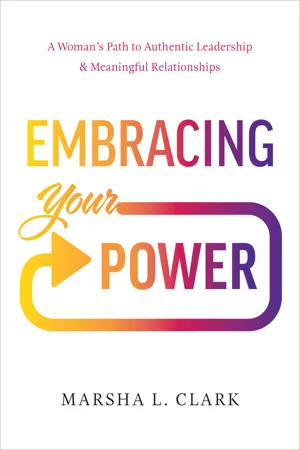
eBook - ePub
Embracing Your Power
A Woman's Path to Authentic Leadership and Meaningful Relationships
- 336 pages
- English
- ePUB (mobile friendly)
- Available on iOS & Android
eBook - ePub
Embracing Your Power
A Woman's Path to Authentic Leadership and Meaningful Relationships
About this book
Information
PART 1
EXPLORING POWER
CHAPTER 1
WHAT IS POWER?
A woman who is in full possession of her mind, who is responsible for her thoughts and actions, and who is unafraid of bucking the status quo is a dangerous woman. Such a woman is a force of nature. She creates whirlwinds of change in individuals, communities, and systems just by being herself.
~ Dawn Marie Daniels and Candace Sandy,
Souls of My Sisters
This chapter is about exploring who we are as women, as woman leaders, and as powerful woman leaders. Each of us is a unique combination of biology, genetics, life experiences, and social conditioning. Over time, we develop habits and defaults, along with patterns of thinking, talking, and behaving. We often operate on autopilot, not even thinking about what just happened or what happens next. Let’s take a moment to discover the origins of some of those automatic tendencies and examine our choices moving forward.
I like to move directly into an exercise. Let’s explore how we define what it means to be powerful.
POWERFUL WOMEN ARE . . .
ACTIVITY:
Complete these sentences. Repeat each sentence stem three times. Don’t overthink it. Don’t fret about being politically correct. Write down the first thing that comes to your mind. There are no right or wrong answers.
Powerful women are
Powerful women are
Powerful women are
Powerful men are
Powerful men are
Powerful men are
Powerless women are
Powerless women are
Powerless women are
Powerless men are
Powerless men are
Powerless men are
REFLECTIONS:
What do you notice about your answers? Are the answers for powerful or powerless women and men similar or different? If different, in what ways? How would you interpret those differences? And where do they come from? What beliefs do you hold that prompt these responses?
Did someone’s face pop into your head based on any one of the four sentence stems? If yes, did you then think of words or phrases that described that person?
Where do you see yourself in your responses? Do you strive to be powerful? How might that aspirational list describing powerful women be daunting? Inspiring?
Were you surprised by any of your responses? If so, in what way?
How might these beliefs impact your relationships with other women? Other men?
How do you feel about the concept of power? I have found it to be an uncomfortable word for women. However, we regularly face this reality in our lives. We might think about people who have had power over us in a negative or limiting way, or even an abusive way. I have found myself behaving as both a powerful and a powerless woman, and I’ve heard many women say the same thing. Power is tricky, and there are many lenses through which to view it. I offer three ways to think about power—all of which are valid and appropriate when used intentionally and effectively.
• Positional Power: This kind of power, hierarchical in nature, refers to a level or title in an organizational or institutional structure. For example, a vice president typically has more positional power or authority than a senior manager. Someone else bestows or gives you positional power. They hire you into the organization with a certain title or promote you to a new role with a specific title. Now, consider this: if someone gives you positional or hierarchical power, they can also take it away. I refer to this as “outside-in” power. Women often think about this as “power over others,” which often conjures up a negative connotation. It may even be hard for us to assert our positional power, and yet that is often a requirement of organizational leadership.
• Relational Power: This kind of power requires at least two people. You and I choose to engage as partners or as part of a larger team to do something that neither of us could do on our own. Thus, we have relational power or a greater collective power. We make individual choices of when to and when not to engage in such a relationship.
• Personal Power: I have personal power when I am making my own intentional choices. No other human bestows personal power on me. My choices are whether to hold on to this personal power, share this power, or give away this power. An example of holding on to this power is when I have clarity and speak my point of view in discussions or meetings, acting with integrity and respect for myself and others. Conversely, giving away my personal power occurs when I don’t set or maintain healthy boundaries, say “yes” when I want to say “no,” don’t ask for what I need, or work unhealthy hours to achieve a desired outcome. I refer to this as “inside-out” power. Personal power is my favorite because it is always available to me and doesn’t depend on someone else’s actions. I display my personal power no matter what role I have in any given scenario, whether it be personal or professional.
ACTIVITY 1:
Think about a recent situation in which you’ve held on to your personal power.
What led to the behaviors and actions that resulted in you holding on to your personal power?
How can you be more conscious and intentional to repeat this behavior or this approach?
ACTIVITY 2:
Think about a recent situation in which you’ve given your personal power away.
What led to your behaviors and actions that prompted you to give your power away?
Are there patterns you can identify that often lead to you giving your power away (e.g., certain people, certain circumstances, certain beliefs)?
POWER SOURCES
Let’s dig a little deeper into this concept of power.
ACTIVITY:
Think about a time when you felt powerful. Capture a few notes describing that time. (And for you mothers out there, I encourage you to think about a time other than when you were giving birth. We’ll give you that one!)
Where were you? Was anyone there with you?
What were you feeling emotionally? Physically?
What would you consider your sources of power to be? In other words, what helped you to experience this powerful moment? Write down as many things as possible.
Thoughts to consider:
• Sometimes it is hard for women to recall powerful moments. We often don’t think in those terms. I invite you to notice when you’re feeling powerful and reflect on how you got there.
• As I mentioned earlier, I have often found myself feeling powerless. I go quiet. I don’t ask for what I need. I let someone else have way too much impact on my mood for the day. When I find myself in one of those powerless moments, my choice point is not whether I’m going to feel powerless—I already do. My choice point is whether I’m going to stay in that powerless place, wallowing in the powerlessness. When you find yourself feeling powerless, pull out your list of power sources, be they family members or friends, or your own life experience. Your power may be found in your faith or in tangible abstracts such as coaching, preparation, knowledge, determination, willpower, or clarity. Better yet, do this activity with other women and compare notes. Add to your list of power sources. You have more available to you than you have yet realized or used.
CHAPTER 2
A LESSON IN CONTRASTS
The most common way we give up power is by thinking we don’t have any.
~ Alice Walker
The emphasis in this chapter is on some of the subtle, subconscious, or unconscious ways that men and women show up differently. Many studies over the years have demonstrated that a woman can do something almost identically as a man, yet it will be interpreted quite differently. For the women who have been pioneers in their organizations by assuming leadership roles, we recognized it was a tricky playing field. If we acted “too much like a man” we were often labeled negatively. If we acted “too much like a woman” we were often labeled as “too soft and fuzzy” or “too touchy-feely” or “too emotional.” It was a fine line to navigate.
A woman once told me that she had a strange experience over a several-year time span. She couldn’t walk past a Victoria’s Secret store without going in and buying some sort of feminine lingerie. She had never done this before. She had grown up in an era where women’s suits were similar to men’s, swapping out a skirt for women rather than men’s trousers. She finally came to realize that she was trying to hold on to her feminine self by wearing feminine lingerie under that male-fashioned suit.
When she shared her story, women were ready to share their versions of these kinds of stories. Dress codes may have changed over the years, but women are still struggling with how to fit in. Remember the cigar-smoking phase? Or asking yourself if you should learn to play golf? Or avoiding the Monday morning coffee discussions about the weekend’s big sporting event? Or declining (and maybe you weren’t even invited) to the executive retreat at your fellow executive’s hunting cabin? The list goes on and on. Even if you have landed an office in the executive suite, these questions and this sort of exclusion still occur today. I hear some version of it in all of my programs and over half of my coaching conversations.
So where does all this come from? Is it nature or nurture? The answer to this last question is “yes.” We all maintain stereotypes and unconscious biases that are automatic, unintentional, deeply ingrained, universal, and able (and likely) to influence our behavior. In this chapter, we’re going to explore stereotypes, invisible differences, male and female brains, and something called the “impostor syndrome.”
As you read this chapter, keep in mind these two factors: 1) The research included here is based on a bell-shaped curve. There are always exceptions on either en...
Table of contents
- Cover
- Title Page
- Copyright
- Dedication
- Contents
- Acknowledgments
- Introduction
- Part 1: Exploring Power
- Part 2: Interpersonal Relationships
- Epilogue
- Appendix
- List of Tools
- Recommended Reading & Resources
- Additional Tools
- About the Author
Trusted by 375,005 students
Access to over 1.5 million titles for a fair monthly price.
Study more efficiently using our study tools.
Frequently asked questions
Yes, you can cancel anytime from the Subscription tab in your account settings on the Perlego website. Your subscription will stay active until the end of your current billing period. Learn how to cancel your subscription
No, books cannot be downloaded as external files, such as PDFs, for use outside of Perlego. However, you can download books within the Perlego app for offline reading on mobile or tablet. Learn how to download books offline
Perlego offers two plans: Essential and Complete
- Essential is ideal for learners and professionals who enjoy exploring a wide range of subjects. Access the Essential Library with 800,000+ trusted titles and best-sellers across business, personal growth, and the humanities. Includes unlimited reading time and Standard Read Aloud voice.
- Complete: Perfect for advanced learners and researchers needing full, unrestricted access. Unlock 1.5M+ books across hundreds of subjects, including academic and specialized titles. The Complete Plan also includes advanced features like Premium Read Aloud and Research Assistant.
We are an online textbook subscription service, where you can get access to an entire online library for less than the price of a single book per month. With over 1.5 million books across 990+ topics, we’ve got you covered! Learn about our mission
Look out for the read-aloud symbol on your next book to see if you can listen to it. The read-aloud tool reads text aloud for you, highlighting the text as it is being read. You can pause it, speed it up and slow it down. Learn more about Read Aloud
Yes! You can use the Perlego app on both iOS and Android devices to read anytime, anywhere — even offline. Perfect for commutes or when you’re on the go.
Please note we cannot support devices running on iOS 13 and Android 7 or earlier. Learn more about using the app
Please note we cannot support devices running on iOS 13 and Android 7 or earlier. Learn more about using the app
Yes, you can access Embracing Your Power by Marsha L. Clark in PDF and/or ePUB format, as well as other popular books in Business & Leadership. We have over 1.5 million books available in our catalogue for you to explore.