- 473 pages
- English
- PDF
- Available on iOS & Android
eBook - PDF
About this book
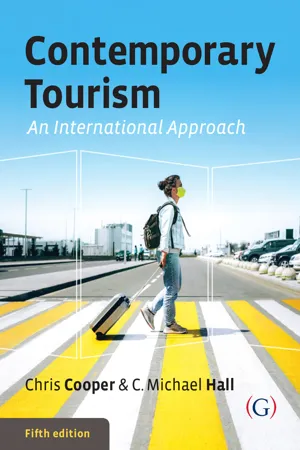
The study of tourism and indeed the tourism industry is changing constantly. Now in its fifth edition, Contemporary Tourism: an
international approach presents a new and refreshing approach to the study of tourism, looking at the far reaching effects that the
COVID pandemic has had on the industry and how it has been forced to change, or not subsequently.
Considering issues such as advances in AI and its impacts, the environmental crisis and air travel, the sharing economy and Airbnb, and the tourist experience in a Covid world. In particular, it highlights the ongoing threats and opportunities faced by the tourism industry today, and discusses
the related management strategies, illustrating the potential implications for the patterns and flow of tourism in the future.
Divided into five sections, each chapter has a thorough learning structure including chapter objectives, examples, discussion points,
self-review questions, checklists and case studies. URL links in the form of QR codes are heavily present throughout the text so that
users of both hard and electronic formats can have direct links to up to date, authoritative and annotated sources of information. Cases are both thematic and destination-based and always international.
New to this edition:
• New material on latest issues such as the impact of the COVID-19 pandemic, international responses to the environmental crisis,
the impact of AI/robotics on tourism human resource and the rise of the staycation;
• Brand new and updated case studies and readings throughout;
• Substantial support for both students and teachers, both within the text itself and via web-based student and instructor resources.
ABOUT THE AUTHORS
Chris Cooper is Professor in the School of Events, Tourism and Hospitality at Leeds Beckett University in the UK.
Professor C Michael Hall is Professor of Marketing at the University of Canterbury in New Zealand; Docent, University of Oulu, Finland and Visiting Professor at Linnaeus University, Kalmar, Sweden.
Information
Publisher
Goodfellow PublishersYear
2022Print ISBN
9781915097170
9781915097163
Edition
5eBook ISBN
9781915097187
Table of contents
- Cover
- Title page
- Contents
- 1 Contemporary Tourism Systems
- 2 Contemporary Tourism Product Markets
- 3 Contemporary Tourists, Tourist Behaviour and Flows
- 4 Contemporary Tourism Marketing
- 5 Delivering the Contemporary Tourism Product: the Destination
- 6 Governing the Contemporary Tourism Product:
- 7 Consequences of Visitation at the Contemporary Destination
- 8 Planning and Managing the Contemporary Destination
- 9 Marketing and Branding the Contemporary Destination
- 10 The Scope of the Contemporary Tourism Sector
- 11 The Tourism Industry: Contemporary Issues
- 12 Supporting the Contemporary Tourism Product – Tourism Service Management
- 13 Tourism in the 21st Century –
- Index
Trusted by 375,005 students
Access to over 1.5 million titles for a fair monthly price.
Study more efficiently using our study tools.
Frequently asked questions
Yes, you can cancel anytime from the Subscription tab in your account settings on the Perlego website. Your subscription will stay active until the end of your current billing period. Learn how to cancel your subscription
No, books cannot be downloaded as external files, such as PDFs, for use outside of Perlego. However, you can download books within the Perlego app for offline reading on mobile or tablet. Learn how to download books offline
Perlego offers two plans: Essential and Complete
- Essential is ideal for learners and professionals who enjoy exploring a wide range of subjects. Access the Essential Library with 800,000+ trusted titles and best-sellers across business, personal growth, and the humanities. Includes unlimited reading time and Standard Read Aloud voice.
- Complete: Perfect for advanced learners and researchers needing full, unrestricted access. Unlock 1.5M+ books across hundreds of subjects, including academic and specialized titles. The Complete Plan also includes advanced features like Premium Read Aloud and Research Assistant.
We are an online textbook subscription service, where you can get access to an entire online library for less than the price of a single book per month. With over 1.5 million books across 990+ topics, we’ve got you covered! Learn about our mission
Look out for the read-aloud symbol on your next book to see if you can listen to it. The read-aloud tool reads text aloud for you, highlighting the text as it is being read. You can pause it, speed it up and slow it down. Learn more about Read Aloud
Yes! You can use the Perlego app on both iOS and Android devices to read anytime, anywhere — even offline. Perfect for commutes or when you’re on the go.
Please note we cannot support devices running on iOS 13 and Android 7 or earlier. Learn more about using the app
Please note we cannot support devices running on iOS 13 and Android 7 or earlier. Learn more about using the app
Yes, you can access Contemporary Tourism by Chris Cooper,C Michael Hall in PDF and/or ePUB format, as well as other popular books in Business & Hospitality, Travel & Tourism Industry. We have over 1.5 million books available in our catalogue for you to explore.