- 342 pages
- English
- ePUB (mobile friendly)
- Available on iOS & Android
About this book
The data structure is a set of specially organized data elements and functions, which are defined to store, retrieve, remove and search for individual data elements. Data Structures using C: A Practical Approach for Beginners covers all issues related to the amount of storage needed, the amount of time required to process the data, data representation of the primary memory and operations carried out with such data. Data Structures using C: A Practical Approach for Beginners book will help students learn data structure and algorithms in a focused way.
- Resolves linear and nonlinear data structures in C language using the algorithm, diagrammatically and its time and space complexity analysis
- Covers interview questions and MCQs on all topics of campus readiness
- Identifies possible solutions to each problem
- Includes real-life and computational applications of linear and nonlinear data structures
This book is primarily aimed at undergraduates and graduates of computer science and information technology. Students of all engineering disciplines will also find this book useful.
Tools to learn more effectively

Saving Books

Keyword Search

Annotating Text

Listen to it instead
Information
1 Fundamental Principles of Algorithm and Recursion
1.1 Algorithm, Its Pseudo-Code Representation and FlowChart
1.1.1 Algorithm Definition
- Input: Zero, one or more quantities are externally provided.
- Output: The algorithm produces at least one output as a result.
- Definiteness: Each statement must be clear, specific, and unambiguous.
- Finite: The algorithm should conclude after a limited number of steps.
- Effectiveness: Every statement must be very fundamental so that it can be carried out by any individual using only paper and pencil.
1.1.2 Pseudo-Code Representation
- FOR⦠ENDFOR
- WHILE⦠ENDWHILE
- IF⦠ENDIF
- WHILE⦠ENDWHILE (this is both a loop and a conditional clause by the way)
- CASE⦠ENDCASE
if (I < 10) { I++; } - Pseudo-code is understood by every programming language developer like Java or C#. Net developer, etc.
- Programming languages are difficult to read for most people, but pseudo-code permits non-programmers, such as business analysts, end user or customer to review the steps to approve the projected pseudo-code that matches the coding specifications.
- By drafting the code in human language first, the programmer protects from omitting an important step.
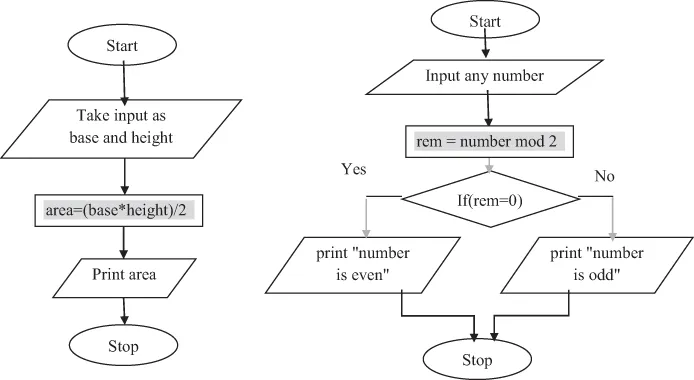
- Step 1: Start
- Step 2: Take input as the base and the height of the user
- Step 3: Area = (base * height)/2
- Step 4: Print area of triangle
- Step 5: Stop.
- Step 1: Start
- Step 2: Enter any input number
- Step 3: Reminder = number mod 2
- Step 4: If reminder = 0, then
Print "number is even" Else Print "number is odd" End if
- Step 5: Stop.
1.1.3 Flowchart

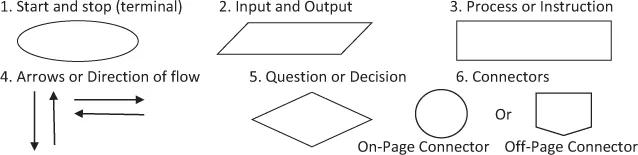
- Start and Stop or Terminal The circular rectangles or oval symbol indicates where the flowchart starts and ends.
- Input and Output The parallelogram symbol denotes input or output operations in the flowchart.
- Process or Instruction The rectangle represents a process like computations, a mathematical operation or a variable assignment operation, etc.
- Arrows or Direction of Flow Arrows or direction of flow represents the flow of the sequence of steps and direction of a process.
- Question or Decision The diamond symbol is used as a representation of the true or false statement tested in a decision symbol.
- Connector A flowchart is divided into two or more smaller flowcharts, consistent with project requirements. This connector is most often used when a flowchart does not fit on a single page or has to be split into sections. A connector symbol, which is a small circle called an On-Page Connector, with a number inside it, allows you to connect two flowcharts on the same page.A connector symbol that looks like a pocket on a shirt, called off-page connector allows you to connect to a flow diagram on another page.
- The arrows should not intersect during the design of a flowchart.
- Processes or activities take place from top to bottom or from left to right in general.
- The on-page connectors are referenced using digits in general.
- Off-page connectors are referenced using alphabets generally.
- The flowchart may have only one beginning symbol and a one-stop symbol.
- The shapes, lines and texts of a flowchart need to be consistent.
- Flowcharts are one of the best ways of documenting programs.
- Flowcharts are easier to understand compared to algorithms and pseudo-codes.
- It helps us to debug and analyze processes.
- It helps us understand how to think or make decisions to formulate the problem.
- Manual tracking is needed to verify the accuracy of the paper flowchart.
- Modification of the flowchart is sometimes time-consuming.
- It is difficult to display numerous branches and create loops in the flowchart.
- A simple modification of the problem logic can result in a complete redesign of the flowchart.
- It is very difficult to draw a flowchart for huge and complicated programs.

1.2 Abstract Data Type
Table of contents
- Cover
- Half Title
- Title Page
- Copyright Page
- Table of Contents
- Preface
- Authors
- 1. Fundamental Principles of Algorithm and Recursion
- 2. Sequential Representation of Linear Data Structures
- 3. Void Pointer and Dynamic Memory Management
- 4. Linked Representation of Linear Data Structures
- 5. Nonlinear Data Structures: Trees
- 6. Nonlinear Data Structures: Graph
- 7. Searching and Sorting Techniques
- References
- Index
Frequently asked questions
- Essential is ideal for learners and professionals who enjoy exploring a wide range of subjects. Access the Essential Library with 800,000+ trusted titles and best-sellers across business, personal growth, and the humanities. Includes unlimited reading time and Standard Read Aloud voice.
- Complete: Perfect for advanced learners and researchers needing full, unrestricted access. Unlock 1.4M+ books across hundreds of subjects, including academic and specialized titles. The Complete Plan also includes advanced features like Premium Read Aloud and Research Assistant.
Please note we cannot support devices running on iOS 13 and Android 7 or earlier. Learn more about using the app