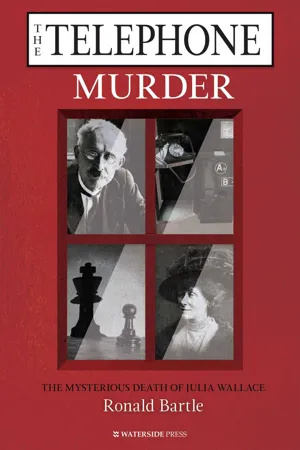
One of a number of real life cases from an era when juries listened with rapt attention to evidence of exact times, distances, estimates of speed and even in some cases whether a clock was fast or slow—from witnesses whose recollections might be first-rate, mildly inaccurate, mistaken or wholly unreliable. A reading of Old Bailey and other Assize court cases from the time suggests there may have been an entire industry centring on the creation of ambiguity, smokescreens and sometimes false alibis. Advocates demonstrated skill, ingenuity and persistence in constructing explanations, favourable or unfavourable, according to whether they acted for prosecution or defence. The Telephone Murder of 1931 in Liverpool, when William Wallace was acquitted on appeal of his wife's murder, is a poignant reminder of those days. The story is further spiced because prosecuting counsel was a man fighting to restore his professional reputation.This second edition contains a new Preface as well as a number of textual explanations, enhancement and a fresh index. It complements the author's series of books on famous cases.
- English
- ePUB (mobile friendly)
- Available on iOS & Android
eBook - ePub
About this book
Trusted by 375,005 students
Access to over 1.5 million titles for a fair monthly price.
Study more efficiently using our study tools.
Information
Print ISBN
9781909976566
Introduction
The case of William Herbert Wallace is unique in the annals of English criminal law. It has been so regarded by lawyers, authors and criminologists since 1931 when it took place. Not so publicly known as the cases of Crippen, Palmer, Heath or Haigh, nor featuring so dramatic a serial killer as the ever illusive Jack the Ripper, it presents a baffling mystery which far exceeds any of these other causes célèbres. For here was a mild-mannered and apparently inoffensive insurance agent charged with the savagely brutal murder of his wife, with whom according to those who knew them well, he lived on terms of marital peace and contentment and had done so for many years. It seemed incredible that such a man, after so many years of harmonious marriage, should batter his wife to death in what was described at his trial as a ‘frenzied attack’. Moreover, the nature of the crime appeared inconsistent with the case presented against Wallace by the prosecution in the trial.
The Crown presented the case to the jury as a carefully and coldly planned killing, almost an assassination. This, it was argued, was no run-of-the-mill husband and wife murder, no unforeseen consequence of a dispute which had got out of hand when the firm balance of controlled emotion had spilt over into blind fury. By common consent of those on both sides of the court the whole act was meticulously planned and ruthlessly carried out. Yet, notwithstanding the shocking nature of the deed, guilt was never finally established.
Criminologists and writers, jurists and forensic experts, some of whom have spent years studying the case, have been unable to agree as to the guilt or innocence of William Herbert Wallace. Prominent authors of books on the subject show that differences of opinion remain. W F Wyndham-Brown in his book, The Trial of William Herbert Wallace (Gollancz, 1933), endorses a general judicial view that there is a just cause for grave suspicion about Wallace, but no direct evidence on which a verdict of guilty could be justified. However in what has been considered the standard work on the topic The Killing of Julia Wallace (Charles Scibner’s Sons, 1969), Jonathan Goodman is emphatically in favour of the innocence of Wallace and points the accusing finger at another party. A similar standpoint is taken by Roger Wilkes in Wallace, the Final Verdict (Bodley Head, 1984) where he maintains that there is a much stronger case against a former fellow employee of Wallace, Richard Gordon Parry. Nevertheless in The Murder of Julia Wallace (Bluecoat Press, 2001), James Murphy, who has devoted much research and labour to a close analysis of the Wallace drama, has no doubt that the guilty verdict of the jury was correct and that the weight of the circumstantial evidence should have been decisive for conviction.
It is not surprising that Edward Hemmerde, the chief prosecuting counsel at the trial, his junior and also Detective Superintendent Hubert Moore who led the police investigation were certain of Wallace’s guilt, while those in charge of the defence took a different view. The opinion of Mr Justice Wright, the distinguished judge who presided at the hearing at Liverpool Spring Assizes on 22 April 1931, expressed many years later, is interesting:
Never forget that Wallace was a chess player. I should say that, broadly speaking, any man with common sense would have said that Wallace’s alibi was too good to be true, but that is not an argument you can hang a man on. So many strange things happen in life. I should not and never did demand a motive for any crime, very often the motive is merely impulse and you must remember that Wallace was a highly strung man. But if Wallace did murder his wife, as the jury thought, then there might have been a motive … after his trial the station master at Birkenhead station mentioned the case to me as I waited for a train. He said it was the opinion of the people in the district that there was another woman in the case. That certainly never came out at the trial, but at the time I could not help thinking that Wallace found domestic felicity a little boring, as it is apt to be occasionally to anybody.
In any case of a ‘domestic murder’ that is to say murder of a wife by a husband, or less usually of a husband by a wife, it is well worth taking a careful look at the background of the parties concerned and the environment in which the crime is committed. The house in which Wallace lived, 29 Wolverton Street in Liverpool, was a terraced house in a cheerless cul-de-sac of similar dwellings typical of the drab, lower middle-class area in which it stood. Three of the houses had been the scene of suicide and two more of bereavement in tragic circumstances. The others had received the attention of local burglars who had escaped arrest.
William Herbert Wallace was born on the 29 August 1878, the eldest of three children of working-class parents. He was an intelligent child at school and it may well be said of him that he was one of those people who should and could have gone further in his later life had his intellectual gifts and his energies been better directed. After leaving school at 14 he became a linen-draper’s assistant for six years and then spent three years in Manchester employed with a wholesale textile factory. However, Wallace sought a more interesting life and in 1902 he sailed to Calcutta where he gained employment as a salesman in a trading company. Three years later he travelled to Shanghai where his younger brother Joseph was working. He became advertising manager in a general store. However, Wallace suffered the curse of ill-health in his career. He was plagued by serious kidney disease and was obliged to return to England where, in 1907, he had his left kidney removed. In due course he moved to Harrogate. There he landed a job as an agent for the Liberal Party and it was there that he met and, in 1914, married his wife Julia.
During the Great War the pair moved to Liverpool. Wallace, who was unfit for military service, was by then working for the Prudential Assurance Company as an agent at a salary of £260 a year (£16,000 today). That sum was fully adequate to cover a very modest rent for their home at 29 Wolverton Street. From that time onwards until 20 January 1931, when Julia was murdered, there is little of interest in the life together of Julia and William Wallace. According to Wallace the marriage was blissfully peaceful, although some witnesses have thrown doubt upon that description. The pair could hardly have been called particularly sociable. Their neighbours at 31 Wolverton Street only visited them on three occasions in 16 years.
The Wallaces remained childless but they retained and practised their interests. In the case of William these consisted of chess, the practice of chemical experiments and the study of Stoicism. For her part Julia spoke fluent French and played the piano with considerable skill. Their shared love of music induced Wallace to achieve a fairly rudimentary knowledge of the violin, and together they would play duets, Wallace on the violin and Julia at the piano. Their social life seems to have been fairly limited, consisting of occasional visits by friends, including Wallace’s sister-in-law, and more rarely by business associates. It was into this placid environment that there came the terrible events of the 20 January 1931.
The catalyst for murder was, of all things, a telephone call. Wallace was a keen though not very expert chess player. The club which he belonged to, the Central Chess Club, conducted its activities in the City Café in the Anfield district of Liverpool. Wallace, who regularly attended the club for play, arrived at the café at about 7.40 pm on Monday 19 January. According to Wallace when subsequently interviewed by the police, he had not informed anyone other than his wife that he would be at the club that night. Soon after his arrival, when he had commenced a game, he was informed by Samuel Beattie, the club captain, that there had been a telephone message for him at about 7.20 pm. The caller left the name of R M Qualtrough and said that he wanted to see Wallace at 7.30 pm the next day at his address, which he gave as 25 Menlove Gardens East. The caller said that it was ‘something in the nature of his, that is Wallace’s business’. The Menlove Gardens area was in the district of Mossley Hill. In fact both name and address were fictitious. Wallace displayed puzzlement over both. He said he knew nobody of the name of Qualtrough and that he was not familiar with the Menlove Gardens area, although he had heard of it. He decided to look for the address next day.
On Tuesday 20 January, after completing his normal round as an agent for the Prudential, he set off for Menlove Gardens East. The search proved fruitless; he asked no fewer than nine people the whereabouts of Menlove Gardens East without success. Finally at about 8 pm he gave up the search and returned home. He arrived at his address at 8.45 pm. His two neighbours from number 31 were just leaving.

The crime scene showing Julia Wallace’s body
After a short conversation with them Wallace attempted to enter his house. They decided to wait to see that all was well. After experiencing some difficulty with both the front door and the back door, Wallace entered the house by the back door and made a quick search of the premises. When he entered the parlour a scene of utter horror met his eyes. The body of Julia Wallace lay face down on the rug in front of the fire. Her head was surrounded by a pool of blood which had seeped into the carpet and splashed onto the walls. Her skull had been crushed by no fewer than eleven blows delivered with great force. The blow that killed her was the one delivered to her left temple; this was the first. The wound was open revealing brain matter and bone. There were signs of a burglary having taken place, but none of breaking and entering. However the sum taken was small, about £4 in cash, a crossed cheque and a postal order. Strangely the thief had closed the lid of the box from which it had been taken and had replaced the box. None of Julia Wallace’s jewellery had been taken. In a jar in a bedroom were a few £1 notes one of which was smeared with blood, these had not been removed. Across the shoulders of the corpse (some accounts say along her left side and probably tucked in) was Wallace’s mackintosh. This was stained with blood and partially burnt. There were further signs of disturbance in the house which the police believed to be an attempt by the murderer to give the impression that the crime was a theft which went badly wrong.
The premises were thoroughly searched by the police but little came to light to assist in their investigations. The forensic expert who examined the body was Professor John Edward Whitely MacFall. MacFall, instead of performing such basic tests as establishing the temperature of the body and of the parlour, based his deductions solely on the evidence of rigor mortis that had set into the neck and left arm, and on the clotting of the blood that had spilled from Julia’s head wounds. This method left room for a wide margin of error as to the time of the assault, which was described by MacFall as ‘frenzied’.
The Liverpool police, under the direction of Detective Superintendent Hubert Moore, began their investigations. Writers who favour the view that Wallace was innocent have criticised the police on various grounds. This is not surprising since it complements their theory that Wallace should not have been charged with the crime. However, in the view of this author, the Liverpool police exercised thoroughness and a fair degree of efficiency in their investigation of a case which by any standards was baffling in the extreme.
There were several factors which made the task of the police difficult from the beginning. Firstly, the apparent absence of any motive and the reported tranquillity of the Wallace’s marriage made the situation seem very different from the average domestic murder. The trivial sum that was missing and the fact that a further sum of money and jewellery were left untouched made theft as a motive seem unlikely. The mysterious telephone call which provided Wallace with an alibi, and the absence of any alternative suspect whom Julia knew well enough to admit to the house were further considerations. In these circumstances it is not surprising that Wallace himself did not escape suspicion: ‘If not Wallace, then who?’ was clearly an important question for the police. In his statements, of which there were several, Wallace persistently protested his innocence. There were four factors which he could pray in aid of his innocence. First, the complete absence of motive; secondly, the alibi created by the phone call; thirdly, the fact that there were no traces of blood on his person; and finally, the time schedule, which would have made it difficult if not impossible for him to commit the murder in the time available.
After his first interview, Wallace told two members of the chess club that he had been cleared. But Detective Superintendent Hubert Moore and his colleagues began to form other ideas. They were particularly influenced by the discovery that the telephone call, purported to be from Mr Qualtrough, had been made from a telephone box which was a mere 400 yards from Wallace’s house.
When Wallace set off on his search for the fictitious 25 Menlove Gardens East he went to Smithdown Road to catch his tram. Police trials showed that the journey from his home to the tram stop varied between 17 and 20 minutes. He caught the tram at 7.06 pm on the evidence of the conductor. The evidence of a milk boy was that he saw Julia Wallace alive at 6.45 pm, though he later changed this to about 6.30 pm. This schedule would have left very little time for Wallace to carry out the murder and catch the tram by 7.06 pm. The second difficulty faced by the police was the absence of any blood on Wallace’s clothes. Could he have changed his clothes after Julia Wallace had been killed? (by a method which caused blood to spurt onto the floor and onto the walls)? If so, when and how did he do so? Not withstanding these obstacles Detective Superintendent Moore decided to charge Wallace with the murder. His theory was that Wallace himself had made the call and supplied himself with an alibi. Wallace’s reply was: ‘What can I say in answer to a charge of which I am absolutely innocent?’
Wallace’s trial took place in 22 April 1931 at the Liverpool Spring Assizes. The judge presiding was Mr Justice Wright a...
Table of contents
- Copyright and publications details
- Acknowledgements
- About the author
- Dedication
- Preface
- Introduction
- Postscript
- Select Bibliography (in alphabetical order)
- Index