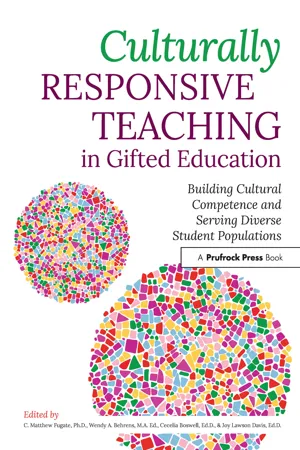
Culturally Responsive Teaching in Gifted Education is a professional learning tool for practitioners who are working to create more culturally responsive school and classroom environments. This book:
Focuses on gifted and talented students from special populations, including those who are culturally, linguistically, and economically diverse.
Is presented as a collection of essays written by educational advocates.
Aims to increase the cultural competence of teachers and school leaders.
Is organized in three sections: Culturally Responsive Practices; Race, Ethnicity, and Culture; and Gender, Sex, and Sense of Self.
Provides readers with personal insights into the implicit biases that exist within the educational system and gifted programs.
Each chapter illustrates the lived experiences of students from special populations and includes reflection questions for continued conversations and planning. Finally, an Educator Inventory is provided that tasks educators with reflecting on their own personal implicit biases and classroom practices related to the diverse populations of gifted and talented students in our schools.
These essays are both enlightening and enriching, enabling readers to reflect on their knowledge. Even more important is the robust amount that we, as educators, need to learn in order to offer research-based, appropriate, and meaningful culturally responsive teaching, listening, and counseling practices to talented young people. It is especially important if we hope to develop their gifts and talents. Although we all share common paths in our learning experiences, we take completely unique journeys. What is critical for each of us to understand and make sense of is the impact of our own culture, biases, stereotypes, and experiences and the necessity for constant reflection about how our actions and intentions affect and influence the children and young adults we teach. We must be cautious not to generalize, or in some cases, over-generalize about any of these populations. When I teach my doctoral seminar in social and emotional development of gifted and talented students, I spend my first class discussing the fact that in too many articles and publications about giftedness, there are inaccurate generalizations about gifted students and adults. To set the record straight, there are some gifted LGBTQ+ students whose parents accept, love, and support them unconditionally. Some gifted transgender and nonbinary students also have extremely supportive parents and school cultures. Some gifted girls and boys do extremely well, having amazing support from parents and educators, as do students who are gifted and from culturally diverse backgrounds. Having said that, many do not, and that is one focus of this book. Another focus is the knowledge that we can all do better, every single day, about providing more culturally responsive and welcoming educational environments, and using culturally supportive and responsive teaching methods, many of which are discussed in this section.
We can all do better, every single day, about providing more culturally responsive and welcoming educational environments.
In the essays in this section, several common themes emerge. The authors understand the necessity of communicating high expectations and unconditional acceptance to the various populations they write about, while advocating for an understanding of the unique challenges and opportunities each group faces. Although the authors write about specific groups, these specific populations are heterogeneous groups, as they include a wide variety of abilities, talents, interests, personality traits, and strengths, as well as diverse challenges and needs these students encounter in their development.
The Essays
My own essay focuses on both current and previous research on gifted and creative girls and women who excel in various fields and domains. It illustrates the complex paths and directions they select, their diversity across multiple perspectives, and the different types of decisions that guide their paths, as well as the obstacles they face in their paths to creative productive work. In my research on gifted girls and women, I have found that the process of talent development in this population differs from the processes in men due to different psychological needs and environmental challenges. It is interesting, however, to note that in all essays in this section, support for talent development, both from parents and educators, is viewed as critically important. It is just that the type of support may vary based on both group and individual profiles and needs, as well as the resources necessary to support the individual process of talent development.
Also discussed are the different characteristics, traits, and gifted behaviors evidenced in males, as well as challenges that they experience. Six issues are addressed in this essay, including the experience of the empathic young male, self-inflected pressures that high-achieving males place upon themselves, identity development issues, image management, cultural expectations for young men of color, and differences in achievement orientations.
In the essay on Black males, the authors discuss what is necessary to support these students through the struggles and adversity that they face. The authors also discuss the various forms of ambiguity relating to the assumptions of others and those that Black males themselves hold regarding their racial and gender identities, particularly when being smart and achieving at high levels can be associated with acting White and emulating feminine traits. Further, the authors argue that these challenges can have a negative impact on academic achievement both in high school and as these young men prepare for college.
In the discussion of transgender and nonbinary gifted students, compelling points are highlighted about how this diverse population possesses gender identities and expressions that do not align with their sex assigned at birth and do not conform to the stereotypes of their assigned gender. The essay also discusses the daily pressures experienced by this group that demand our attention and support. In particular, to promote consistent application of best practices, schools and districts should not rely on individuals. The authors advise us to consider developing policies that support culturally responsive teaching. These policies should be enacted, documented, and made known to all stakeholders, and districts should encourage educators to accommodate gender expressions that may not conform to traditional social stereotypes.
Finally, the essay on students who are LGBTQ+ asks us to recognize the many sexual and gender identities that exist, and the need to understand that many of these students are a subculture within other subcultures, such as being gifted, Black, and LBGTQ+. Meeting the needs of this population may be daunting for educators and families of this group, as the young person begins a journey of discovering who they currently are and who they intend to be in the future.
Common Themes
Each of the authors of the compelling essays that follow provide insightful and interesting perspectives about the types of support and culturally appropriate teaching needed for some of the common experiences that the group has. Several themes emerge across essays regarding the needs and characteristics of these groups.
Inclusion and Support
One common theme that is found across these essays is the need for these students to be included in various ways and across various groups. Gifted students from each of these groups often fail to be identified for various reasons. Without broad and universal screening, many of the groups discussed will be overlooked for inclusion in gifted programs. Professional learning is necessary to understand the support that these young people need. Professional learning can enable educators to develop and enhance cultural competencies to create safe, welcoming, and productive environments for all of their students. In these safe environments, whenever possible, educators and parents should consider the types of strategies that support talent development, including those that welcome each student and those that develop the strengths and interests of all.
Pressure, Anxiety, Depression, and Sensitivities
The authors recognize the regular pressure and anxiety that some of these young people experience because they are both gifted and members of diverse populations. High-achieving males may experience self-inflicted pressures related to their identity development, image management, and cultural expectations. At the same time, many gifted girls face issues to excel across multiple areas and battle perfectionism. Black youth face additional anxiety and fear as a result of the current racial climate of our society. Teachers must be aware of the emotional anxiety gifted Black males and females carry within and try to understand and support them. Finally, gifted LGBTQ+ students may experience intense feelings of anxiety, self-isolation, and sensitivity regarding their decisions to come out. Transgender and nonbinary youth are more likely than cisgender peers to experience violent victimization, substance abuse, suicidal ideation, bullying, and feelings of being unsafe.
Search for Identity
All adolescents search for their identity, and indeed, the development of a stable sense of self is critical during this time period. Although one's identity development continues throughout adulthood, adolescence begins the process of considering how one's identity may emerge, affect life's most important decisions, and also change over time. We have to understand how young people who are gifted—Black or Brown; male, female, nonbinary, or transgender; gay or straight—search for compromises as they begin to understand that a journey in one direction, toward high levels of accomplishment, can take them on a different path from their friends and family. This journey affects their need for affiliation and acceptance, especially if the choices they make are not supported by their friends and family.
Defining Success
We must be aware that we cannot associate academic success with what we perceive to be assimilation into the dominant culture, despite the fact that the most successful individuals that most of us see on a regular basis are White men. Many glaring examples exist of the continuation of this outdated stereotype. As a society we must endeavor to broaden our definition of success and expose students to more global and diverse examples of successful people. Providing peer and mentor support can help teachers and counselors become key advocates in identifying what success really means and can help gifted students transition from high school to take their place in college where they can continue to pursue their hopes and dreams.
Culturally Responsive Practices Across Diverse Groups
The authors suggest that educators need to recognize and support the development of different kinds of gifts and talents through strength-based pedagogy and planned talent development opportunities. Educators must continue to evolve and learn new strategies and information to support these groups and develop their talents. Teachers, administrators, and gifted coordinators should participate in professional learning that enables them to develop cultural competency and enhance the creation and sustainment of safe and productive environments for all gifted students to develop. Teachers who implement welcoming behaviors that support purposefully integrating students' strengths can create positive classroom and school environments.
9Culturally Responsive Practices for Developing Gifts and Talents in Women
Sally M. Reis
DOI: 10.4324/9781003234029-16
What practices make a difference as educators strive to develop the innovative and creative talents of young girls and women in specific disciplines or domains? Do young women have adequate numbers of role models to develop their creativity and sense of creative self-efficacy? How do talented girls and women maintain their drive to create when they encounter obstacles that threaten their love of and passion for their work? How can educators, particularly educators of talented and gifted girls and young women, serve as agents of positive change to help these young women combat the boredom that they may encounter in some of their classes, and instead develop their creativity to make a positive impact and difference in the world? And most importantly, how do educators convince this population to pursue leadership opportunities in their professional fields or work?
Current and previous research on gifted and creative girls and women who excel in various fields and domains illustrates the complex paths and directions they select and the different types of decisions that guide their paths, as well as the obstacles they face in their pursuit of creative productive work. Creative and gifted girls and young women are an extraordinarily diverse group in every way Their personalities vary, as do their interests and personal choices. The processes of developing their talents also vary (Reis, 1998, 2002, 2005). The process of talent development for this population is complex, due their heterogeneity, but some of the obstacles they face, both internally and externally, are similar.
Various theories have been offered by researchers, including Karen Arnold, Kate Noble, and Rena Subotnik's (1996) theory about "remarkable women," Barbara Kerr's (1985; Kerr & McKay, 2014) work about smart girls and women, and my own research and theories of talent development in women (Reis, 2002, 2005, 2021). This research documents the variations in talented girls' and women's personal and professional lives, home and work environments, parental and teacher support, creative processes, and some of the self-beliefs that guide their talent development and enable them to become eminent creative producers in their futures.
Why Concerns Linger On and On
Why do I remain worried about the creative futures of talented and creative women? Although the United States ranks first in women's educational attainment on the World Economic Forum's (2017) Global Gender Gap Index of 144 countries, it also ranks 26th in women's economic participation and opportunity, and 73rd in women's political empowerment. The Global Gender Gap Report benchmarks 144 countries on their progress toward gender parity across four thematic dimensions—economic participation and opportunity, educational attainment, health and survival, and political empowerment—finding that it will take more than 200 years to achieve gender parity in these areas (World Economic Forum, 2017).
Women's Creative Work and Leadership
Across the globe in 2019, 29% of senior management roles were held by women, the highest number ever on record (Catalyst, 2020), but this is still a depressingly low number. However, the same report shows that women working in male-dominated industries face a variety of challenges, including consistent stereotypes and sexual harassment.
And what about women's leadership positions? In 2013, women accounted for 8% of all national leaders and 2% of all presidential posts. In an analysis, the American Association of University Women (AAUW, 2016) noted that, "Despite gains in every profession, women remain underrepresented at all levels of leadership. In Congress, on corporate boards, and in our nation's colleges and universities, male leaders outnumber female leaders by considerable margins" (p. v).
Many obstacles prevent women from participating in leadership positions. They are less likely to ...
Table of contents
Cover page
Half Title page
Title Page
Copyright Page
Dedication page
Table of Contents page
Acknowledgements page
From the Editors page
Introduction Acknowledging the Past, Committing to the Future
SECTION I Culturally Responsive Practices
SECTION II Race, Ethnicity, and Culture
SECTION III Gender, Sex, and Sense of Self
SECTION IV A Call to Action
Concluding Thoughts
Appendix A Reflections on Classroom Practice Survey
Appendix B Suggested Reading for Developing Culturally Responsive Practices
About the Editors
About the Authors
Trusted by 375,005 students
Access to over 1.5 million titles for a fair monthly price.
Study more efficiently using our study tools.
Frequently asked questions
Yes, you can cancel anytime from the Subscription tab in your account settings on the Perlego website. Your subscription will stay active until the end of your current billing period. Learn how to cancel your subscription
No, books cannot be downloaded as external files, such as PDFs, for use outside of Perlego. However, you can download books within the Perlego app for offline reading on mobile or tablet. Learn how to download books offline
Perlego offers two plans: Essential and Complete
Essential is ideal for learners and professionals who enjoy exploring a wide range of subjects. Access the Essential Library with 800,000+ trusted titles and best-sellers across business, personal growth, and the humanities. Includes unlimited reading time and Standard Read Aloud voice.
Complete: Perfect for advanced learners and researchers needing full, unrestricted access. Unlock 1.5M+ books across hundreds of subjects, including academic and specialized titles. The Complete Plan also includes advanced features like Premium Read Aloud and Research Assistant.
Both plans are available with monthly, semester, or annual billing cycles.
We are an online textbook subscription service, where you can get access to an entire online library for less than the price of a single book per month. With over 1.5 million books across 990+ topics, we’ve got you covered! Learn about our mission
Look out for the read-aloud symbol on your next book to see if you can listen to it. The read-aloud tool reads text aloud for you, highlighting the text as it is being read. You can pause it, speed it up and slow it down. Learn more about Read Aloud
Yes! You can use the Perlego app on both iOS and Android devices to read anytime, anywhere — even offline. Perfect for commutes or when you’re on the go. Please note we cannot support devices running on iOS 13 and Android 7 or earlier. Learn more about using the app
Yes, you can access Culturally Responsive Teaching in Gifted Education by C. Matthew Fugate, Wendy A. Behrens, Cecelia Boswell, Joy Lawson Davis, C. Matthew Fugate,Wendy A. Behrens,Cecelia Boswell,Joy Lawson Davis in PDF and/or ePUB format, as well as other popular books in Education & Inclusive Education. We have over 1.5 million books available in our catalogue for you to explore.