From the pages of Teaching for High Potential, a quarterly publication of the National Association for Gifted Children, this collection of articles is sure to be of use to any educator of high-ability students. Topics included range from instructional methods across all content areas, including tips and tools for reading and vocabulary instruction, integrating STEM content, and engaging students in math, to identification, differentiation, and addressing gifted students' social-emotional needs. Articles also delve into current issues pertinent to the field of gifted education and this unique group of students, including underachievement and underrepresented minority populations, as well as new classroom strategies such as Makerspaces and teaching growth mindset. This resource can be used to enhance a classroom lesson, guide curriculum development, or supplement professional development. The featured articles are unique, well written for the audience, and selected by reviewers who understand what teachers need.
eBook - ePub
Teaching Gifted Children
Success Strategies for Teaching High-Ability Learners
- 578 pages
- English
- ePUB (mobile friendly)
- Available on iOS & Android
eBook - ePub
Teaching Gifted Children
Success Strategies for Teaching High-Ability Learners
About this book
Information
PART I
Classroom Practices
DOI: 10.4324/9781003238638-1
Like many teachers of the gifted, my first experiences with gifted students were like being thrown into the deep end of a volcano. I had no knowledge of who gifted students where, what they needed, or how to teach them. My credentials, along with an education degree, included a degree in theater; therefore, it was believed I would be fine with gifted and talented students. Not so!
What I learned very quickly as a teacher of gifted students is the curricular and instructional practices learned during “teacher school” were insufficient to meet the needs of my students. Most of my students were already proficient or knowledgeable about the general curriculum. I was not provided recourse to take my students into deeper levels of age-appropriate materials. My students would often ask questions well beyond the levels of the general curriculum—leaving me to try and answer those questions. Plus, my students craved to go further with topics of interest than I had materials. This truly was baptism by lava!
This part of the book contains a wealth of information regarding effective classroom practices for gifted students. The first part provides an overview of gifted education. To be able to apply effective practice for gifted students, teachers must have a comprehensive knowledge of the whole gifted child and the needs for a quality gifted program. Therefore, the first two chapters cover both the need for identification, as well as ideas for developing talent.
The classroom environment has a significant impact on how students learn. All classrooms should be safe for risk-taking and welcoming of diversity. In a gifted classroom the space becomes a place for exploring new ideas, discussing controversial issues, building an understanding of different points of view and of scholarly dispositions and each author brings a dimension to consider.
Another way to look at changing up the space in the classroom for gifted students is through the use of Socratic seminars. The authors in this section aptly show how the Socratic process actually enhances student learning and benefits argumentative writing and provide the logistical nuts and bolts and methodology to use Socratic Circles in your classroom to increase critical, evaluative, and synthetic thinking.
The next group of chapters offers insight into creativity in the classroom for gifted students. In my experience as a classroom teacher, I found many of my gifted students reticent to attempt creativity, whether in actions or production. Additionally, some of my students controlled a fixed mindset—they were only as smart as their last right answer—where fear of failure possessed them. Creativity has no sure “right” answer. This section is helpful in understanding the critical nature of creativity in the gifted classroom and authors explore the barriers to and concerns over teaching creativity in the gifted classroom, offering solid arguments for the inclusion of this essential tool.
The final chapters provide varying methods and perspectives on planning curriculum and teaching thinking skills and lay the foundation for best practices in teaching gifted students. Far beyond the curriculum design offered in my teacher training, the strategies here offer best practices in differentiation. Several authors offer advice on examining students’ depth of thinking, especially in relation to examining essential questions and the use of Bloom’s taxonomy in curriculum development. Authors in this section encourage us to really delve into looking at curriculum with fresh eyes, one encouraging the teaching of current events, another advocating that we examine the epistemology behind the learning we impart, and the third encouraging us to plan with a more conceptual lens. One chapter in this section focuses entirely on the process of compacting curriculum so that we may provide greater challenge to those students demonstrating previous mastery of content. This section concludes with a self-assessment we can use to check up on our progress in utilizing best practices for teaching gifted students.
I hope that you will find these chapters as valuable as I have and I only wish I might have utilized these in my own days teaching gifted and talented students. Moving beyond trial by fire, these strategies offer ways for us to teach in a manner that is engaging and gets students “fired up” about learning.
Section I: General Gifted Education
Chapter 1
A Guide to Teaching the Gifted
What We Need to Know … and Why We Need to Know It
DOI: 10.4324/9781003238638-3
As a teacher, I am constantly bombarded with questions when it comes to educating my most advanced students. Such questions come from every side, but the most pressing ones come from my own conscience. In striving to be the best teacher I can be, I am constantly asking myself whether I am meeting the needs of all of my students.
The population known as “gifted” is often the most overlooked. People often assume these students are just fine on their own. After all, they would probably pass the state test even if they didn’t show up for school all year! Others think that calling some kids “gifted” fosters elitism and makes other children feel inferior. Given these opinions about gifted students, I asked myself whether it is even necessary to have such a label. Why do we care who is “gifted” and who is “not gifted”? Should we lose the label altogether and just look for what Renzulli (2005) calls “gifted behaviors”? Using “gifted” as an adjective rather than a noun is certainly appealing. Borland (2005) suggests that we dispense with the idea of gifted children altogether. He proposes that we instead focus on providing appropriate modifications to curriculum and instruction for all children, because every child is different on an individual (and not categorical) level. In this way, there would be no need for labeling or classifying children, as their differing needs and readiness levels at any given time would be recognized and addressed.
“Why isn’t my child in the accelerated math program?”—parent
“What do I do with a student who already knows everything I’m supposed to teach?”—teacher
“How come I’m the only one in the class who goes to TAG?”—student
I wish it were that simple. Unfortunately, there can be no aid for meeting students’ needs if there is no identification, and there can be no identification without a definition. However, given the controversy over the “g” word, it would be prudent to use it only when doing so will serve a greater purpose. To that end, I suggest a definition of giftedness that is needs based. Teachers need to be able to identify children who are gifted only when it is a necessary step toward meeting an individual student’s needs. A good teacher should almost always be able to provide developmentally appropriate learning experiences for students who fall within two standard deviations from the norm. Labels only become necessary when the teacher needs to provide something more than what can typically be provided through differentiation within the regular classroom. Being able to identify the gifted students will help guide a teacher’s actions both within the regular classroom and in reaching out to other resources when necessary.
Identification and Education: Why and How?
There are three basic reasons a “gifted” student may need to be identified, whether formally or informally (see Figure 1.1):
- to better understand some of the social-emotional issues that may accompany advanced cognitive abilities;
- to qualify students for specific preexisting special programs for the gifted, such as school-sponsored afterschool programs, a pull-out program, or special summer camps; and
- to be aware of a greater need for differentiation in the classroom, and in some cases, to validate a drastically modified curriculum.
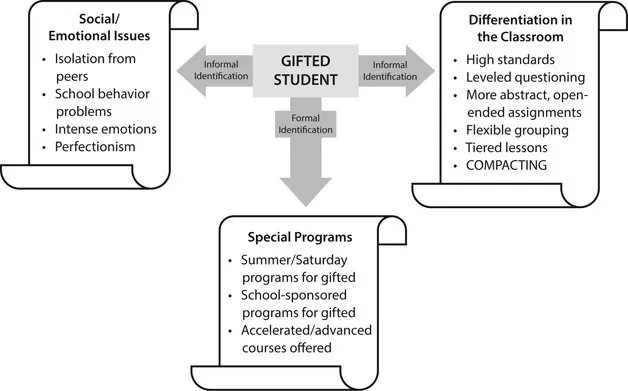
Social-Emotional Issues
Due to their advanced cognitive abilities, gifted students may experience certain issues more intensely than their peers. This leads to certain social and emotional problems that are often misunderstood or ignored (Davis & Rimm, 2004). Here are a few examples of the most common of these issues:
- isolation—difficulty interacting/connecting with peers;
- behavior—frustration and boredom may lead to school behavior problems;
- intense emotions—depression, anxiety about world problems (e.g., hunger, war, and death); and
- perfectionism—intense fear of failure; unrealistic, self-imposed standards.
Many experts in the field have recommended that counseling be an integral part of any program for the gifted (Davis & Rimm, 2004). Although this would be extremely beneficial, the fact remains that school counselors are often overburdened with students. Additionally, many regular school counselors are not trained to understand and counsel gifted students. These students’ social-emotional issues are numerous and serious, but who can help them in their time of need? With the ideal situation in the back of our minds, we need to think about what we as teachers can do now to help gifted students cope with such issues.
Identification. The identification process rooted in social and emotional behaviors is usually quite informal and relies upon observation. Just like a physician, teachers must be able to observe certain behaviors and provide a timely and accurate assessment. Identifying a problem early may make all the difference in a child’s development. To do this, teachers and others in the school building need to have some basic knowledge of these issues.
Simply being aware that there are social-emotional issues connected to giftedness may help teachers and others connect the dots. This minimal goal can be met through a one-time professional development session for the entire school, with the possibility for additional follow-up training for those who express more interest.
Intervention. An understanding and supportive teacher presents the greatest variable in the education of a gifted child. Behavior problems caused by boredom can be remedied through more challenging class work, once a teacher recognizes that there is a need. Students who have difficulty connecting with their peers may benefit from a class or program for the gifted where they will be able to interact with students more like themselves. Teachers can also make parents aware of the issues, recommending that they learn more about their child’s particular issues. Once the problem is identified, the adults in a child’s life will be able to react more appropriately to each situation, and thus ease the often-misunderstood relationship between the adult and the child. Table 1.1 shows how identification can alter the way a teacher reacts to a student’s social and emotional needs.
| Situation | Without Identification | With Identification |
|---|---|---|
| Max is disruptive in class. He frequently interrupts lessons to call out ideas or make a joke. | Max is disciplined with increasing severity. Trips to the vice principal become frequent. Max begins to see himself as the “bad kid” and, fed up with the system, ends up dropping out of high school. | Max’s teacher recognizes that he is bored and frustrated. The teacher begins to provide more challenging work for him and also recommends him for accelerated learning in an advanced course. Max finds renewed interest in school, and by the end of the year, his behavior problems are less evident. |
| Max is very upset every time he receives any grade below 100. | Max’s teacher tells him that his grades are very good and he should be proud of himself. Max is never satisfied by a brief remark, and eventually this fear of failure causes him to underachieve, first by not turning in assignments, and later expresses itself as an unwillingness to participate in any extracurricular activities. | Max’s teacher recognizes aspects of perfectionism, speaks to his parents about it, and together, through suggested resources and strategies, ... |
Table of contents
- Cover
- Half Title
- Title Page
- Copyright Page
- Table of Contents
- Acknowledgements
- Foreword
- Editors’ Note
- Part I: Classroom Practices
- Part II: Curriculum Content
- Part III: Meeting Student Needs
- Part IV: Special Populations
- About the Editors
- About the Authors
- List of Article Publication Dates
Trusted by 375,005 students
Access to over 1.5 million titles for a fair monthly price.
Study more efficiently using our study tools.
Frequently asked questions
Yes, you can cancel anytime from the Subscription tab in your account settings on the Perlego website. Your subscription will stay active until the end of your current billing period. Learn how to cancel your subscription
No, books cannot be downloaded as external files, such as PDFs, for use outside of Perlego. However, you can download books within the Perlego app for offline reading on mobile or tablet. Learn how to download books offline
Perlego offers two plans: Essential and Complete
- Essential is ideal for learners and professionals who enjoy exploring a wide range of subjects. Access the Essential Library with 800,000+ trusted titles and best-sellers across business, personal growth, and the humanities. Includes unlimited reading time and Standard Read Aloud voice.
- Complete: Perfect for advanced learners and researchers needing full, unrestricted access. Unlock 1.5M+ books across hundreds of subjects, including academic and specialized titles. The Complete Plan also includes advanced features like Premium Read Aloud and Research Assistant.
We are an online textbook subscription service, where you can get access to an entire online library for less than the price of a single book per month. With over 1.5 million books across 990+ topics, we’ve got you covered! Learn about our mission
Look out for the read-aloud symbol on your next book to see if you can listen to it. The read-aloud tool reads text aloud for you, highlighting the text as it is being read. You can pause it, speed it up and slow it down. Learn more about Read Aloud
Yes! You can use the Perlego app on both iOS and Android devices to read anytime, anywhere — even offline. Perfect for commutes or when you’re on the go.
Please note we cannot support devices running on iOS 13 and Android 7 or earlier. Learn more about using the app
Please note we cannot support devices running on iOS 13 and Android 7 or earlier. Learn more about using the app
Yes, you can access Teaching Gifted Children by Jeff Danielian,C. Matthew Fugate,Elizabeth Fogarty,Matthew Fugate,Elizabeth A. Fogarty in PDF and/or ePUB format, as well as other popular books in Education & Inclusive Education. We have over 1.5 million books available in our catalogue for you to explore.