This book combines academic research with practical guidelines in methods and techniques to supplement existing knowledge relating to organizational management in the era of digital acceleration. It offers a simple layout with concise but rich content presented in an engaging, accessible style and the authors' holistic approach is unique in the field.
From a universalist perspective, the book examines and analyzes the development of, among others, Industry 4.0, artificial intelligence (AI), AI 2.0, AI systems and platforms, algorithmics, new paradigms of organization management, business ecosystems, data processing models in AI-based organizations and AI strategies in the global perspective. An additional strength of the book is its relevance and contemporary nature, featuring information, data, forecasts or scenarios reaching up to 2030. How does one build, step by step, an organization that will be based on artificial intelligence technology and gain measurable benefits from it, for instance, as a result of its involvement in the creation of the so-called mesh ecosystem? The answer to this and many other pertinent questions are provided in this book.
This timely and important book will appeal to scholars and students across the fields of organizational management and innovation and technology management, as well as managers, educators, scientists, entrepreneurs, innovators and more.
1 Industrial revolution – from Industry 1.0 to Industry 4.0
DOI: 10.4324/9781003184027-1
1.1 Genesis and development of Industry 4.0
From the evolutionary perspective, the development of Industry 4.0 started at the turn of the 18th and 19th centuries, with the transition from craft and manufacture production to mechanized factory production, which became the First Industrial Revolution (Industrial Revolution 1.0). A pioneer of those early transformations was James Watt, a Scottish engineer and inventor from Glasgow, who, in the winter of 1763, received a lucrative, though difficult to complete order regarding improvements in one of the first steam pumps in the UK (Pottin & Dietz, 2018). As it turned out later, for Watt the task became the idée fixe, which did not leave him in subsequent years. The inventor received help from a friendly plumber, whose involvement and – for those times – primitive tools resulted in the design of the steam engine, which was the device’s central drive unit. Watt’s achievement, which was an improvement on the atmospheric steam engine developed by Thomas Newcomen,1 was thereby regarded as a breakthrough in industrial technology and proclaimed a worldwide industrial revolution. In recognition of his achievement, in 1769 Watt was awarded his first patent by the King of England.
In the context of the above, it should be noted that the First Industrial Revolution, beginning around 1760 and ending around 1840, was and is an important part in the world’s economic history, which paved the way for its future development. It began an era of mechanization and the use of a number of (at the time) innovative technical inventions, primarily for the production of energy. The changes that occurred at that time also revolutionized people’s thinking about the workplace and methods of performing work. With mechanization, it was possible to produce the same things in factories eight times faster than before. As a result, for the first time in the world’s history the individual and his/her “costly” work were being substituted by steam machines driven by cheap coal. From the economic point of view, this substitution led to reductions in the earlier costs of production and an almost exponential growth in work efficiency, which was reflected in related profits. Work automation related to the application of the steam machine in the mining industry, or later in textiles, was the largest breakthrough in the history of production. Importantly, the achieved effect was further strengthened by the discoveries that humanity experienced at the beginning of the 19th century, primarily James Neilson’s2 “hot blast” or George Stephenson’s3 steam locomotive. The first of these inventions contributed to a significant reduction in the cost of fuel in metallurgical furnaces, while the second enabled the transportation of cargo across substantial distances in less time. In consequence, civilizational development at the onset of the 19th century became even more dynamic. To a significant extent, which is worth emphasizing, it was a result of efforts of talented engineers, chemists, physicists or technologists, rather than an accident or a gift from the gods.
The term “industrial revolution” was used again in 1936 by the French sociologist and psychologist Georges Friedmann to describe the changes that were taking place in Europe and in the United States during the first half of the 19th century, related to the effects of mass production, which utilized assembly lines, division of labor, development of the human being and that of entire societies.4 It is commonly accepted in literature that the Second Industrial Revolution (Industrial Revolution 2.0) falls in the period 1870–1914. This means that, after one hundred years from the beginning of the First Industrial Revolution, the world and humanity had to face another one, this time characterized by even greater upgrades and challenges. The greatest innovations connected with the Second Industrial Revolution era, which strongly affected the dynamics of industrial development at that time, were directly linked to two new energy sources: electricity (electric motor) and oil and natural gas (internal combustion engine). With them, the industrial world witnessed a sudden transition from conventional production methods to more innovative ones, based on new technologies, which changed the earlier processes of manufacturing and processing goods that took place in the majority of British and US factories. However, the changes, important from the point of view of technology and innovation, were taking place not only in industry, but also in communications or transportation. In the case of communications a considerable role for human development and the world was played initially by the telegraph,5 which revolutionized communication systems and allowed people to communicate remotely and then by the telephone,6 the forefather of the smartphone, which is now considered the foundation of contemporary communication systems. In transportation, groundbreaking for that era and later also the world’s further history, were discoveries by US aviation pioneers, the Wright brothers.7 It is thanks to their talent that the airplane became a new means of transport, and distance ceased to be of significance. In addition, the principles of mechanics and steering in aviation that they developed remain the standard of aircraft design to this day. The American industrialist Henry Ford also had an invaluable contribution to the development of transport at that time. The first prototype of the car he built in 1896 marked the beginning of the development of the automotive sector, which changed forever people’s thinking about transport, distances and time. Significantly from the point of view of work organization, Ford performed a true revolution by introducing a moving assembly line to his factories, and forever changed the layout of production plants, shift-based work systems, thinking about cost and profits in companies and occupational safety.
The Second Industrial Revolution, unlike the first one, was primarily characterized by the fact that it was supported, to a large extent, by an appropriate scientific base, which in practice allowed for better and more effective use of (previously known) processes and made technology more effective (utile) (Mokyr & Strotz, 2000). In addition, it changed the world’s thinking about organization of production, mainly due to a surge in industrial efficiency and the phenomenon of economies of scale. The standard of living was also improving gradually, although not very significantly. However, as noticed by Mokyr and Strotz (2000), technological leadership was still monopolized at the time by the industrialized Western world.
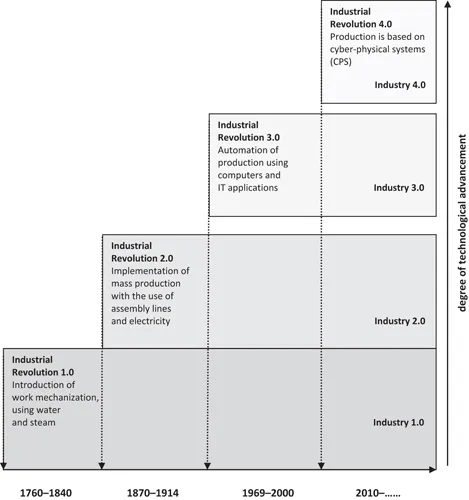
An opinion can be proposed that, while the First Industrial Revolution prepared the ground for the development of the Second Industrial Revolution, the Second Industrial Revolution, in particular in the area of skillful use of knowledge and technology, prepared a stable ground for the development of the Third Industrial Revolution (Industrial Revolution 3.0) (see Figure 1.1). It is commonly assumed in the literature that it lasted from 1969 to 2000. However, for clarity of analysis, this period can be divided into two sub-periods: the first one from 1969 to 1989 and the second one from 1990 to 2000. The first sub-period was distinguished by the introduction of the first programmable logical controllers8 (earlier: sequential logical controllers), which were in fact microprocessor devices intended to control the work of machines or other technological devices, including personal computers and production lines. Thanks to their application, in 1987 computers could start “cooperating” with the first professional office applications, which irreversibly revolutionized organization management methods. The second of the listed sub-periods covers the years of dynamic development of the Internet and the growing digitization of work, which, through their influence, determined new paradigms of life for individuals and entire societies. As a result, Industrial Revolution 3.0 created millions of new workplaces and paved the way for the development of the sustainable global economy of the 21st century, based on renewable energy resources. Therefore, the whole “strategy” of the Third Industrial Revolution, in the opinion of Rifkin (2012), is based on five pillars, inseparably inter-related, and is connected with:
Figure 1.1 From Industry 1.0 to Industry 4.0 – stages of evolution. Source: Study based on Deloitte (2015).
first – shifting to renewable energy,9
second – transformation of available buildings on each continent into micro power plants, which are to collect scattered renewable energy,
third – implementation of a technology for intermittent energy storage,
fourth – use of IT and online technologies to convert power transmission and electric lines into the so-called energy internet,
and fifth – transitioning...
Table of contents
Cover
Half-Title
Series
Title
Copyright
Contents
List of tables
List of figures
Preface
Acknowledgments
1 Industrial revolution – from Industry 1.0 to Industry 4.0
2 Artificial intelligence (AI) – a new technology in the postmodern era
3 Organizations in the artificial intelligence era
4 Artificial intelligence development strategies on the global arena
Summary
Bibliography
Index
Trusted by 375,005 students
Access to over 1.5 million titles for a fair monthly price.
Study more efficiently using our study tools.
Frequently asked questions
Yes, you can cancel anytime from the Subscription tab in your account settings on the Perlego website. Your subscription will stay active until the end of your current billing period. Learn how to cancel your subscription
No, books cannot be downloaded as external files, such as PDFs, for use outside of Perlego. However, you can download books within the Perlego app for offline reading on mobile or tablet. Learn how to download books offline
Perlego offers two plans: Essential and Complete
Essential is ideal for learners and professionals who enjoy exploring a wide range of subjects. Access the Essential Library with 800,000+ trusted titles and best-sellers across business, personal growth, and the humanities. Includes unlimited reading time and Standard Read Aloud voice.
Complete: Perfect for advanced learners and researchers needing full, unrestricted access. Unlock 1.5M+ books across hundreds of subjects, including academic and specialized titles. The Complete Plan also includes advanced features like Premium Read Aloud and Research Assistant.
Both plans are available with monthly, semester, or annual billing cycles.
We are an online textbook subscription service, where you can get access to an entire online library for less than the price of a single book per month. With over 1.5 million books across 990+ topics, we’ve got you covered! Learn about our mission
Look out for the read-aloud symbol on your next book to see if you can listen to it. The read-aloud tool reads text aloud for you, highlighting the text as it is being read. You can pause it, speed it up and slow it down. Learn more about Read Aloud
Yes! You can use the Perlego app on both iOS and Android devices to read anytime, anywhere — even offline. Perfect for commutes or when you’re on the go. Please note we cannot support devices running on iOS 13 and Android 7 or earlier. Learn more about using the app
Yes, you can access Management, Organisations and Artificial Intelligence by Bartosz Niedzielski,Piotr Buła in PDF and/or ePUB format, as well as other popular books in Business & Business General. We have over 1.5 million books available in our catalogue for you to explore.