"An illuminating and entertaining read . . . an analytical assessment of the two figures who led the Lancastrian faction during the Wars of the Roses." —
History . . . The Interesting Bits!
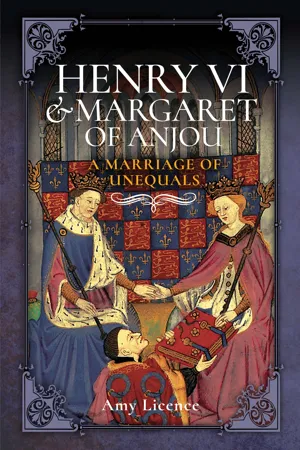
He became king before his first birthday, inheriting a vast empire from his military hero father; she was the daughter of a king without power, who made an unexpected marriage at the age of fifteen. Almost completely opposite in character, together they formed an unlikely but complimentary partnership.
Henry VI and Margaret of Anjou have become famous as the Lancastrian king and queen who were deposed during the Wars of the Roses but there is so much more to their story. The political narrative of their years together is a tale of twists and turns, encompassing incredible highs, when they came close to fulfilling their desires, and terrible, heart-breaking lows. Personally, their story is an intriguing one that raises may questions. Henry was a complex, misunderstood man, enlightened and unsuited to his times and the pressures of kingship. In the end, overcome by fortune and the sheer determination of their enemies, their alliance collapsed. England simply wasn't ready for a gentle king like Henry, or woman like Margaret who defied contemporary stereotypes of gender and queenship.
History has been a harsh judge to this royal couple. In this discerning dual biography, Amy Licence leads the way in a long-overdue re-evaluation of their characters and contributions during a tumultuous and defining period of British history.
"A delight to read . . . A fresh new look at this power couple." —
Adventures of a Tudor Nerd
- 216 pages
- English
- ePUB (mobile friendly)
- Available on iOS & Android
eBook - ePub
About this book
Information
Chapter One
Henry 1421–1444
I
The most famous of all medieval illuminations was created just a few years before the birth of Henry VI. Depicting the labours of the months of the year, the Très Riches Heures de Duc de Berri was illustrated between 1412 and 1416, in dazzlingly bright blues, reds and golds on calfskin, all watched over by the twelve zodiac signs moving through the arc of the heavens. January represents a splendid feast, where the duke in flowing robes sits behind a table laden with food; in March, a golden dragon flies above the white-walled Chateau, while April is devoted to the pursuits of love. In May, young aristocrats dress in the latest fashions to ride to the sound of trumpets, they hunt with falcons in August and chase the boar to its death in December. Reproduced on modern calendars and postcards, their gothic castles and stylised scenes represent an idealised glimpse into the romance of medieval life, six centuries ago, a simulacrum that fuels fiction, a misleading idyll, a fairy tale.
And yet, the labours of the months depicts a second narrative too. In the depths of the February snow, one peasant chops wood while another drives an ass to market; in March they sow the fields; in the summer months they harvest and shear the sheep; September sees them picking the grapes; in October they plough and till, while November has them watching the pigs, fattening them with acorns ahead of the traditional Martinmas slaughter. But the pigs don’t die in the pretty woodland scene, with its exquisite clump of trees, each leaf lovingly delineated. They will be slaughtered elsewhere, in order to furnish the duke’s table. The Très Riches Heures is a reminder that the world in 1421 encompassed extremes of wealth and poverty, of dazzling castles full of cupboards of gold plate and wooden hovels where clothes hang from the walls to dry. There are labourers in plain, torn garments, giving a bawdy glimpse of the thigh or the buttocks, and women in immaculate white wimples, trailing gold ornament. A golden-haired lady with feathers in her hat receives a ring from a lover while a heavily pregnant grape-picker pauses for a moment amid her work. Rich and poor live side by side, both dependent upon the land, both certain of their place in the world and the relative freshness of their linen.
Perhaps the most significant aspect of medieval life is conspicuously absent from the labours of the months. However, the Catholic faith suffuses the rest of the Très Riches Heures, implicit in its very name. The labours comprise only a small percentage of the text, while the remainder is made up of prayers and reflections, intended to be read at times of the canonical hours, which were the daily times designated by the church for worship. Containing psalms, readings, prayers and masses, the theme of the manuscript is the powerful faith that provided the framework for the secular lives of all classes, from castle-dwellers to the field-workers. The churches of England and France were the largest landowners after the crown and wielded significant political influence. Religious belief and practices were never far away, underpinning the structure of each day and the thinking of Henry and his contemporaries. Thus, life in the 1420s, when Henry was born, was defined by religion and duty, leisure and pleasure, within the context of the social hierarchy and the church.
In demographic terms, 1420 was a year of transition. England and France had been through a devastating period of plague, revolt and famine, decimating the population and emptying villages. Estimates at population have offered figures for England of 3 million and France of 14 million in 1400, which were equal, or less, to what they had been a century before.1 By the time of Henry’s birth however, the tide was starting to turn. His father’s successes in France had contributed to a sense of national identity and pride, the flourishing wool industry created new wealth and population began to climb. Less than a fifth of English people lived in a town, perhaps even as few as only ten per cent, but the country’s infrastructure began to grow following the investment of a new gentry class. New churches sprung up across Suffolk and Norfolk, decorated in the gothic style, dwarfing the scattering of households they were intended to serve. Fortunes were made in trade and money lending, with perhaps the most famous example being London’s mayor, Richard ‘Dick’ Whittington, who served his fourth and final term in 1419–20. He founded a library at London’s Guildhall, a hospital for illegitimate births, fresh public drinking fountains and public toilets, before leaving the equivalent of £3 million in his will to charity. London’s livery companies flourished, raised imposing new buildings in which to conduct their business and received royal charters. Although many of the old dangers still lurked on the horizon, a cautious new sense of optimism began to be felt in the corridors of Westminster Palace and among the farmers’ ridges and furrows.
Henry VI was born at Windsor Castle on 6 December 1421. Built of sturdy grey stone, it had been remodelled by Edward III, using money from his success in the wars against France. He had created three courts, new gateways, a chapel and hall with large windows, luxurious royal apartments and a mechanical clock, totalling over £50,0002 of work over two decades prior to Edward’s death in 1377, more than was spent on any other building by any medieval king.3 Further work and modernisation had taken place under his son, Richard II, making Windsor the most advanced, comfortable castle of its age. Catherine of Valois, who was used to the Parisian splendour of the Louvre and Hôtel St Pol, chose it as her residence and delivered her son there.
Henry arrived on the feast day of St Nicholas, a date associated with gift-giving and the election of ‘boy-bishops’, when a child was chosen from among the choristers to enact a parody of real ecclesiastical duties, inverting the usual order of age and experience. Yet this was not just a humorous custom. By association, Henry’s birthdate marked both generosity and the exaltation of the humble and meek over the mighty. John Capgrave, the Norfolk historian, who was a teacher of 28 in 1421, saw a divine significance in the day of Henry’s arrival, considering that it was ‘not without a reason that certain great men have herded together on certain days of greater desert than others’. He added that it was also the month in which the ‘Blessed Virgin was conceived’ and ‘the Saviour of the World was born’, drawing the conclusion that ‘he who is born at a holy season may imitate His holy life’. Capgrave also commented that Henry had taken after St Nicholas, as both men lived restrained, abstemious lives and had remained dignified when raised to power.4 Henry was probably christened in the chapel at Windsor, with his uncles Henry Beaufort, Bishop of Winchester and John, Duke of Bedford as godfathers and his aunt by marriage, Jacqueline, Duchess of Hainault, as godmother. Only the fourth godparent, Henry Chichele, Archbishop of Canterbury, was unrelated to the baby.5
Henry was quickly established in his own nursery, independent of his mother. Payments recorded in the Patent Rolls tell us that his main nurse was a Joan Astley, or Asteley, whose husband Thomas was also in royal service. As the recipient of £20 a year, Joan was clearly more important than Matilda Foebroke, his day-nurse who received £10, or Agnes Jakeman and Margaret Brotherham, both described as ‘chamberer and laundress’, at salaries of 100s a year.6 Henry remained in the care of his nurses until the end of April 1423, by which time he was 16 months old, and probably beginning to walk. The following month he was reported to be ‘in perfect health’7 and when Joan Asteley relinquished her role, her annuity doubled to £40 as a reward.8 Her place in the boy’s household was taken by a Dame Alice Butler, or Botiller, an expert on ‘courtesy and nature’, who would have been Henry’s first teacher and advised on the spending of his household’s budget.9 By the end of 1426, at the time of Henry’s fifth birthday, her role came to an end, and she was granted 50 marks a year for life.10
In a significant move that marked the end of Henry’s babyhood, Alice Butler’s replacement was male. On 1 June 1428, Richard Beauchamp, Earl of Anjou of Warwick, was appointed as the young king’s guardian, at a salary of 250 marks. Beauchamp was then aged 46 and already had years of distinguished royal service behind him. His father, Thomas, had been governor to the boy-king Richard II, a relationship that influenced the choice of the king as young Beauchamp’s godfather, back in 1382. As a young man, he had fought alongside the future Henry V at the decisive Battle of Shrewsbury, defeating the Welsh and being created a Knight of the Garter. He had continued to serve Henry after his accession as king in 1413, acting as Lord High Steward at his coronation, serving on the royal council, fighting alongside Henry in French sieges, becoming Captain of Calais and Master of the Horse. There was also a deeply devout side to Beauchamp, who had undertaken a lengthy pilgrimage to the Holy Lands. He had been present at the death of Henry V at Vincennes, where the dying king named him as the man to oversee his young son’s education.
When it came to the infant king of England, it was not merely a question of raising the boy and furnishing him with a suitable education. The country also needed to be run until he came of suitable age to play a more active role in government. Beauchamp had been part of the minority council established in 1422 when the political transition from father to son had been surprisingly smooth. On the unexpected early death of Henry V, which provoked an outpouring of national grief, it would appear that the country, personified by its leading nobles and prelates, wanted England to be ruled by Henry V’s son. There was no question about the boy’s legitimacy, or health, and no challenge was mounted to his accession. This shows just how far the Lancastrian dynasty had secured its position in the space of three generations, since Henry IV had usurped his cousin, Richard II. Just twenty-three years after that event, the baby Lancastrian grandson was considered the legitimate heir in spite of the existence of Edmund Mortimer, a fully-grown man of 31, whose line had been nominated by the childless Richard II as his heirs. Mortimer had the advantage of birth and maturity, but in 1422, no one championed his cause over that of the infant Henry VI. In fact, Mortimer was one of the seventeen men appointed to the Regency Council and the following year, he was appointed to be Lieutenant of Ireland at an annual salary of 5,000 marks; a further quarrel with the king’s uncle, Humphrey of Gloucester, neatly removed him from the picture before his early death from plague.11 The Council had come together by September that year, being formally sworn into their duties on 9 December, to ‘assist’ in the government of the realm ‘during the tender age’ of the king.12 They were charged to remain impartial, honest, confidential and loyal, under the rule of the two men whose influence upon the infant Henry was due to their relation to him.
Henry V had been survived by two of his three brothers. As the king’s uncles, it was perhaps inevitable that two such experienced, ambitious men would not wield or relinquish power easily. John of Lancaster, Duke of Bedford, was one of the most wealthy, cultured men of his age, who had been appointed Lieutenant of England during Henry V’s French campaigns. He had proved an effective, efficient ruler, acting swiftly to repel enemies, whether it was the Scots or traitors within government, and had commanded a fleet to lift the blockade of Harfleur harbour, an essential port for English access to France. Until 1422, John would have been a natural choice as protector during a royal minority, with Lancastrian possessions across the Channel being governed by their elder brother, Thomas. But Thomas’s death in 1421 led Henry V to name Bedford as regent of France, with the guardianship of the young king being given to their youngest brother Humphrey, Duke of Gloucester. This was a reversal of their former roles, which had established England as Bedford’s sphere of influence, while Gloucester had been Thomas’s deputy in France, and was to create a degree of tension between the brothers that was never satisfactorily resolved.
The other most significant influence during Henry’s childhood years was his mother, Catherine of Valois. The codicil Henry V added to his will in August 1422, bequeathed ships and jewellery to be sold in order to pay for the upbringing of his son, who was expected to remain with his mother. In spite of her nationality and youth, coupled with her diminished status as a widow, Catherine’s right to remain with her son was never challenged. Nor, does it seem, did she ever seriously consider returning to her native France. Her dower payment was generously settled by Parliament at 40,000 crowns, a larger sum than that which had been specified by the Treaty of Troyes. Henry had also left her income from his Lancastrian estates, including those of the de Bohun line, which he inherited from his mother, so she was well provided for. Still very young and relatively new to queenship, Catherine’s character remains elusive beyond her reputation for beauty and that which has been extrapolated by historians regarding her supposed ‘romantic’ tendencies and love of pleasure. She wielded little political influence over her son or the course of his early reign, but neither she, nor the council, would have expected her to play a role in statescraft; her influence was essentially of the nurturing, domestic kind.
The first official record of Henry and his mother together dates from 1423, when he was approaching his second birthday. The London Chronicle records that upon Saturday 13 November, Catherine brought her son from Windsor, in order to be present at the second Parliament of his reign, which had assembled in October under the speaker Sir John Russell. They spent Saturday night at Staines, seven miles from Windsor and around twenty miles to the south-west of their destination of Westminster Palace, but on the Sunday morning, as Henry was carried to his mother’s ‘chare,’ or chariot, he ‘schriked and cryed and sprang, and wolde nought be caryed forthere’. He was carried back into the inn, where he remained all day, appearing happy to travel again on Monday. That day they went as far as Kingston, reached Kennington on Tuesday and arrived in Westminster on Wednesday, where Henry was carried in his mother’s arms ‘with a glad sembland and mery chere’.13 This incident was cast in a religious light by some of Henry’s contemporaries, and hinted at in the chronicle, as an innate sign of the infant’s piety that he would not travel upon a Sunday.
On 16 November, Henry and Catherine left Windsor and travelled to Waltham, ‘a certen tyme there were abiding’.14 They would have stayed at the manor house of Great Waltham, which had been part of the dowager’s de Bohun legacy, favoured by the royal family for its proximity to the forest and the opportunities for hunting. Founded in the twelfth century on the site of an existing church, the nearby Abbey was one of the largest churches in England and, as Henry’s reign coincided with a surge in pilgrimage, it would have been busy as visitors flocked to see its primary relic, the Holy Cross. From there, they travelled the twelve miles north to Catherine’s other property, Hertford Castle, where Henry was to spend significant periods of his childhood. Once the possession of his paternal great-grandfather, John of Gaunt, it had also provided a home to Catherine’s elder sister Isabella, the young bride of Richard II in the 1390s. They stayed at Hertford for the Christmas season, where they were joined by another young man who knew the house well and for a few years was like another member of the family, perhaps even providing a role model for the infant king.
The uncrowned King James I of Scotland, a handsome, poetic, romantic figure, was 29 years old by the time he celebrated Christmas with the King of England and the dowager queen. Following the murder of his elder brother, he had been smuggled out of Scotland to escape his enemies, but his ship had been seized by the English and he became a prisoner of Henry IV in 1406. Just weeks later, his father died, and the 12-year-old captive became king. Since then, he had been treated like a king in exile; educated, entertained, provided for and invited to play an active role in court life. As part of the household of Henry V, James had accompanied the king to France and been knighted in 1421; he had sat at Catherine’s side during her coronation banquet and accompanied her back to England after her husband’s death. He was Catherine’s only friend at court who was of an equal status, as well as understanding the difficulties of being a foreigner in England. The evidence suggests that their similarities led to the development of a close, sympathetic connection, that provided mutual support to them both. If there were ever any deeper feelings involved, no record survives of it, and the resulting complexities of a potential union between the two, which would hav...
Table of contents
- Cover
- Title
- Copyright
- Contents
- Dedication
- Introduction
- Prologue
- Chapter One Henry 1421–1444
- Chapter Two Margaret 1430–1444
- Chapter Three Marriage 1445
- Chapter Four The Young Wife 1445–1453
- Chapter Five Madness 1453–1455
- Chapter Six War 1455–1458
- Chapter Seven Disaster 1459–1460
- Chapter Eight Civic Chaos 1461
- Chapter Nine Royals in Waiting 1461–1470
- Chapter Ten Readeption 1470–1471
- Chapter Eleven The Prisoner 1471–1482
- Notes
- Bibliography
- Acknowledgements
- Plate section
Trusted by 375,005 students
Access to over 1.5 million titles for a fair monthly price.
Study more efficiently using our study tools.
Frequently asked questions
Yes, you can cancel anytime from the Subscription tab in your account settings on the Perlego website. Your subscription will stay active until the end of your current billing period. Learn how to cancel your subscription
No, books cannot be downloaded as external files, such as PDFs, for use outside of Perlego. However, you can download books within the Perlego app for offline reading on mobile or tablet. Learn how to download books offline
Perlego offers two plans: Essential and Complete
- Essential is ideal for learners and professionals who enjoy exploring a wide range of subjects. Access the Essential Library with 800,000+ trusted titles and best-sellers across business, personal growth, and the humanities. Includes unlimited reading time and Standard Read Aloud voice.
- Complete: Perfect for advanced learners and researchers needing full, unrestricted access. Unlock 1.5M+ books across hundreds of subjects, including academic and specialized titles. The Complete Plan also includes advanced features like Premium Read Aloud and Research Assistant.
We are an online textbook subscription service, where you can get access to an entire online library for less than the price of a single book per month. With over 1.5 million books across 990+ topics, we’ve got you covered! Learn about our mission
Look out for the read-aloud symbol on your next book to see if you can listen to it. The read-aloud tool reads text aloud for you, highlighting the text as it is being read. You can pause it, speed it up and slow it down. Learn more about Read Aloud
Yes! You can use the Perlego app on both iOS and Android devices to read anytime, anywhere — even offline. Perfect for commutes or when you’re on the go.
Please note we cannot support devices running on iOS 13 and Android 7 or earlier. Learn more about using the app
Please note we cannot support devices running on iOS 13 and Android 7 or earlier. Learn more about using the app
Yes, you can access Henry VI & Margaret of Anjou by Amy Licence in PDF and/or ePUB format, as well as other popular books in History & Historical Biographies. We have over 1.5 million books available in our catalogue for you to explore.