"Schattenberg has done a service in rescuing the Brezhnev period from obscurity." The Morning Star
"[Offers an] unparalleled examination of the Brezhnev papers." Literary Review
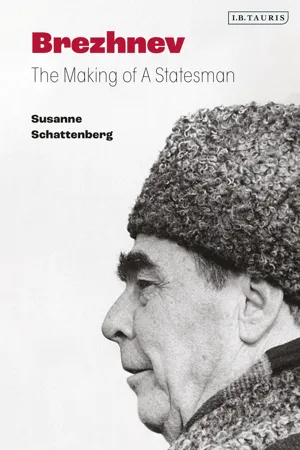
Leonid Brezhnev was leader of the Soviet Union for eighteen years, a term of leadership second only in length to that of Stalin. He presided over the Brezhnev Doctrine, which accelerated the Cold War, and led the Soviet Union through catastrophic foreign policy decisions such as the invasion of Afghanistan. To many in the West, he is responsible for the stagnation (and to some even collapse) of the Soviet Union. But much of this history has been based on the only two English-language biographies (both published before Brezhnev's death and without access to archival sources) and Brezhnev's own astonishingly untrue memoirs – written for propaganda purposes.
Newly translated from German, Schattenberg's magisterial book systematically dismantles the stereotypical and one-dimensional view of Brezhnev as the stagnating Stalinist by drawing on a wealth of archival research and documents not previously studied in English. The Brezhnev that emerges is a complex one, from his early apolitical years, when he dreamed of becoming an actor, through his swift and surprising rise through the Party ranks. From his hitherto misunderstood role in Khrushchev's ousting and appointment as his successor, to his somewhat pro-Western foreign policy aims, deft consolidation and management of power, and ultimate descent into addiction and untimely death. For Schattenberg, this is the story of a flawed and ineffectual idealist - for the West, this biography makes a convincing case that Brezhnev should be reappraised as one of the most interesting and important political figures of the twentieth century.
- 512 pages
- English
- ePUB (mobile friendly)
- Available on iOS & Android
eBook - ePub
About this book
Information
1
Dreams of the Stage, or an Ordinary Soviet Man
Our photograph shows Leonid Brezhnev and his siblings Vera and Yakov lined up before a theatre curtain. Brezhnev, the eldest, aged eighteen, is on the far left, with visibly sunken cheeks. Two things make this photograph remarkable. Firstly, there are no other images of Brezhnev looking so thin and emaciated, and secondly, the three of them are shot as an amateur dramatics troupe; nothing about them is revolutionary, even though the picture was taken in 1924: neither their dress nor their pose are suggestive of Bolsheviks, the proletariat or their victory. On the contrary, Brezhnev is wearing a white shirt with a tie and a dark jacket, not a party shirt or soldier’s coat. His hair is worn smoothed down in a side parting and his posture is upright as he looks straight into the camera. Like his siblings, he appears severe and bourgeois; hence it is hardly surprising that although there are very few photographs of the young Brezhnev, this one did not find its way into any official works or albums depicting the general secretary. It shows a Brezhnev that officially never existed: a young, well-educated man with delicate facial features hollowed by the famine of 1921/22. And what it does not show would also be hushed up: a Brezhnev barely interested in politics who at the time the photograph was taken had only just joined the Komsomol, the Bolshevik youth organization, and who dreamed of becoming an actor.
While the official biographies constructed his career as a linear path to the office of general secretary and his Western biographies also perceived him as an enthusiastic Stalinist who fulfilled the tasks he was given with distinction and Bolshevik enthusiasm, it appears Brezhnev was not remotely passionate about politics. If we tell his life story not in terms of its end point as general secretary but by comparing the young Brezhnev to his contemporaries in the 1910s and 1920s, he hardly appears predestined to become the most powerful man in the communist world. On the contrary, he appears almost apolitical, a young man trying to avoid contact with the new political organizations and transformations for as long as possible. If we try to view him without prejudice, then what we notice is not political enthusiasm, passion for the Bolsheviks or leadership qualities, but the struggle for sheer survival.
Revolution, civil war and collectivization were not challenges Brezhnev sought, but events that disrupted and eventually destroyed his hitherto quiet, orderly life. His development was driven not so much by revolutionary fervour as by pure survival instinct: he took flight whenever circumstances became difficult or threatening. He first fled with his family to Kursk in 1921, to escape famine and unemployment in Ukraine; the second time was in 1930, when he moved to the city to escape the civil-war-like situation in the Urals at the height of dekulakization and collectivization; the same year, he fled for a third time, leaving Moscow due to the accommodation crisis. Admittedly, given the paucity of sources, or the restricted access to them, it is also difficult to demonstrate that Brezhnev was a ‘quite ordinary Soviet man’ principally interested in his own life and survival with little enthusiasm for Bolshevism. There are merely indications, such as the photograph described above, pointing to Brezhnev the apolitical amateur thespian.
Striving for education and bourgeois prosperity
Such an indication of Brezhnev’s apolitical stance is the absence in his ‘memoirs’ of effusive and specific enthusiasm for the October Revolution and subsequent events. In the Soviet Union, it was commonplace for the memoirs of convinced communists to depict the victory of the Soviet forces with greater ardour and to interweave the authors’ own personal development with the battles and Bolshevik victories: liberation from violent fathers or exploitative factory foremen; joining the Red Guard and fighting in the Civil War; working for the party or trade union in the 1920s to help develop the young state; considering the day they joined the party the happiest of their lives; being sent to study and beginning a career in the economy and in some cases in politics. Brezhnev’s ‘memoirs’ include none of this, which is all the more astonishing given they were composed as an ‘ideal biography’: it seems Brezhnev’s life offered the ghostwriters so little to go on they settled on very general clichés ‘proving’ his enthusiasm for the Bolsheviks and his identifying with the proletariat lest the narrative become completely implausible.
‘I was lucky enough to be born, grow up and become toughened by labour in a worker’s family in a large working-class settlement. One of the earliest and strongest impressions of my childhood was the factory whistle. I remember that the dawn would just be breaking when my father was already in his overalls and mother was seeing him off at the door’, Brezhnev’s ‘memoirs’ ‘Life by the Factory Whistle’ begin.1 In order to be a legitimate party secretary it was of great importance to have a working-class background. But since Brezhnev’s birth certificate was removed from the district records, there is wide-ranging speculation as to his true provenance.2 The theories range from claims he was really a Pole who had been adopted to the assumption that his family was not working, but middle class. The curator of the history museum in Brezhnev’s home city of Kamenskoye, Natal’ya Bulanova, suspects the records were purged to hide the fact that Brezhnev had been baptized, which would have severely blemished a purely proletarian biography.
This second rumour developed on the basis that from 1915 onwards, Brezhnev attended the local grammar school, which was reserved for the sons of factory owners, engineers and clerks. This is justified in his ‘memoirs’ by the explanation that only one in fifteen working-class children was selected and in his year there had been six other sons of workers. ‘They called us “State Scholarship holders”. This did not mean that we received a grant, but only that if we achieved spectacular successes they would let us off paying for instruction. The fee was excessive – 64 gold roubles. Even the most highly qualified worker did not earn that much, and of course father, however much he wanted to, could not pay that amount.’3

Figure 3 Brezhnev family photograph: the mother standing, the father sitting with Brezhnev’s siblings Yakov and Vera, Leonid standing on the right in his grammar school uniform, 1915.
It seems relatively certain that Brezhnev’s father was a member of the working intelligentsia.4 These workers did not primarily desire the collapse of the existing order, but sought to rise within that society in order to live a bourgeois life themselves; the path was not revolution, but education. This would explain why Brezhnev’s parents presumably did everything they could to give their son the best possible schooling.
There are two further pieces of evidence indicating his family belonged to the working intelligentsia: firstly, both his father and his mother could read, which was highly unusual for ordinary workers.5 Secondly, there is an early photograph of the Brezhnev family from 1915 in which Leonid is pictured wearing a grammar school uniform while his sister Vera is in a white dress, his younger brother Yakov in a white shirt. The two younger siblings are leaning on the father, who is seated, in a suit complete with waistcoat and a high-necked white shirt; the mother is behind them in a white blouse and dark skirt. Both the type of clothing and the taking of such a family photograph suggest that the Brezhnevs led a life in accordance with bourgeois values. Ordinary workers could not afford Sunday best or a visit to a photographer’s studio.
Childhood in Kamenskoye, 1906–1917
Brezhnev’s father Il’ya Yakovlevich Brezhnev (1880–1937) and the parents of his mother Natal’ya Denisovna Mazolova (1886–1975) left Russia for Ukraine around the turn of the century, in search of work. Kamenskoye was a small, tranquil settlement on the Dnieper until 1878, when engineers from Warsaw founded an ironworks and railway track factory. In 1886 the factory became part of the South Russia Company, under Belgian, Polish, German and French management. In 1887, the first two blast furnaces were built, becoming operational in 1889.6 The settlement then quickly shot up around the factory, which also grew, primarily producing railway tracks. In 1897, Kamenskoye had a population of around 26,000; by 1917 it had grown to 100,000.7 This was the heyday of industrialization in Russia and it was quite typical for investors to be from abroad. In 1892, the factory employed around 3,000 workers, most of whom had migrated from the north-western governorates of the Russian Empire; their Russian became mixed with the Ukrainian of the local peasants and the Polish and French of the engineers and factory management.8 Along with churches – two Orthodox, one Catholic and one Protestant – there sprung up a w...
Table of contents
- Cover
- Half-Title Page
- Title Page
- Epigraph
- Contents
- List of Illustrations
- Glossary and list of abbreviations
- Leonid Brezhnev: Chronology of life events
- Note on translation
- Introduction
- 1 Dreams of the Stage, or an Ordinary Soviet Man
- 2 ‘How the Steel was Tempered’, or a Career Amidst Terror and War
- 3 In Stalin’s Shadow, or a General Secretary’s Apprenticeship I
- 4 Under Khrushchev, or a General Secretary’s Apprenticeship II
- 5 The Caring General Secretary, or Collective Leadership as Theatre
- 6 Live and Let Live, or ‘Everyone should be able to live and work in peace’
- 7 ‘Developed Socialism’, or Re-launching the Soviet Project?
- 8 Emotions and Pills in the Cold War, or How to Play the Western Statesman
- 9 Craving Glory and Physical Decline, or the Loneliness of the General Secretary
- Epilogue
- Notes
- Sources and Bibliography
- Index
- Copyright
Trusted by 375,005 students
Access to over 1.5 million titles for a fair monthly price.
Study more efficiently using our study tools.
Frequently asked questions
Yes, you can cancel anytime from the Subscription tab in your account settings on the Perlego website. Your subscription will stay active until the end of your current billing period. Learn how to cancel your subscription
No, books cannot be downloaded as external files, such as PDFs, for use outside of Perlego. However, you can download books within the Perlego app for offline reading on mobile or tablet. Learn how to download books offline
Perlego offers two plans: Essential and Complete
- Essential is ideal for learners and professionals who enjoy exploring a wide range of subjects. Access the Essential Library with 800,000+ trusted titles and best-sellers across business, personal growth, and the humanities. Includes unlimited reading time and Standard Read Aloud voice.
- Complete: Perfect for advanced learners and researchers needing full, unrestricted access. Unlock 1.5M+ books across hundreds of subjects, including academic and specialized titles. The Complete Plan also includes advanced features like Premium Read Aloud and Research Assistant.
We are an online textbook subscription service, where you can get access to an entire online library for less than the price of a single book per month. With over 1.5 million books across 990+ topics, we’ve got you covered! Learn about our mission
Look out for the read-aloud symbol on your next book to see if you can listen to it. The read-aloud tool reads text aloud for you, highlighting the text as it is being read. You can pause it, speed it up and slow it down. Learn more about Read Aloud
Yes! You can use the Perlego app on both iOS and Android devices to read anytime, anywhere — even offline. Perfect for commutes or when you’re on the go.
Please note we cannot support devices running on iOS 13 and Android 7 or earlier. Learn more about using the app
Please note we cannot support devices running on iOS 13 and Android 7 or earlier. Learn more about using the app
Yes, you can access Brezhnev by Susanne Schattenberg in PDF and/or ePUB format, as well as other popular books in Politics & International Relations & Political Biographies. We have over 1.5 million books available in our catalogue for you to explore.