The Making of Eurasia investigates the multi-layered spectrum of China and Russia's Eurasian policies towards each other, ranging from competition to cooperation, as well as the role of regional actors in between. The book examines the impact of and responses to the dynamic Sino-Russian interaction in the wake of China's Belt and Road initiative, focusing on the selected case studies of Kazakhstan, Mongolia and Uzbekistan, but also on inter-regional implications across the Eurasian space. With China's imprint on inter-regional politics and ambition to make a distinctive Chinese contribution to 'globalization' and Russia's vision of a 'Greater Eurasia' in which Moscow stakes out a place for itself as an indispensable power, other regional actors adopt policies that respond to and co-shape the resulting centrifugal forces.
Meanwhile, power shifts are underway on a global plane, as the normative divide between Russia and the West has widened, and as the Sino-American rivalry is intensifying. The book therefore also sheds light on the effects of Eurasian power shifts on global governance in a context where global 'leadership' is contested, and in which the US and Europe are re-defining their relationship not only towards a self-confident China but also towards each other. As such, this study will provide valuable insight for students and scholars of Eurasian Asia Studies, Foreign Policy Analysis, and International Relations at large.
eBook - ePub
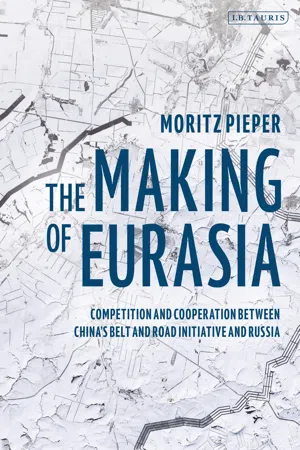
The Making of Eurasia
Competition and Cooperation Between China’s Belt and Road Initiative and Russia
- 184 pages
- English
- ePUB (mobile friendly)
- Available on iOS & Android
eBook - ePub
The Making of Eurasia
Competition and Cooperation Between China’s Belt and Road Initiative and Russia
About this book
Information
1
The making of Eurasia
On 23 June 2016, as international attention focused on the Brexit vote in the UK, the heads of government of China, Mongolia and Russia witnessed the signing of a plan to establish the ‘China-Mongolia-Russia Economic Corridor’. This was the result of Mongolian lobbying efforts for its inclusion in what came to be called the ‘Silk Road Economic Belt’ that Chinese President Xi Jinping had first outlined during a speech in Kazakhstan in September 2013. Presenting Mongolian territory as a useful transit space between China and Russia for potential onward travel of goods, Mongolian officials were also hoping to attract new direct investments for Mongolia’s own infrastructure and other economic sectors. Most importantly perhaps, they felt that potentially tectonic shifts were underway that would make a new Eurasian order. Claiming co-ownership of this process was a way for landlocked Mongolia, sandwiched between Russia and China, to prevent the region’s biggest and most influential powers from making arrangements over the heads of others in between.
This book investigates the interaction between China, Russia and other Eurasian actors, in the joint making of such a new Eurasian order. It examines how China and Russia’s grand visions for regional order impact on political agency of the countries ‘in between’, and how the latter feedback into and co-shape inter-regional order. This is an aspect too often written out of analyses of Sino-Russian interaction in Eurasia. Acknowledging agency of the ‘in-between-states’ is therefore an important motivation underlying this book and remains a surprisingly understudied level of analysis in the quickly burgeoning literature on China’s ‘New Silk Roads’ and its effects on Eurasia.1 To this effect, the book zooms in on illustrative cases to examine the interaction between externally proposed integration dynamics and the regional co-ownership of these processes. Much like the ancient Silk Roads was a network of trading intermediaries with overlapping travel routes, interests and external backers, the making of Eurasia today can only be usefully analysed if we try to understand the agency of ‘the places in between’, to borrow Rory Stewart’s phrase.2
The Belt and Road Initiative and questions of regional order
In 2013, President Xi announced the ‘Silk Road Economic Belt’ as the land-based variant of what would later become the ‘One Belt, One Road’ (yi dai, yi lu). He presented the initiative as a means to revitalize the ancient Silk Roads through the creation of new economic corridors across Eurasia. With a focus on the construction of infrastructure at first, this initiative took a global turn – and the new label ‘Belt and Road Initiative’ (BRI) in its English alteration – about two years later and became an umbrella term for China’s growing presence in almost all policy domains in more than sixty countries around the world.
It is no coincidence that China’s BRI is not accompanied by official maps with clear geographical delimitations. The discourse used to accompany the BRI vision is indicative in this regard. China speaks of an ‘inclusive’ and ‘networked’ vision (initially for its western neighbourhood primarily, then globally), emphasizes ‘connectivity’ and refers to ‘economic corridors’ that traverse multiple state borders. Foreign Minister Wang Yi called the BRI the ‘most important public service provided by China to Asian and European continent [sic]’.3 In China’s vision, the BRI goes well beyond infrastructure investments and spreads out to a range of policy domains. In the wake of the Covid-19 pandemic engulfing the world in 2020, China’s ‘health silk road’ as part of the BRI acquired an additional geopolitical significance, as China’s race to develop and distribute a vaccine especially to ‘developing countries’ was in line with its attempts to position itself as a provider of global public goods.4
This portrayal of the BRI as a universally beneficial policy initiative has been contrasted with critical readings that see the SREB primarily as an instrument to bolster China’s economic predominance in its ‘extended periphery’ and a means to shape a ‘Sinocentric Eurasian order’.5 Such critiques warn that participating states could become ‘satellites’ of China, akin to the ancient tributary system centred around the Middle Kingdom.6 On the other side of the spectrum, there is no shortage of foreign commentators describing the initiative as heralding a ‘Chinese World Order’,7 as a target no longer ‘constrained by geography or even gravity’,8 or as the revitalization of mystical arteries giving China the power to shape events in the heart of the world.9 The ‘new Silk Road(s)’, as China’s initiative is popularly known in the West, has become a catchphrase for the reading that power is shifting away from the West. Regardless of whether one subscribes to the view that the BRI is driven first and foremost by Chinese domestic economic motivations10 or to the view that China aims to ‘go out’ and make a distinctive contribution to globalization on Chinese terms,11 there can be no doubt that China’s foreign policy portfolio has acquired a distinctly Eurasian component.12 As China projects governance ideas, norms and standards outward across Eurasia, it gradually changes the regional order – which in turn also transforms China’s place in it.
But Eurasia is neither a coherent territorial entity nor an actor with an easily recognizable agency. It is first and foremost a geopolitical imaginary that means different things to different people. Geologically, the Eurasian tectonic plate stretches from Iceland to Japan, yet generations of historians, political scientists, publicists and politicians have differentiated between Europe and Asia and invented terms such as Transoxiana, the Near and Middle East, South Asia, Central Asia, Southeast Asia, East Asia, West Asia and Eurasia for the purpose of political cartography.
The ‘Making of Eurasia’, as will be shown, is not only a question of customs tariffs, tax harmonization or infrastructure investments. Infrastructure becomes instrumental in ‘mastering the space’.13 But importantly, the ‘mapping’ of territory also needs narration. Critical scholarship has carved out the link between economic power and the capacity to shape not only the physical space, but also the maps in our heads.14 Steeped in this logic, Marlene Laruelle has applied critical geopolitics to understand the various Silk Road allegories as geopolitical imaginaries.15 These, she writes, are often foreign policy narratives that contain ‘mythological features’ and are used in an instrumental purpose in government diplomacy.16 Without the use of ‘strategic narratives’, economic projects revolving around vaguely defined ‘connectivity’ labels across multiple countries would not be able to succeed.17
Especially China’s contemporary ‘connectivity’ discourse initially tapped into the ancient Silk Road imagery to package cross-border infrastructure plans in China’s western neighbourhood. It then experienced a shift as the BRI began to denote China’s global policies in various domains. But China is not alone in reverting to geopolitical imagery. Different ‘initiatives’ couched in the language of economic corridors have been proposed by different actors across Eurasia, be that Kazakhstan’s Bright Road (Nurly Zhol), Mongolia’s Development Road initiative, or Russia’s Greater Eurasian Partnership. The concept of the ‘Indo-Pacific’ floated by the US administration is another example of a term that is supposed to give meaning to a new geopolitical reality. It is a political initiative intended to present a counter-narrative to China’s BRI.18 Maximilian Mayer and Dániel Balázs put it well when they describe such new Eurasian ‘geo-visions’ as ‘crucial sites of spatial construction’.19 The analysis in the chapters to follow will caution us to be careful not to hype state-induced geopolitical narratives as alleged blueprints for future orders – either on a regional or on a global plane.
On peripherality and agency in Eurasia
The analysis of the interplay between Russia, China and local agents in the age of inter-regional connectivity initiatives adds empirical substance to an otherwise essentialist debate. A vast amount of Western foreign policy analysis casts Chinese and Russian foreign policy towards their neighbours as neo-imperial designs to dominate them and establish ‘spheres of influence’.20 Such an analytical lens obfuscates an understanding of the interplay between domestic, regional and inter-regional factors. Analysing the interaction between Mongolian, Kazakhstani, Uzbek and other responses to Russian and Chinese regional order conceptions, I aim to resist the temptation to boil down more complex dynamics in the ‘making of Eurasia’ to mere functions of supposed ‘grand bargains’ between the region’s paymaster (China) and its fading hegemon (Russia).21
While both these states wield considerable influence over and in other countries in their shared neighbourhood, ‘influence’ is a variable often taken for granted in studies of Sino-Russian relations steeped in the literature on hegemonic power transition. Such studies often conveniently but simplistically deny agency on the part of the actors ‘in between’.22 Viewing Central Asia exclusively as a chessboard for great power rivalry neglects the role regional actors can play in shaping the final outcome of new geopolitical projects. The post-Cold War relations between Central Asian states and influential neighbouring states like Russia and China have indeed been ambivalent. Accommodation with ‘hegemonic’ Great Power politics in some policy domains has not ruled out the striving for more autonomous foreign policy options in others.23
The point here is not whether the BRI or the Russian-dominated Eurasian Economic Union (EAEU) are essentially geopolitical projects that foster national interests of influential ‘Great Powers’ (they may well be, as the first two chapters will explore), but whether analysts choose to read such a conclusion a priori into the policies under investigation, thereby selectively ignoring regional co-ownership in the ‘making of Eurasia’. Such a research bias is not unique to analyses of the BRI. Steven Parham notes in his study of China’s Central Asian borderlands that many accounts of Central Asian politics tend to perpetuate the topos of local powerlessness.24 Such a research angle reproduces political discourses emanating from centres of power external to the region, where ‘the “rules of the game” are liable to suddenly change, reflecting processes taking place in far-away places and expressed in the fanciful language of regional stability, border security and Eurasian trade flows’, he writes.25 In the period of imperial rivalry during the nineteenth century as well as during Soviet times, geopolitical commentaries about Central Asia similarly were replete with recurring ‘Great Games’ metaphors. Following the end of the Cold War, the region was largely regarded as either a testing ground for new post-Cold War demarcations between China, Russia and the Islamic world, or as a source of instability and religious fundamentalism. Either way, the chessboard and ‘Great Game’ metaphors quickly returned. These have been unmasked as essentially colonial references which deny local agency and over-emphasize Great Power intervention.26
Whether regional orders end up being competitive or cooperative depends not only on the interests and policies of external powers. One strand of the literature on regional order-creation has formulated a communitarian perspective according to which local actors are in the driver’s seat;27 another focuses on the agency of external stakeholders alone.28 These two exclusive positions are juxtaposed by a hybrid approach that conceives of regional order as the outcome of a process in which internal and external stakeholders enter into contestation.29 According to this view, local ownership forms a crucial part of the process leading to new orders.30 The chapters that follow will examine how external power intervention in the political fabric of states in the region impacts on regional order, but equally to what extent regional actors co-own the latter.
Ownership is here understood to encompass agency also on the part of sub-national actors. While many of the states under investigation here (with the exception of Mongolia) have authoritarian governance structures and therefore decision-making structures without much societal participation, it will be shown how popular perceptions, business communities and other non-governmental actors have to be taken into account if ‘agency’ of a given country is to mean more than simply the central government. This observation ties into insights from emerging scholarship on ‘de-centred practice’ whereby power is ‘produced relationally in specific situations through the practices of ongoing interactions between locally situated actors’.31 We should not overstate the power of central governments to unilaterally change cross-border political configurations.32 Recent scholarly contributions have therefore advanced a ‘state transformation’ approach that helps to relax some of the classic political science assumptions revolving around the state as a unitary, rational actor capable of projecting national interests.33 As much as power is relational and diffuse, state agency has become fragmented and decentralized. Central states become power brokers, intermediaries between multiple networks and agencies.34
The chapters that follow will thus trace how the interaction between China, Russia and other Eurasian actors across different policy domains and levels of agency shapes new political realities. In this effort, they draw on the scholarly literature, expert commentary and available open source material, complemented by interviews conducted with analysts as well as involved stakeholders in and outside of government from Russia, China, Mongolia, Kazakhstan and Uzbekistan.
Outline of the book
This book studies public diplomacy, economics and the politics surrounding the ‘making of Eurasia’. Chapter 2 therefore puts China’s BRI into historical and contemporary context, before Chapter 3 outlines the contours of Sino-Russian interaction in the broad area under investigation, Eurasia. Chapters 4 to 6 then zoom in on case studies to substantiate the analysis of the spectrum of possible reactions to these dynamics on a regional plane. The cases have been chosen in light of their function in the larger web of Sino-Russian neighbourhood policies. With the aim to investigate variety in the reception of and reaction to Chinese and Russian foreign policy initiatives across Eurasia, the selection of these cases has to do with a range of institutional, poli...
Table of contents
- Cover
- Halftitle Page
- Title Page
- Contents
- List of maps
- Acknowledgements
- Note on translation and transliteration
- List of Acronyms
- 1 The making of Eurasia
- 2 Reviving the Silk Road: China’s new approach to Central Asia
- 3 Sino-Russian relations in Eurasia
- 4 The Linchpin of Eurasia: Kazakhstan between Russia’s defensive regionalism and China’s new Silk Roads
- 5 The New Silk Road heads north: Implications of the China-Mongolia-Russia economic corridor for Mongolia’s place within Eurasian power shifts
- 6 Eurasia’s ‘Southern Corridor’: Uzbekistan between Russia, China and West Asia
- 7 Eurasia and world order
- Epilogue
- Notes
- Bibliography
- Index
- Imprint
Trusted by 375,005 students
Access to over 1.5 million titles for a fair monthly price.
Study more efficiently using our study tools.
Frequently asked questions
Yes, you can cancel anytime from the Subscription tab in your account settings on the Perlego website. Your subscription will stay active until the end of your current billing period. Learn how to cancel your subscription
No, books cannot be downloaded as external files, such as PDFs, for use outside of Perlego. However, you can download books within the Perlego app for offline reading on mobile or tablet. Learn how to download books offline
Perlego offers two plans: Essential and Complete
- Essential is ideal for learners and professionals who enjoy exploring a wide range of subjects. Access the Essential Library with 800,000+ trusted titles and best-sellers across business, personal growth, and the humanities. Includes unlimited reading time and Standard Read Aloud voice.
- Complete: Perfect for advanced learners and researchers needing full, unrestricted access. Unlock 1.5M+ books across hundreds of subjects, including academic and specialized titles. The Complete Plan also includes advanced features like Premium Read Aloud and Research Assistant.
We are an online textbook subscription service, where you can get access to an entire online library for less than the price of a single book per month. With over 1.5 million books across 990+ topics, we’ve got you covered! Learn about our mission
Look out for the read-aloud symbol on your next book to see if you can listen to it. The read-aloud tool reads text aloud for you, highlighting the text as it is being read. You can pause it, speed it up and slow it down. Learn more about Read Aloud
Yes! You can use the Perlego app on both iOS and Android devices to read anytime, anywhere — even offline. Perfect for commutes or when you’re on the go.
Please note we cannot support devices running on iOS 13 and Android 7 or earlier. Learn more about using the app
Please note we cannot support devices running on iOS 13 and Android 7 or earlier. Learn more about using the app
Yes, you can access The Making of Eurasia by Moritz Pieper in PDF and/or ePUB format, as well as other popular books in Economics & Political Economy. We have over 1.5 million books available in our catalogue for you to explore.