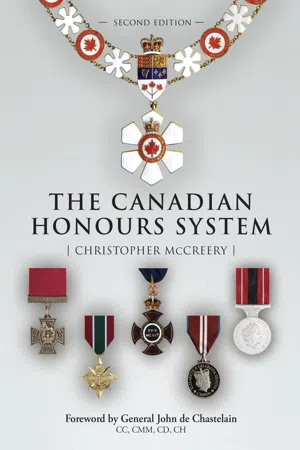
This updated, full-colour illustrated book recounts the history of Canada's various national orders, decorations, and medals. This expanded and updated edition of The Canadian Honours System surveys the history of Canada's various orders, decorations, and medals, from New France's Croix de St. Louis, Britain's the Order of the Bath, to modern Canadian honours such as the Sacrifice Medal and recently created Polar Medal. Since the establishment of the Order of Canada in 1967, the Canadian honours system has grown to become one of the most comprehensive in the world — with more than 300, 000 Canadians having been rewarded over the past fifty years. Each honour in the modern Canadian honours system, and its precursor, the British imperial honours system, is examined here in detail, including historical background, design, and criteria for bestowal. With special chapters on heraldry, protocol, and the proper mounting and wearing of medals, The Canadian Honours System is an essential reference for anyone interested in Canadian honours.
- 712 pages
- English
- ePUB (mobile friendly)
- Available on iOS & Android
eBook - ePub
The Canadian Honours System
About this book
Trusted by 375,005 students
Access to over 1.5 million titles for a fair monthly price.
Study more efficiently using our study tools.
Information
PART I
1
ORDERS, DECORATIONS, AND MEDALS AROUND THE WORLD: UBIQUITOUS NATIONAL INSTITUTIONS
Like flags and coats of arms, almost every country possesses an honours system. At the centre of these systems there is usually a national honour. iBritain has the Order of the Garter and Order of the Thistle, France the Légion d’honneur, Japan the Order of the Rising Sun, Canada the Order of Canada, and the list goes on. Indeed, there are only a few countries that do not currently possess a national honour or honours system.[1] All other states and regimes have found a use for honours, and in many ways they are a necessity of nationhood.
The concept of honour is as old as humanity itself. Yet honours — that is, the official bestowal of recognition — are in comparison a relatively recent phenomenon. The concepts of honour and honours are directly linked, though there are important differences. Honour is the notion of adhering to what is right: high respect and good reputation through persistent good deeds. One can lead an honourable life and never receive official recognition in the form of an honour. Honours are official marks of recognition, whether they are conferred by proclamations, titles, grants of arms, or insignia. It is equally possible for a person to have received an honour and yet be dishonourable. These variables are defined by every society in accordance with the values that a particular civilization prizes.
Canada’s honours system is derived primarily from two of its founding peoples, the French and British. However, not even these two countries can claim to have invented honours. Throughout modern history a plethora of systems and awards has been designed and used as essential apparatuses of both states and regimes. At times, systems have been displaced by both evolution and revolution, yet always a revised system, roughly patterned on its predecessor, has emerged. All modern honours systems have certain common elements, and the most central of these is the presentation of an insignia, being a badge or medal. This tradition can be traced back to circa 150 B.C. and the gold button given by Alexander, the ruler of Seleucid Syria, to a Jewish high priest for bravery demonstrated in battle. Honour has also been accorded through the bestowal of land and titles, and in ancient Greece a complex system of crowns was devised to reward public and military service. The practice of embossing medallic insignia on breastplates (phaleristics) was initiated by the ancient Romans and has in some ways carried forward to the present day. In India’s Pudukkottai state there was an ancient tradition of the raja presenting gifts and honours to loyal subjects. This ritual served not only as a mechanism for recognition but was also a source of political power. As well, few are unfamiliar with the stories of King Arthur and his Knights of the Round Table. Moving through history, the ideals of chivalry and honours gradually replaced the act of granting land with that of bestowing knighthoods and insignia.
The purpose of honours is to reward service or valorous acts, and to accord recognition to those who, according to the state, are deemed to merit such. At various times honours have also been, and in some countries continue to be, a central tool of political patronage. All types of honours are intended to foster a feeling of loyalty and a personal connection to the state or regime.
Our modern national honours system can be divided into three main categories: orders, decorations, and medals. It is worth noting that there is some overlap between the last two categories, and some honours referred to as medals are actually decorations, and vice versa.
Orders
These are societies of honour that are instituted by the state, usually to recognize lifelong exemplary service of the highest calibre. Orders are usually divided into several different levels to allow for recognition of those who have rendered service at both the national/international level and at the local or regional level. In Canada we have several orders that are national in scope: the Order of Merit, the Order of Canada, the Order of Military Merit, the Order of Merit of the Police Forces, the Royal Victorian Order, and the Most Venerable Order of the Hospital of St. John of Jerusalem.
Orders can be “field specific” — the Order of Military Merit, for example, is restricted to members of the Canadian Armed Forces who have rendered meritorious service over an extended period of time. Similarly, the Royal Victorian Order is primarily bestowed upon those who have served the Queen or Royal Family in a distinguished manner.
Decorations
This section can be further divided into two subsections: Bravery/Valour/Gallantry and Meritorious Service. The term also applies to the Canadian Forces’ Decoration and is colloquially used to describe all honours.
Bravery/Valour/Gallantry
Awarded for a specific act of bravery, valour, or gallantry, bravery awards are bestowed upon those who perform an exemplary act, such as life-saving, in a time of peace, while valour and gallantry decorations are for valour and devotion to duty in the presence of the enemy. Provisions have been made in the Canadian honours system to allow for valour decorations, such as the Victoria Cross (VC), to be awarded for gallant acts performed while in non-warlike situations, provided they involve a hostile armed force.
Meritorious Service
These are awarded for a specific act of meritorious service, not necessarily over an extended period of time. This category is notably employed to recognize short-term merit as part of a specific action or project, whether it is rendered over five minutes or five years.
Medals
There are four types of medals: service medals, commemorative medals, long service medals, and other awards. The term is often used in common parlance to describe all honours, be they the insignia of orders, decorations, or medals.
Service Medals
These are awarded for service in a particular mission or operation. While primarily limited to members of the armed forces, in the Canadian context police officers and civilian personnel from various government departments are also often included.
Commemorative Medals
Commemorative medals are awarded on the occasion of a special event such as a coronation, jubilee, or anniversary.
Long Service Medals
These are awarded for long service and honourable conduct over a set period of time. The Canadian Forces’ Decoration (essentially a medal despite its name) is awarded for twelve years of honourable service, while the Royal Canadian Mounted Police (RCMP) Long Service Medal and Exemplary Service Medals are awarded for twenty years of honourable service.
Other Awards
Most specifically these are the Sacrifice Medal, awarded to those who have been physically or psychologically wounded as a result of service in an operational area; the Polar Medal, which i...
Table of contents
- Cover
- Table of Contents
- Foreword
- Acknowledgements
- Introduction to the Second Edition
- PART I
- 1
- 2
- 3
- 4
- 5
- 6
- 7
- 8
- 9
- 10
- PART II
- 11
- 12
- 13
- 14
- 15
- 16
- 17
- 18
- 19
- 20
- 21
- 22
- 23
- 24
- 25
- 26
- 27
- 28
- 29
- 30
- 31
- 32
- 33
- 34
- PART III
- 35
- 36
- 37
- 38
- 39
- 40
- APPENDIX 1
- APPENDIX 2
- APPENDIX 3
- APPENDIX 4
- NOTES
- BIBLIOGRAPHY
- PHOTO CREDITS
- COPYRIGHT
Frequently asked questions
Yes, you can cancel anytime from the Subscription tab in your account settings on the Perlego website. Your subscription will stay active until the end of your current billing period. Learn how to cancel your subscription
No, books cannot be downloaded as external files, such as PDFs, for use outside of Perlego. However, you can download books within the Perlego app for offline reading on mobile or tablet. Learn how to download books offline
Perlego offers two plans: Essential and Complete
- Essential is ideal for learners and professionals who enjoy exploring a wide range of subjects. Access the Essential Library with 800,000+ trusted titles and best-sellers across business, personal growth, and the humanities. Includes unlimited reading time and Standard Read Aloud voice.
- Complete: Perfect for advanced learners and researchers needing full, unrestricted access. Unlock 1.5M+ books across hundreds of subjects, including academic and specialized titles. The Complete Plan also includes advanced features like Premium Read Aloud and Research Assistant.
We are an online textbook subscription service, where you can get access to an entire online library for less than the price of a single book per month. With over 1.5 million books across 990+ topics, we’ve got you covered! Learn about our mission
Look out for the read-aloud symbol on your next book to see if you can listen to it. The read-aloud tool reads text aloud for you, highlighting the text as it is being read. You can pause it, speed it up and slow it down. Learn more about Read Aloud
Yes! You can use the Perlego app on both iOS and Android devices to read anytime, anywhere — even offline. Perfect for commutes or when you’re on the go.
Please note we cannot support devices running on iOS 13 and Android 7 or earlier. Learn more about using the app
Please note we cannot support devices running on iOS 13 and Android 7 or earlier. Learn more about using the app
Yes, you can access The Canadian Honours System by Christopher McCreery in PDF and/or ePUB format, as well as other popular books in History & Military & Maritime History. We have over 1.5 million books available in our catalogue for you to explore.