Border Cities and Territorial Development
eBook - ePub

Border Cities and Territorial Development

  1. 256 pages
  2. English
  3. ePUB (mobile friendly)
  4. Available on iOS & Android
eBook - ePub

Border Cities and Territorial Development

About this book

This monograph analyses the role of border cities in promoting territorial development processes in border regions across the world. It not only embraces the scientific fields of regional and urban studies but also addresses territorial (urban, local, regional) development and planning theories, as well as the effects of development policies applied to border regions in both Europe and North America.

In essence, the book offers a full toolkit of border regions' territorial development knowledge and, in particular, advances a range of policy development proposals. It provides a comprehensive introduction to contemporary thinking about how border cities can play a decisive role in boosting territorial development processes in border regions.

The book is divided into three parts. Part I presents a theoretical framework on the role of border cities in promoting territorial development and planning in border regions. Part II debates current mainstream policies focusing on supporting border regions and specifically border cities in the EU, the UK, and North America. Finally, Part III presents a wealth of updated knowledge, based on the analysis of several concrete case studies: border cities from both Europe (north, south, east and west) and North America (Canada, the United States, and Mexico). The chapters are written by some of the most renowned authors on the subject, including scholars from several European and North American countries, as well as the secretary generals of three European border regions associations (AEBR, MOT, and CESCI).

The book will thoroughly prepare students and provide knowledge to academics and policymakers in the fields of urban and regional planning and development studies, human geography, economic development, EU policies, border regions, and policy impacts.
Frequently asked questions

Yes, you can cancel anytime from the Subscription tab in your account settings on the Perlego website. Your subscription will stay active until the end of your current billing period. Learn how to cancel your subscription.
No, books cannot be downloaded as external files, such as PDFs, for use outside of Perlego. However, you can download books within the Perlego app for offline reading on mobile or tablet. Learn more here.
Perlego offers two plans: Essential and Complete
  • Essential is ideal for learners and professionals who enjoy exploring a wide range of subjects. Access the Essential Library with 800,000+ trusted titles and best-sellers across business, personal growth, and the humanities. Includes unlimited reading time and Standard Read Aloud voice.
  • Complete: Perfect for advanced learners and researchers needing full, unrestricted access. Unlock 1.4M+ books across hundreds of subjects, including academic and specialized titles. The Complete Plan also includes advanced features like Premium Read Aloud and Research Assistant.
Both plans are available with monthly, semester, or annual billing cycles.
We are an online textbook subscription service, where you can get access to an entire online library for less than the price of a single book per month. With over 1 million books across 1000+ topics, we’ve got you covered! Learn more here.
Look out for the read-aloud symbol on your next book to see if you can listen to it. The read-aloud tool reads text aloud for you, highlighting the text as it is being read. You can pause it, speed it up and slow it down. Learn more here.
Yes! You can use the Perlego app on both iOS or Android devices to read anytime, anywhere — even offline. Perfect for commutes or when you’re on the go.
Please note we cannot support devices running on iOS 13 and Android 7 or earlier. Learn more about using the app.
Yes, you can access Border Cities and Territorial Development by Eduardo Medeiros in PDF and/or ePUB format, as well as other popular books in Economics & Business General. We have over one million books available in our catalogue for you to explore.

Information

Publisher
Routledge
Year
2021
Print ISBN
9780367759438
eBook ISBN
9781000472370
Edition
1

Part I

Territorial development and border cities

A theoretical debate

1 Territorial development and border cities

A theoretical debate

Eduardo Medeiros and MartĂ­n Guillermo RamĂ­rez
DOI: 10.4324/9781003164753-1

1.1 Introduction

According to dominant theories, cities need to be adequately involved in the conception and implementation of development policies with a multilevel governance approach. Moreover, these development policies need to be better adapted not only to the urban realities where they will be implemented but also to the surrounding hinterland (EC, 2014). As crucial drivers of territorial development, mainly due to their functional specialisation and their position in the knowledge economy, cities are significant nodes for regional competitiveness and cohesion, at all territorial levels (ESPON, 2006). Then again, in cross-border regions, which are commonly characterised by lagging territorial development and demographic trends, border cities, which are mostly small and medium-sized, can play a vital role in their territorial development process, as development anchors, as providers of services of general interest and quality of life, and also by serving as crucial nodes for cross-border urban networks (EC, 2016).
The key socio-economic, environmental, planning, and governance opportunities and challenges facing border cities, in a contrasting ‘globalisation’ vs ‘rising nationalism’ era, are particularly demanding, as the 2020 covidfencing process has shown (Medeiros et al., 2020). More importantly, however, in our view, is the role of border cities in supporting cross-border cooperation processes in a sustainable way, as a means to achieving territorial integration processes and knowledge flows across cross-border regions (Cappelli & Montobbio, 2016). In a similar manner, border cities have a crucial role in materialising the political, institutional, socio-economic, and sociocultural added-value, often associated with the implementation of cross-border cooperation processes (AEBR, 2008). In the end, it is expected that all sorts of persisting border barriers (Medeiros, 2011, 2018b) will be systematically mitigated in order to increase business across borders, resulting in positive territorial development processes for cross-border regions. For this, border cities should also engage in cross-border planning processes (Braunerhielm et al., 2019), and in favouring integrated sustainable urban development policies (ESPON, 2014; Medeiros & van der Zwet, 2020a, b).
In this context, this chapter addresses the importance of border cities for the territorial development of cross-border regions. It starts by providing a concise theoretical overview of the territorial development concept by identifying its main analytic dimensions, pillars, and scales. The next section identifies the main roles of border cities in promoting territorial development processes in border areas. Largely based on the European example, in which the authors have been working for the past three decades, the analysis is mostly based on desk research (literature review), complemented with quantitative data for the selected number of border twin cities. From a methodological standpoint, this chapter proposes a novel typology to identify different types of border twin cities, applied to 65 cases in Europe. The analysis ends by shedding light on the territorial development trends of European Union (EU) border cities in the past decade (2005–2015), largely based on data (demography, territorial articulation, environmental sustainability, social inclusion, and institutional building) collected at the EU Nomenclature of Territorial Units for Statistics (NUTS) 3 level.

1.2 Territorial development: The concept, dimensions, and components

Commonly associated with positive progress, advancement, and social betterment, no matter how it is measured, development ends up being geographically uneven. Conceptually speaking, the popular understanding of development implies improvement in society’s economic, social, or environmental conditions (Greiner, 2014). Also noteworthy is the dominant academic and policy focus on economic development, which entails the growth of per capita income and the consequent reduction in poverty (Warf & Stutz, 2012). Also referring to ‘processes of change involving the nature and composition of the economy of a particular region as well as to increases in the overall prosperity of a region’, economic development implies: (i) changes in the structure of the region’s economy; (ii) changes in the forms of economic organisation within the region; and (iii) changes in the availability and use of technology within the region (Knox & Marston, 2016: 286).
Notoriously hard to define, development can be viewed as both a material process and a political or ideological project (Daniels, 2016). Much contemporary research on the concept of development also reveals how it has been highly contested through time, and how its meaning varies from place to place. Impelled by increasing social inequality and environmental concerns, economic development has gradually incorporated an interplay with these analytic dimensions, as previously seen. Rather remarkably, the notion of development has also broadened over the years to incorporate aspects related to political freedoms (Potter et al., 2008).
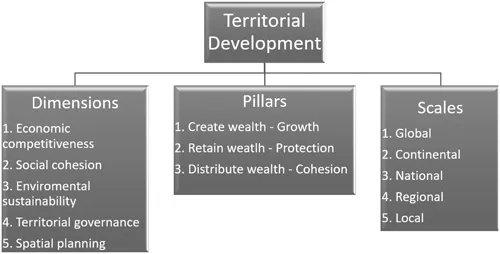
Indeed, the broader concept of territorial development, which dominates this chapter, not only encompasses all these economic, social, environmental, governance, and planning analytic dimensions, but it also covers all territorial scales of analysis. Likewise, the territorial development process is distinctive in terms of economic growth processes, since it addresses not only the need to create wealth but also the pro-active requirements to retain and distribute this wealth across territories (Figure 1.1). A similar, yet debatable, perspective (Medeiros, 2018c) is advanced by Sachs (2015: 11) when discussing the concept of sustainable development as ‘a way to understand the world as a complex interaction of economic, social, environmental, and political systems’. This holistic vision for global development is also retained in the United Nations (UN) Sustainable Development Goals (SGDs) expressed in their 2030 Agenda for Sustainable Development (UN, 2016) (Table 1.1).
Figure 1.1 The territorial development concept. Source: Based on Medeiros (2019c).
Table 1.1 Relation between the UN SDGs and the territorial development dimensions
Territorial development dimensions UN SDG
Economic competitiveness
Goal 8. Promote sustained, inclusive, and sustainable economic growth, full and productive employment, and decent work for all
Goal 9. Build resilient infrastructure, promote inclusive and sustainable industrialisation, and foster innovation
Goal 12. Ensure sustainable consumption and production patterns
Social cohesion
Goal 1. End poverty in all its forms everywhere
Goal 2. End hunger, achieve food security and improved nutrition and promote sustainable agriculture
Goal 3. Ensure healthy lives and promote well-being for all at all ages
Goal 4. Ensure inclusive and equitable quality education and promote lifelong learning opportunities for all
Goal 5. Achieve gender equality and empower all women and girls
Environmental sustainability
Goal 6. Ensure availability and sustainable management of water and sanitation for all
Goal 7. Ensure access to affordable, reliable, sustainable, and m...

Table of contents

  1. Cover
  2. Half-Title
  3. Series
  4. Title
  5. Copyright
  6. Contents
  7. List of figures
  8. List of tables
  9. List of contributors
  10. Foreword
  11. Introduction
  12. PART I Territorial development and border cities: A theoretical debate
  13. PART II Territorial development policies for border cities and regions
  14. PART III Evidence from border cities and their contribution to territorial development
  15. Index