This book is the first socio-intellectual history of the Dharma Drum Lineage of Chan (Zen), a new lineage of Buddhism founded by the late Chinese Buddhist cleric, Sheng Yen (1931–2009)—arguably one of the most influential Chan masters in contemporary times.
The book challenges the received academic and popular image of Chan Buddhism as a meditation school that bypasses scriptural learning. Using Sheng Yen's doctrinal classification (Chn. panjiao) chart as an example, the book shows Sheng Yen's Chan as a synthesis of both Indian and Chinese premodern forms of Buddhism, and as the summum bonum of Han transmission of Chinese Buddhism (Chn. Hanchuan fojiao). The book demonstrates how Sheng Yen's presentation of Chan was intimately related to the volatile social and political realities of his life—the Communist takeover of China and the subsequent industrial boom that impacted Taiwanese society. In short, this book presents a historically and culturally embodied approach to the formation of Buddhist doctrine and practice. Drawing on the works of postcolonial theories that integrate the role of the researcher into the research, the book also offers a more integrated approach between emic and etic, insider and outsider perspectives to research.
Advancing the field of Buddhist studies, the book will be of interest to scholars of Buddhism in the modern period, twentieth-century religious history of China and Taiwan, Chan/Zen studies, World Religions, Asian civilizations, and Modern Biographies.
In 2009, from February 3rd straight through to the 15th, all major media outlets in Taiwan, including print, TV, and online, featured news about Sheng Yen's passing, following his funeral service, cremation, and eventual burial.1 His death was a great loss for the millions of Buddhists in Taiwan and caused a sensational outpouring. The Taiwanese media had never before reported on the passing of a religious cleric for such duration. In the West, Buddhist periodicals such as Tricycle Magazine2 and Buddhadharma Magazine3 published exclusive news reports and articles. Academic online forums such as H-Buddhism also published eulogies.4
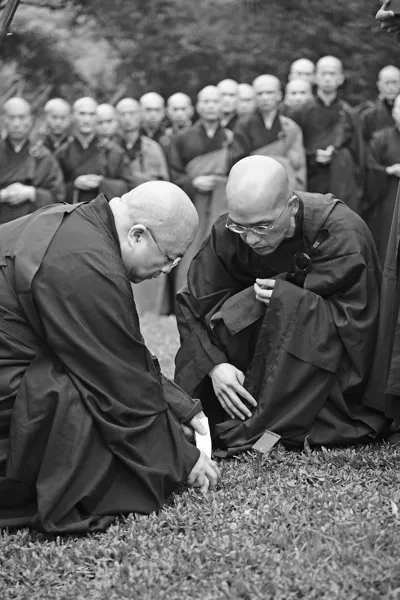
Four hours after Sheng Yen passed away at Dharma Drum Mountain (hereafter, DDM), the first public figure to arrive was the Taiwanese president, Ma Ying-jeou 馬英九 (1950–).5 Ma respected Sheng Yen greatly and had learned meditation from him after their public dialogue ten years earlier when Ma was the mayor of Taipei.6 At Sheng Yen's “natural burial” service on February 15, where his ashes were separated into five small recycled paper bags and buried in the eco-friendly DDM “Life Park” (shengming yuanqu 生命園區), basically a field of grass where cremated ashes are buried, Ma eulogized Sheng Yen's many contributions to the betterment of society.7
The practice of “green burial” in DDM's Life Park is historically unprecedented, not only in Taiwan but also elsewhere in Chinese-speaking countries in modern times, given its ideological conflict with the millennia-old practice of ancestral worship at burial sites.8 The Life Park natural burial site was established in 2008. Its inaugural ceremony was held on November 24 to bury the ashes of Sheng Yen's own teacher, Master Dongchu Denglang 東初鐙朗 (1907–1977), along with those of eleven laypeople.9 Sheng Yen had worked with the Taiwanese government for approximately seven years to get approval for this green burial site project as part of his “environmental protection for the mind” (xinling huanbao 心靈環保) program. This program aimed to address many social problems, including overpopulation, wasteful and boisterous funeral services, and the shortage of available land in Taiwan. In the following statement, Sheng Yen pinpointed, with characteristic bluntness, what he saw as the heart of the problem, namely, people's attachments:
In life, most people are unable to let go of this and that; specifically, they cannot put down their money, their wealth, fame, and social status. In death, even though they should be able to put down everything, many still cannot. Because they cannot relinquish their “smelly skin bag” (chou pinang 臭皮囊), they’re propelled to buy a piece of land to house it. These are the foolish things that people do.10
At the green burials site of the Life Park on DDM, there are no markers for the deceased, and so there are no annual memorial services to be held. There is only a field of grass where the ashes are buried and left to return to the natural environment. There, the dead leave no trace. This was the way Sheng Yen had wanted to be buried and remembered as well. As seen in the epigraph above, one could say his own death and burial was his last teaching on the truth of nonattachment.
Figure1.1The then abbot Guodong 果東 (b. 1955) left, and one of Sheng Yen's personal attendants, Changkuan 常寬 (b. 1965) on the right, inserting into the ground at Life Park one of six dissolvable recycled paper bags that holds Sheng Yen's ashes. Photo courtesy of DDM.
This Life Park on DDM had been donated to the local Jinshan County government on April 6, 2007, to be managed as part of the Taiwan government's own promotion of environmental and natural protection. Families who wish to bury their relatives on DDM can apply to the local government agency and are generally accepted, although the waiting list is long. My own father was buried there in 2011 and at that point, the waiting list for future burials was several years long.
The popularity of the Life Park on DDM derived from Sheng Yen's popularity and visibility in the social sphere. From the early to mid-1990s, he attracted the attention of both Buddhists and non-Buddhists. He appeared regularly on the TV news and in newspapers in Taiwan, advancing his many socioethical programs that I discuss in greater detail in the conclusion of this book. Suffice it to say that these programs aimed to address everyday problems of modern life in Taiwan as well as social issues on a global scale.
In 1998, Master Sheng Yen was recognized in Taiwan's most prestigious magazine, Tianxia 天下 or The CommonWealth Magazine, as one of the fifty most influential Chinese people within the past 400 years of Chinese history. In the magazine, his page spread was sandwiched between the page introducing Hu Shih 胡適 (1891–1962), the eminent modern Chinese historian and philosopher, and that of Sun Yatsen 孫逸仙 or 孫中山 (1866–1925), the provisional president and the founding father of the Republic of China (1912–1949).11 For a Buddhist cleric to be ranked alongside these historical giants was quite exceptional. Needless to say, he was the only Buddhist cleric included in this magazine.
In the public media of Taiwan, Sheng Yen was presented as a progressive Buddhist cleric, intellectual, and educator who helped to uplift the moral character of the people through socioethical programs and spiritual practice—Chan practice—which he articulated as a form of “education.” For example, after the September 21, 1999 earthquake in central Taiwan, which was the worst disaster on the island since World War II, Sheng Yen was at the forefront mobilizing DDM volunteers, doctors, social workers, and others at the site to help the victims of the disaster. The president at that time, Li Teng-hui 李登輝 (1923–2020), in a speech on October 11 regarding the earthquake, cited Sheng Yen's teachings as encouragement for the survivors:
“All the victims of the September 21 earthquake are bodhisattvas, our teachers.” They have used their lives as tools to teach us. They suffered on behalf of the 22,000,000 citizens of Taiwan, allowing the next generation to learn and live and rebuild from our past mistakes. Thus, we must be grateful to them for allowing our society to be filled with goodness and harmony.12
President Li Teng-hui is a Christian, but that didn’t stop him from quoting Sheng Yen's words, “All the victims of the earthquake are bodhisattvas,” to reassure the populace. During his presidency, he also sought out Sheng Yen to teach him and his wife meditation. This took place at the old Nongchan Monastery, and I was present as Sheng Yen's attendant. In the mass media in Taiwan, Sheng Yen's words and teachings were often quoted by political and cultural leaders, as well as journalists, as sources of guidance. He was also the only Buddhist cleric in Taiwan who was asked to write an exclusive newspaper column, addressing various social issues.13
In the West, however, beginning in the mid-1970s Sheng Yen was primarily known for his Chan teachings, giving classes and leading intensive retreats for his American students. When Dongchu passed away in 1977, he started to return to Taiwan on a regular basis to take care of Dongchu's temples. While there, he began to hold intensive Chan retreats with many young college students attending. At that time, no one was holding intensive retreats in Taiwan, only ritual ceremonies or recitation of the Buddha's name retreats. Sheng Yen's retreats led to a resurgence of Chan Buddhism there. Years later, he became a world-recognized master as a result of his Chan teachings, which led to him becoming the religious chairman at the United Nations in 2004.14 Yet, despite these titles and accomplishments, Sheng Yen would say that he was only an ordinary person (fanfu 凡夫).15
In order to understand Sheng Yen and the formation of his ideas, it is essential to dig into his self-perception and life experiences—to understand his life as he remembered it. There is nowhere better to do this than in his autobiographies and memoirs, in which he recounted his humble origins, tribulations, and the observations of his life. I contextualize these in the historical, political, and religious turmoil of his time.
In my own reading, there are several prominent themes in these autobiographies and memoirs. First, his life events created in him a sense of urgency or “crisis mentality” (weiji gan 危機感) that, instead of crippling him, seems to have energized him to overcome his own suffering and that of others he encountered. Second, his life was shaped by both war and political turmoil in China, which he experienced through two distinct social spheres: the monastery and the army. Third, because he left home to become a Buddhist monk at a young age, the only tool he had for making sense of the world was Buddhism. Yet the cognitive dissonance between all the funerary rites that he had to perform and the Buddhist scriptural teachings he read—which to him seemed unrelated, even contradictory—propelled him to focus all of his life's energy on making the teachings embodied in the Buddhist scriptures relevant to people of his time and for posterity, which led to his campaign to clarify what he perceived as “orthodox Buddhism.” His formulation of orthodoxy was meant to redress the socioreligious problems he witnessed. Fourth, his particular way of interpreting Buddhism eventually evolved into his new creation, the Dharma Drum Lineage of Chan.
Sheng Yen's life shaped the way he understood orthodox Buddhism, and this form of Buddhism—including the socially engaged programs he started and the commentarial works he wrote—was set in motion by his initial spiritual experience of Chan in 1959. In order to understand his Chan teachings, in the current chapter I explore the sociopolitical, intellectual, and religious conditions that shaped him. Understanding these conditions allows us to appreciate how he responded to the religious landscape of Taiwan in the 1980s and 1990s, which is the subject of the next chapter. Only then will we appreciate the complexity and innovation in his teachings and how he imagined and instituted the doctrinal and soteriological foundations of the Dharma Drum Lineage, the subject of Chapters 3 and 4. In the following sections, I historicize the contingencies from the time of his birth to the time when he became a Chan master.
Born of disasters and political turmoil
Stories are the way people make sense of life. The meaning that comes from the stories shape people's perceptions of themselves and the choices they make. Sheng Yen's own autographical narratives provide a glimpse of how he made sense of his life—of both the things that happened to him and the internal experiences that created the rich texture of his unique, subjective sense of purpose in relation to his Buddhism.16
In his memoirs, Sheng Yen described a weak, divided, and hopeless China, struggling to survive in the face of foreign invasion and internal division. In the midst of this, the Buddhism he witnessed was fragmented and had devolved into ritualism and decadence, with only a few handful of Buddhist clerics seeking to change the situation against all odds. He had concluded early on as a young novice that “The Buddhadharma is so good, yet so many misunderstand it.”17 These words stem from painful memories and life experiences that had been branded into his consciousness from an early age. He lived through natural disasters, poverty, deaths, wars, social unrest, and the degeneracy of Buddhism—all before the age of eighteen, when he escaped to Taiwan by joining the Nationalist Guomindang Party (GMD) youth army.
Sheng Yen was born just twenty years after the fall of the Qing dynasty (1644–1911), on January 22, 1931, in the southeastern part of Nantong County (present-day Nantong City) in Jiangsu Province. His family name was Zhang 張. With the repeated flooding of ...
Table of contents
Cover Page
Half-Title Page
Series Page
Title Page
Copyright Page
Contents
Acknowledgments
List of figures
Note on romanization
Introduction: Biography, history, and positionality
1 A life of contingencies and crises
2 An imagined orthodoxy
3 Chan as the doctrinal culmination of the Han transmission of Chinese Buddhism
4 Chan as the experiential fulfillment of the Han transmission of Chinese Buddhism
Conclusion
Abbreviations and conventions
Bibliography
Index
Trusted by 375,005 students
Access to over 1.5 million titles for a fair monthly price.
Study more efficiently using our study tools.
Frequently asked questions
Yes, you can cancel anytime from the Subscription tab in your account settings on the Perlego website. Your subscription will stay active until the end of your current billing period. Learn how to cancel your subscription
No, books cannot be downloaded as external files, such as PDFs, for use outside of Perlego. However, you can download books within the Perlego app for offline reading on mobile or tablet. Learn how to download books offline
We are an online textbook subscription service, where you can get access to an entire online library for less than the price of a single book per month. With over 1.5 million books across 990+ topics, we’ve got you covered! Learn about our mission
Look out for the read-aloud symbol on your next book to see if you can listen to it. The read-aloud tool reads text aloud for you, highlighting the text as it is being read. You can pause it, speed it up and slow it down. Learn more about Read Aloud
Yes! You can use the Perlego app on both iOS and Android devices to read anytime, anywhere — even offline. Perfect for commutes or when you’re on the go. Please note we cannot support devices running on iOS 13 and Android 7 or earlier. Learn more about using the app
Yes, you can access Reimagining Chan Buddhism by Jimmy Yu in PDF and/or ePUB format, as well as other popular books in Social Sciences & Ethnic Studies. We have over 1.5 million books available in our catalogue for you to explore.