Programming for Health and Wellbeing in Architecture presents a new approach to architectural programming that includes sustainability, neuroscience and human factors. This volume of contributions from noted architects and academics makes the case for rethinking the practices of programming and planning to incorporate evidence-based design, systems thinking and a deeper understanding of our evolutionary nature.
These 18 original essays highlight how human and environmental health are closely related and should be incorporated as mutually reinforcing goals in every design project. Together, these chapters describe the framework for a new paradigm of building performance and design of the human experience.
Programming—the stage at which research is conducted and goals established—provides an opportunity to examine potential impacts and to craft strategies for wellbeing in new buildings and renovations using the latest scientific methods. This book expands the scope of the programming process and provides essential guidance for sustainable practice and the advancement of wellbeing in the built environment for architecture and interiors students, practitioners, instructors and academics.
1PROGRAMMING INTERIOR ENVIRONMENTS Human Experience, Health and Wellbeing
J. Davis Harte, PhD, WELL AP and Laura Regrut, IIDA, ASID
DOI: 10.4324/9781003164418-3
The complexities of human/environment interaction form the basis of our sense of place and of ourselves. As such, our health and wellbeing are entwined with this relationship along multiple dimensions. In this chapter the authors explore the intricacies of environmental psychology and the potential of evidence-based design to inform programming that ensures the built environment frames our activities and interactions with wellbeing in mind.
Designers are more interested in “health-first” designs than at any time in recent memory. Our collective global experience with an invisible chronic environmental stressor—COVID-19—has shifted our common understanding of what makes a place healthy. It is more important than ever to deliberately program spaces to actively support health and wellbeing, on both physical and mental levels. It is also essential to design with culturally enriched approaches. There is over half a century of evidence showing that environmental psychology principles can benefit design and users. More recent neuroscientific findings now contribute additional important layers to this health-first approach. The better we understand the human response to stressors and our need for social cohesion, the better we can deliberately design spaces that benefit the health and wellbeing of the occupants.
Design Meets Science
As we emerge from the COVID-19 pandemic many of us have a heightened awareness regarding the power of connection and community. We are tired of the isolation and ready to be with friends, family and co-workers again. It is not the place of this chapter to determine how returning to the workplace and life in general will occur. This will be different for each individual, place of gathering, workplace, town, city and country. The current situation is merely a benchmark for a sea change happening which will alter the field of design forever. For instance, Gensler, an industry leader, in their Design Forecast 2021 wrote: “Human-experience design is a powerful opportunity to bring people back together safely and provide spaces that allow them to feel healthy, inclusive, and purposeful; places that support community and social connection perform better” [1].
Such simple words. But how does the designer put this insight into action? Where does the designer go for guidance? This book is full of information on how our biology affects our perceptions, sensations, interpretations and resultant stress and recovery levels. In this chapter, we suggest designers ground their design work in science and research by employing evidence-based design (EBD) principles from the fields of psychology, neuroscience, neuroaesthetics and salutogenic design to achieve health-first environments that support social connection. We aim to inspire conversation about the importance of evidence-based design, including neurobiological and environmental psychological strategies, so that designers can create interiors that promote health and wellbeing.
What Is Evidence-Based Design (EBD)?
Evidence-based design (EBD) is a deliberate process that filters high-quality scientific research to guide and create the best possible design solutions and outcomes for physical environments. Many design scholars have been working to define and describe EBD and how it can be applied in practice. Typically it has been used in healthcare settings. EBD is defined by design researchers Stichler and Hamilton as “a process for the conscientious, explicit, and judicious use of current best evidence from research and practice in making critical decisions, together with an informed client, about the design of each individual and unique project” [2].
We argue that there are actually three intersecting elements that need to be included if EBD is going to succeed in practice. The first is the actual evidence—published peer-reviewed design research. The second element to consider is individual and client preferences. The third is the designer’s expertise and experience in applying the evidence and preferences in the design plan. This understanding originates in the medical profession’s definition of evidence-based medicine—the root of EBD—which sees evidence-based practice as a guide, not as an absolute mandate [3].
EBD practice is flourishing in the industry, with platforms to help train and monitor the impact of EBD, such as The Center for Health Design’s Evidence Based Design Accreditation and Certification (EDAC) process. There is substantial evidence that using an EBD approach for hospital-based projects significantly improves factors such as patient outcomes and staff satisfaction [4]. For instance, when a hospital is designed with EBD approaches, including biophilic design elements, patients tend to create more positive associations with the healthcare setting. These gains have been shown to lead to improved patient outcomes, which, in turn, reduce healthcare system costs [5]. With a typical monthly expenditure of over $40 billion for healthcare construction costs in the U.S. in 2019, an application of EBD practices for better outcomes is worth incorporating [6]. Such gains in complex hospital settings suggest that an EBD approach yielding similar or greater positive effects in other interior environments is possible. Applying EBD approaches should intersect with individual client preferences, which we will discuss in the following sections.
Environmental Psychology and Interior Design
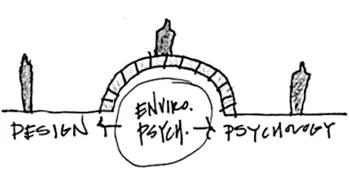
Along with EBD practice the field of environmental psychology is our next focus as a means to better understand individual and client preferences. Environmental psychology investigates and considers the interactions between people and environments (Figure 1.1). Design scholars have investigated the environment-behavior relationship since at least the mid-1960s, with the first books about environmental psychology published in the early 1970s (see, for instance, Proshansky et al. 1976, Mehrabian & Russell, 1974 and Stokols, 1978) [7–9]. Recent work by Gifford (2014), Bechtel (2010) and Kopec (2018) further contribute to our understanding [10–12].
FIGURE1.1 Environmental psychology bridges considerations between design and psychology. Image courtesy of Dax Morton, 2020.
What is environmental psychology and how is it applicable to programming? Let’s first accept that our state of mind and wellbeing are influenced by both internal and external factors. You might wake up one morning and decide to feel eager for the day. That decision is an internally derived attitude. However, let’s say that the external environment, your bedroom, is disorganized in such a way that you trip, step on something painful or unpleasant, become disoriented or discouraged. The original state of mind to be eager and optimistic is transformed to a negative state of mind. Our biology interacts with our environment, and vice versa. We are influenced by layers of conditioning, identity construction, cultural meaning and expectation. Our mind/brain/body has the built-in tools of sensory processing to help us make sense and meaning of our world. At times we would rather be in a more alert state, while at other times we want to be in a more relaxed state. To clarify, environmental psychology seeks to understand this interplay between people and their surroundings, and to determine how one’s environment might be changed to maximize environmental quality. Understanding and applying both EBD and environmental psychological principles will help your designs be simultaneously more effective, functional and beautiful.
Learning about environmental psychology opens a door of understanding to show that multiple perspectives can all be “correct,” and that the space in which a diverse group is gathered can also succeed in helping all these points of views to generate states of both alertness and relaxation. One factor that helps determine how you feel and behave is the theory of environmental load, or how much and to what degree the environment provides stimulation and how much attention we can put on the stimuli [13, 14]. For some, a tile pattern on the floor is perceived as elegant, while for others, this material might be perceived as cold and hard, or even create an optical illusion that is perceived as unsafe. These responses are individual and context dependent.
Environmental psychology for design is a large field which we cannot do full justice to in this brief chapter, however we hope this introduction provokes curiosity for the reader to explore this fascinating field more fully. Designers who leverage an environmental psychology approach are adept at understanding how stimuli affects behaviors, thoughts and the emotional states of their clients and end-users [15]. Designers can incorporate user needs assessment tools used by environmental psychology to target these emotional processes in project development.
Stages of Design: Programming for Health and Wellbeing
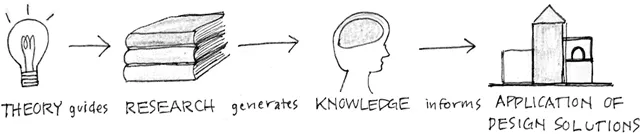
Next we’ll discuss how EBD and environmental psychology fit within the design process, from both a research and programming framework (Figure 1.2). Dickenson and Marsden in their book Informing Design clarify that “research is discovery that can be generalized, while programming is information gathering pertaining to a specific project” [16].
FIGURE1.2 Overview of design programming process. Image courtesy of Laura Shue, 2020.
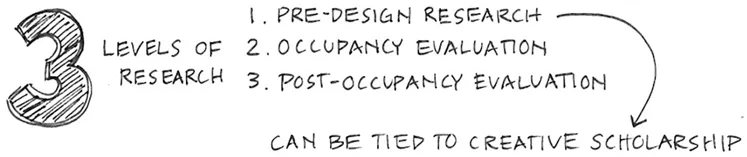
Dak Kopec, a contributor to the expansion of environmental psychology for design, outlines three programming phases for designers to better meet end-users’ needs—Kopec calls this “research.” They are pre-design research, occupancy evaluation and post-occupancy evaluation (Figure 1.3). The first step, pre-design research, is a natural activity for most designers. This is an assessment and evaluation of clients’ needs prior to design, which recognizes the difference between temporary and long-standing needs, and considers creative means to bring more to the design than is readily perceived, such as scenario-planning. This may include EBD findings, creative scholarship (original and new contributions) or conducting studies, as the project allows.
FIGURE1.3 Levels of design research. Image courtesy of Laura Shue, 2020.
The second step in design programming is occupancy evaluation. This is an evidence gathering exercise performed by conducting observations, interviews and/or surveys of end users, who are familiar with the needs and constraints of the project, to determine improvements needed, and the review of precedents and contemporaneous writing on relevant topics. The final step is post-occupancy evaluation, performed after move-in to determine if the design meets the user’s needs and how it can be improved. When a design team employs these methods the outcome is more likely to match the client’s ethos or company culture and to create a space that facilitates wellbeing.
Design-Related Hypotheses and Theories That Inform Programming
In design scholarship and practice it is important to have a basic understanding of theory. We define theory in the context of programming for health and wellbeing as the creation of informed explanations and pred...
Table of contents
Cover
Half Title
Title Page
Copyright Page
Dedication Page
Table of Contents
Contributor Biographies
Introduction
Part 1 Human Factors
Part 2 Buildings
Part 3 Streetscapes
Part 4 Region
Part 5 Commissioning
Acronyms
Glossary
Index
Trusted by 375,005 students
Access to over 1.5 million titles for a fair monthly price.
Study more efficiently using our study tools.
Frequently asked questions
Yes, you can cancel anytime from the Subscription tab in your account settings on the Perlego website. Your subscription will stay active until the end of your current billing period. Learn how to cancel your subscription
No, books cannot be downloaded as external files, such as PDFs, for use outside of Perlego. However, you can download books within the Perlego app for offline reading on mobile or tablet. Learn how to download books offline
Perlego offers two plans: Essential and Complete
Essential is ideal for learners and professionals who enjoy exploring a wide range of subjects. Access the Essential Library with 800,000+ trusted titles and best-sellers across business, personal growth, and the humanities. Includes unlimited reading time and Standard Read Aloud voice.
Complete: Perfect for advanced learners and researchers needing full, unrestricted access. Unlock 1.5M+ books across hundreds of subjects, including academic and specialized titles. The Complete Plan also includes advanced features like Premium Read Aloud and Research Assistant.
Both plans are available with monthly, semester, or annual billing cycles.
We are an online textbook subscription service, where you can get access to an entire online library for less than the price of a single book per month. With over 1.5 million books across 990+ topics, we’ve got you covered! Learn about our mission
Look out for the read-aloud symbol on your next book to see if you can listen to it. The read-aloud tool reads text aloud for you, highlighting the text as it is being read. You can pause it, speed it up and slow it down. Learn more about Read Aloud
Yes! You can use the Perlego app on both iOS and Android devices to read anytime, anywhere — even offline. Perfect for commutes or when you’re on the go. Please note we cannot support devices running on iOS 13 and Android 7 or earlier. Learn more about using the app
Yes, you can access Programming for Health and Wellbeing in Architecture by Keely Menezes, Pamela de Oliveira-Smith, A. Woodworth, Keely Menezes,Pamela de Oliveira-Smith,A. Vernon Woodworth,A. Woodworth, Keely Menezes, Pamela de Oliveira-Smith, A. Vernon Woodworth in PDF and/or ePUB format, as well as other popular books in Architektur & Architektur Allgemein. We have over 1.5 million books available in our catalogue for you to explore.