
eBook - ePub
Classroom Management for Gifted and Twice-Exceptional Students Using Functional Behavior Assessment
A Step-by-Step Professional Learning Program for Teachers
- 350 pages
- English
- ePUB (mobile friendly)
- Available on iOS & Android
eBook - ePub
Classroom Management for Gifted and Twice-Exceptional Students Using Functional Behavior Assessment
A Step-by-Step Professional Learning Program for Teachers
About this book
Classroom Management for Gifted and Twice-Exceptional Students Using Functional Behavior Assessment assists educators in understanding how to identify and target behaviors that influence the success of students and daily classroom instruction. Each module:
- Provides case studies with examples of the concepts being taught.
- Includes presentations, interactive graphic organizers, and small-group problem-solving activities.
- Offers self-assessments and resources for developing interventions.
- May be used within a university course, a series of workshops, or professional teacher learning communities.
- Uses functional behavior assessment (FBA), a successful research-based approach to behavioral interventions.
Using this book, teachers can learn to manage student behavior and implement differentiation in the classroom.
Frequently asked questions
Yes, you can cancel anytime from the Subscription tab in your account settings on the Perlego website. Your subscription will stay active until the end of your current billing period. Learn how to cancel your subscription.
No, books cannot be downloaded as external files, such as PDFs, for use outside of Perlego. However, you can download books within the Perlego app for offline reading on mobile or tablet. Learn more here.
Perlego offers two plans: Essential and Complete
- Essential is ideal for learners and professionals who enjoy exploring a wide range of subjects. Access the Essential Library with 800,000+ trusted titles and best-sellers across business, personal growth, and the humanities. Includes unlimited reading time and Standard Read Aloud voice.
- Complete: Perfect for advanced learners and researchers needing full, unrestricted access. Unlock 1.4M+ books across hundreds of subjects, including academic and specialized titles. The Complete Plan also includes advanced features like Premium Read Aloud and Research Assistant.
We are an online textbook subscription service, where you can get access to an entire online library for less than the price of a single book per month. With over 1 million books across 1000+ topics, weâve got you covered! Learn more here.
Look out for the read-aloud symbol on your next book to see if you can listen to it. The read-aloud tool reads text aloud for you, highlighting the text as it is being read. You can pause it, speed it up and slow it down. Learn more here.
Yes! You can use the Perlego app on both iOS or Android devices to read anytime, anywhere â even offline. Perfect for commutes or when youâre on the go.
Please note we cannot support devices running on iOS 13 and Android 7 or earlier. Learn more about using the app.
Yes, you can access Classroom Management for Gifted and Twice-Exceptional Students Using Functional Behavior Assessment by Yara N. Farah,Susan K. Johnsen,Yarah Farah in PDF and/or ePUB format, as well as other popular books in Education & Inclusive Education. We have over one million books available in our catalogue for you to explore.
Information
MODULE 1Characteristics of Gifted and Twice-Exceptional Students
DOI: 10.4324/9781003233640-2
OVERVIEW
This module will describe the historical back ground, definitions, and characteristics of gifted students and gifted students with disabilities (i.e., twice-exceptional, or 2e, students).
GOALS
At the conclusion of this module, participants will be able to:
- define and describe the characteristics of gifted students,
- define and describe the characteristics of twice-exceptional students, and
- compare and contrast the strengths and needs of gifted and 2e students.
MAIN IDEAS
- Definitions of gifted students emphasize their potential for high performance; their variability relative to others of the same age, experience, and background; and their need for services.
- Gifted students have individual strengths, needs, and interests.
- Characteristics vary by area of giftedness, culture, socioeconomic class, school conditions, social and emotional areas, and disability.
- Twice-exceptional students are those with both a gift and a disability, which may mask one another.
- Working with gifted and twice-exceptional students requires specialized professional development.
Background Information for the Instructor
The information in the following sections provides background for the instructor, which may or may not be used with the participants depending on the instructorâs goals and the participantsâ knowledge and skill level.
Is This Student Gifted?
Jeff is a high school student. He plays the trombone and enjoys time with his friends in the school band. He and a small group of his friends have started a jazz ensemble that plays at school and community events. He is also academically talented and enjoys writing, recently publishing a short story in a literary magazine. This past week, he learned that he is a National Merit Scholar.
Stephanie is in middle school and attends a school for gifted and talented students. She performs at the top of her science and math classes but is struggling with her classes in English language arts, particularly in writing. Realizing that students are not talented in every domain, the teachers have begun to differentiate their classrooms to match the strengths and needs of the students. However, even with this assistance in her language arts classes, Stephanie is still struggling.
Allen is in fourth grade and has been identified as a student with gifts and talents because he performed in the top 5% on both achievement and intelligence tests. He currently attends a weekly magnet school program in his school district that offers opportunities for investigations in areas of interest and problem-based interdisciplinary units. However, he is very disruptive in his magnet school classroom, often talking with his friends during instructional time. Because his behavior has become quite disruptive to the other students, the teachers are considering removing him from the program.
Jennifer is in fifth grade and does just enough work to pass from one year to the next. She appears to do well on the required state achievement tests but does not seem to be very engaged in her classwork. Recently Jennifer has been building mechanical objects in her backyard, much to the delight of her neighborhood friends! She holds performances each week, weaving her mechanical objects into puppet shows.
All of these examples describe children who are gifted and talented. These students demonstrate their gifts in different contextsâat home, at school, and with their friendsâand in a variety of areasâmusic, writing, leadership, science, math, drama. Although Jeff would definitely be identified as gifted and talented because of his outstanding performance in school and on assessments, Jennifer might not because of her underachievement, and Allen and Stephanie may be at risk of not receiving services in the gifted program.
Who Are Gifted Students?
Brief Historical Perspective of Intelligence
In the beginning of the 20th century, the concept of giftedness was closely associated with highly intelligent and academically achieving children who were typically identified by scores on intelligence tests (Henry, 1920; Whipple, 1924). As an example, Terman (1925) identified individuals as gifted if they performed in the top 1% of the school populations as measured by the Stanford Revision, an extension of the Binet-Simon Scales for Measuring Intelligence (Terman, 1917). Hollingworth (1926) also defined gifted children as those in the top 1% of the school population, although she did note, âa gifted child may be far more excellent in some capacities than in othersâ (p. 202). In the 1920s, Spearman (1923) viewed intelligence as an underlying ability common to all tests and tasks, which he labeled g, for general intelligence. He also identified variations of g as sâa two-factor theory.
In 1950, at an address to the American Psychological Association, Guilford added another kind of ability, divergent production, which he identified using factor analysis. He distinguished divergent production from other abilities found on intelligence tests, such as comprehension, memory, evaluation, and convergent production. A decade later, Cattell (1963) represented Spearmanâs g by two kinds of abilityâfluid and crystalized. Fluid ability referred to the successful adaptation in situations in which previously learned skills offer no advantage, whereas crystallized ability referred to those areas influenced by experience and education. Carroll (1993) later elaborated Cattellâs view by analyzing different ability matrices and developing a three-stratum taxonomic structure in which g, general intelligence, is at the apex of a hierarchical structure of abilities followed by eight broad factors that include crystallized and fluid intelligence, general memory and learning, and other general processes (e.g., visual and auditory perception, retrieval, and speed). The bottom stratum consists of 65 narrow abilities, such as those found in core academic areas. The Cattell-Horn-Carroll model is central to the design of most current intelligence tests.
Models of Giftedness and Talent
These definitions reflect the changing conception of giftedness that initially was associated with intelligence. The most current models focus on the number of influences that contribute to giftedness as well as talent development. For example, Tannenbaum (2003) described how excellence is influenced by general ability; special aptitudes in specific areas; nonintellectual facilitators, such as persistence, mental health, and metalearning; environment, such as caregivers, peers, culture, social class, and classrooms; and chance, ranging from accidental to personalized action. GagnĂ© (2005) placed these areas into a developmental model. He suggested that individuals are born with natural abilities or gifts that are developed into talents systematically. The development of gifts into talents has three subcomponents: access to a systematic program of activities; investment of time, money, and psychological energy; and progress from novice to expert. Contributors to this developmental process include environmental (individual, milieu, and provisions) and intrapersonal (physical, mental, motivation, awareness, volition) catalysts. All of the components of GagnĂ©âs model are influenced by chance, such as being born into a particular family, time, and culture.
Definitions of Gifted and Talented
The first federal definition of gifted and talented children was provided by the Advisory Panel to the U.S. Office of Education in 1972 in its report to Congress Education of the Gifted and Talented (Marland, 1972):
Gifted and talented children are those identified by professionally qualified persons who, by virtue of outstanding abilities, are capable of high performance. These are children who require differentiated educational programs and/or services beyond those normally provided by the regular school program in order to realize their contribution to self and society.
Children capable of high performance include those with demonstrated achievement and/or potential ability in any of the following areas, singly or in combination:
- general intellectual ability;
- specific academic aptitude;
- creative or productive thinking;
- leadership ability;
- visual and performing arts;
- psychomotor ability. (p. 9)
According to Marland (1972), general intellectual abilities included verbal, number, spatial, memory, and reasoning factors most often associated with superior performance in school and on intelligence tests. Specific academic aptitude included abilities in one or more school subject areas, such as science, mathematics, social studies, and language. Creative or productive thinking represented originality in solving problems, flexibility in thinking, and fluency in ideas. The category of leadership ability included those individuals who demonstrated an ability to improve human relationships and assist groups in attaining goals. Gifts and talents in the visual and performing arts were demonstrated by the abilities and skills of prominent artists, dancers, writers, musicians, and actors in their fields. Psychomotor ability was demonstrated in athletics or in those mechanical skills required by engineering, fine arts, and science. Although psychomotor was dropped from the definition in 1976, this definition focusing on multiple areas of giftedness continues to dominate the field of gifted education.
In the 1990s, the U.S. Department of Educationâs Office of Educational Research and Improvement (Ross, 1993) issued a report titled National Excellence: A Case for Developing Americaâs Talent, which included this definition:
Children and youth with outstanding talent perform or show the potential for performing at remarkably high levels of accomplishment when compared with others of their age, experience, or environment. These children and youth exhibit high performance capability in intellectual, creative, and/or artistic areas, possess an unusual leadership capacity, or excel in spec...
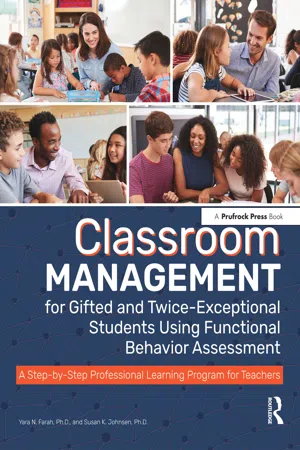
Table of contents
- Cover Page
- Half Title Page
- Title Page
- Copyright Page
- Table of Contents Page
- Introduction
- MODULE 1 Characteristics of Gifted and Twice-Exceptional Students
- MODULE 2 Beliefs About Classroom Management
- MODULE 3 Influences on Behavior: The A-B-C Model
- MODULE 4 Defining and Describing Behaviors
- MODULE 5 Antecedents and Contextual Variables
- MODULE 6 Identifying and Describing Consequences
- MODULE 7 Identifying Schedules of Reinforcing Consequences
- MODULE 8 Analyzing Data to Examine Functions: Developing a Hypothesis
- MODULE 9 Implementing a Behavioral Intervention With a Student
- MODULE 10 Creating a Classroom Environment That Influences Desired Behaviors
- Glossary
- References
- About the Authors