eBook - ePub
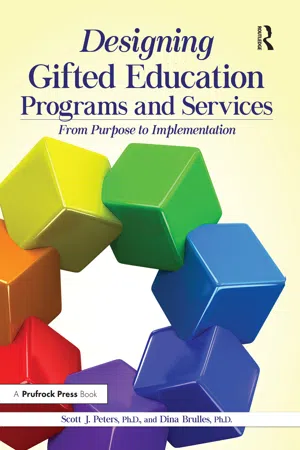
Designing Gifted Education Programs and Services
From Purpose to Implementation
- 240 pages
- English
- ePUB (mobile friendly)
- Available on iOS & Android
eBook - ePub
Designing Gifted Education Programs and Services
From Purpose to Implementation
About this book
This book is intended to support educators in the design and implementation of comprehensive gifted education plans. From planning to actual implementation, this book takes the reader from goals and purpose to assessing student needs and program design. The authors begin with a broad overview of best practices in programming and services, highlighting connections to student needs, programming standards, and state laws. Their recommendations include philosophical, cultural, and practical considerations and data-based decision making. In this book, Peters and Brulles guide the reader through the process of determining the most optimal programming methods for schools to take based on their individual needs and circumstances. With this book, schools will be able to design and develop programs and/or services that lay the foundation necessary to ensure all students are appropriately challenged.
Information
PART I
BEST PRACTICES
CHAPTER 1
ESSENTIAL ELEMENTS OF GIFTED EDUCATION
DOI: 10.4324/9781003234081-3
GUIDING QUESTIONS
- Why have gifted education?
- Why devote funds and resources to kids who are already proficient when so many kids are not?
- Why devote additional funds and services to kids who are already privileged?
- Won’t gifted education exacerbate achievement gaps and make inequality even worse?
If you’re in gifted education and you haven’t had to address these questions yet, be assured that you will at some time! Although many in gifted education tire of them, it’s important to have reasoned, rational answers to these and a host of other questions. In an ideal world, it’s even better if these kinds of questions can be headed off before they are asked by having in place a comprehensive gifted education plan and communicating it effectively.
Something that continues to shock practitioners and researchers in gifted education is just how rare it is that a program or intervention for advanced learners has an explicit goal for its reason for being. If a parent or school board member can walk up to you, ask you what the goal is for the local gifted program, and you don’t have an answer at the ready, then your program may not be around for long. Many definitions of “giftedness” exist, and we will discuss some later on, but the actual “why” of gifted education is rarely made explicit. In this book we will proceed as if the general purpose of any gifted education program, service, or intervention is to more appropriately challenge those who have unmet academic needs. Implied in this goal is that the unmet need is at the advanced end of the spectrum, although as we will discuss, the process should be the same in developing services for those who have unmet needs for remediation or those who have needs related to language development or a disability. Our goal for everyone is to better personalize learning and align educational interventions to student needs.
In conversations with educators who have long experience in gifted education, we have heard concerns about the use of the term academic when talking about the purpose of gifted education. It is important we make clear that the term academic does not simply refer to math and reading, nor does it only include the more traditional school subjects of science, social studies, and language arts. Our definition of academic is more liberal and includes any subject area or domain for which the broader school community has decided to provide services. For example, in rural Wisconsin, many schools have strong agriculture programs and credit-bearing courses, while others in urban areas have begun expanding computer science offerings. Such courses are part of their academic offerings. These schools will have some students who are just beginning their exposure to these domains, while others have long history with them, thus necessitating a range of service levels. For these reasons, gifted education does not carry specific domains. Rather, the domains of service are locally determined based on the philosophical, cultural, and practical values of the school and community.
With all of that out of the way, there are a few golden rules that will guide Part I of this book that we recommend any gifted coordinator also keep in mind while drafting a gifted education plan.
- The primary purpose of any service provided under the label of “gifted education” should be to alleviate an otherwise unmet advanced academic need. These needs are and should be locally defined and continually, proactively evaluated.
- Any gifted education plan should make it clear how student needs will be assessed and how programs to be provided are in line with and would help alleviate student needs.
- Any gifted education plan should be explicit in how its implementation would place the school or district in compliance with state rules, regulations, or laws. Ideally, GT plans would also outline how they align to the National Association for Gifted Children’s Pre-K–Grade 12 Gifted Programming Standards (2010; see Appendix A).
One of the first things we will discuss in the next chapter is how to understand and identify student learning needs and the degree to which they are or are not being met by existing services. Gifted education has long been interested in student needs, often measuring them with ability or intelligence tests. But having an advanced level of need (or ability) is not sufficient to determine if a student requires additional, supplementary services, and if so, what type of service. This is why we try to be careful and use the term unmet academic needs. For example, in roughly 5% of American schools, the average student achievement is around the 95th percentile on a national norm. This means that for 5% of American schools, half of the students are above 95% of their peers from around the country (Lohman, 2006). The traditional model of gifted education would see many, if not all, of these students as gifted. But the more important question, and the one most relevant for schools, is whether or not these students are being sufficiently challenged in their learning so that they can continue to grow and develop.
Simply knowing a person’s level of ability, need, or intelligence is necessary but not sufficient to answer this question. For this reason, much of the next chapter will talk about how to determine what needs are currently going unmet by the curriculum and services that are already offered in your school or district. This perspective of gifted education being in place in order to better challenge students who are otherwise underchallenged, is nothing revolutionary. The following is the federal definition of giftedness:
Children and youth with outstanding talent perform or show the potential for performing at remarkably high levels of accomplishment when compared with others of their age, experience, or environment. These children and youth exhibit high performance capability in intellectual, creative, and/or artistic areas, possess an unusual leadership capacity, or excel in specific academic fields. They require services or activities not ordinarily provided by the schools. Outstanding talents are present in children and youth from all cultural groups, across all economic strata, and in all areas of human endeavor. (U.S. Department of Education, 1993, p. 3, emphasis added)
The italicized sentence in this definition is often overlooked but it makes an important point. In addition to exhibiting high-performance capability, gifted learners are those who require services or activities not ordinarily provided. To us, this is critically important, as it states that part of the goal of gifted education is to seek out those who require services or supports that are not provided by a given school as part of their regular curriculum. This is why any good gifted education program must start by understanding who is and is not likely to be appropriately challenged by existing services (in Chapter 4, we discuss the need to modify services when the existing model[s] do not address gifted students’ unmet academic needs). In the ideal world where every child is perfectly challenged by a universally flexible range of services, schools would have no need for gifted or special education.
One of the implications of what we’ve presented so far is that gifted education, with its identification procedures and services, is inherently local. The needs of one particular building could be different from a building across town, which means the services will need to look different as well. “Gifted” is not a static, permanent trait of people, but rather represents a dynamic and ever-changing need for services beyond what is currently being provided. Although the services offered and level of interventions might look different across different schools, what should be universal is that every building has a plan in place for how it will search out and select or create services to make sure all students are challenged in their learning. It doesn’t matter if what is needed is teaching a 16-year-old to read or a 9-year-old how to do calculus. The goal for every student is the same—to alleviate unmet academic needs so that every student is appropriately challenged. How this happens and what the process looks like is the meat of a gifted education plan.
A further implication of our second point from above is that programs or interventions are provided to those who have a need for or would benefit from them. This also means that students are not kept out of programs or services unless there is evidence that students will not benefit from them. There is a somewhat-famous statement in gifted education that if an intervention or curriculum is something all students would want to do, could do, or should do, then it’s not really gifted education. For example, learning math with manipulatives is something that many students would probably prefer to lengthy worksheets. It’s also something that is probably good for all students to practice so that they can think more broadly about math and not just apply math with pencil and paper. Because of these facts, the chance to learn math with manipulatives should not be restricted to identified “gifted” kids, as many more kids would likely want to work with them, should work with them, and could learn better with them. The same can be said for curriculum on critical or creative thinking, project-based learning, or real-world applications. All of these topics are important for all students to learn and be exposed to and as such, they should not be reserved solely for identified gifted students.
Every district must function within the broader context of the state in which it exists. There are also national laws and regulations to consider as well as best practices and standards. For all of these reasons, the following section outlines the current state of the nation with regard to gifted education requirements followed by an overview of what some states do. After reading this section, we recommend the reader review his or her state’s page on the National Association for Gifted Children’s State of the States report as well as the Davidson Institute’s state policy page for his or her particular state. Although we think it’s important to know what is happening across the country with regard to gifted education, state-level requirements are the most relevant to crafting gifted education plans.
STATE OF THE NATION
Often, the “why” of gifted education is a state law or regulation requiring identification, services, or both. Throughout the country, there are laws at the state and federal level that districts need to comply with. Of course, these laws are enforced to a wide degree—some, we would argue, are not being enforced at all. Still, what we present in the following section are the main laws at the federal level that relate to gifted education followed by an overview of state rules and regulations with a few in-depth examples. As we said earlier, any gifted education plan should address how the district will be in compliance with any state laws or regulations. For some, this will be easy (because there aren’t any state regulations), whereas for others, this will be an exhaustive process.
HIGHER EDUCATION OPPORTUNITY ACT
Before we outline what individual states require in terms of gifted and talented education, it’s worth addressing what is actually required by the federal government. Most veteran gifted education practitioners would say there isn’t any federal mandate for gifted education (which is true), but in the last 10 years, a number of changes have been made to federal law that relate to advanced learners. First, in summer 2008, President Bush signed the Higher Education Opportunity Act (HEOA) reauthorization into law. This reauthorization made three important changes. First, it redefined “teaching skills” to include the ability to identify the needs of and tailor instruction toward gifted students (among others). This was a consequential change because much of HEOA’s emphasis on teaching skills dealt with how colleges and universities prepared teachers. In a less-than-direct way, HEOA mandated that all teachers be trained in how to identify and serve gifted and talented learners. Given the near-nonexistent training that most preservice teachers receive in gifted education, this seemed like a monumental change.
The HEOA also required states to issue report cards on the quality of teacher preparation programs, including information on how they were assuring their pre-service teachers’ mastery of “teaching skills” as defined in HEOA. In other words, there was some accountability built in to say that each state had to report on how it was assuring all preservice teacher candidates were proficient in the federally defined teaching skills, which, as discussed in the previous paragraph, now included gifted education teaching skills. The final change to HEOA required that any teacher preparation program that received Title II funds must include the “teaching skills” of preservice education students as an outcome. If taken as intended, this would mean any university receiving Title II money would have to at least consider how its programs would support preservice teachers’ knowledge development with regard to gifted and talented education. If truly implemented with fidelity, HEOA would have injected gifted education into every teacher education program in the country.
Unfortunately, there’s little reason to believe that states implemented the HEOA requirements as intended. Most states simply needed to...
Table of contents
- Cover Page
- Half Title Page
- Title Page
- Copyright Page
- Table of Contents
- Foreword
- Introduction: The Importance of a Board-Approved Plan
- Part I: Best Practices
- Part II: District Plans
- References
- Appendix A: NAGC Pre-K–Grade 12 Gifted Programming Standards
- About the Authors
- About the Contributors
Trusted by 375,005 students
Access to over 1.5 million titles for a fair monthly price.
Study more efficiently using our study tools.
Frequently asked questions
Yes, you can cancel anytime from the Subscription tab in your account settings on the Perlego website. Your subscription will stay active until the end of your current billing period. Learn how to cancel your subscription
No, books cannot be downloaded as external files, such as PDFs, for use outside of Perlego. However, you can download books within the Perlego app for offline reading on mobile or tablet. Learn how to download books offline
Perlego offers two plans: Essential and Complete
- Essential is ideal for learners and professionals who enjoy exploring a wide range of subjects. Access the Essential Library with 800,000+ trusted titles and best-sellers across business, personal growth, and the humanities. Includes unlimited reading time and Standard Read Aloud voice.
- Complete: Perfect for advanced learners and researchers needing full, unrestricted access. Unlock 1.5M+ books across hundreds of subjects, including academic and specialized titles. The Complete Plan also includes advanced features like Premium Read Aloud and Research Assistant.
We are an online textbook subscription service, where you can get access to an entire online library for less than the price of a single book per month. With over 1.5 million books across 990+ topics, we’ve got you covered! Learn about our mission
Look out for the read-aloud symbol on your next book to see if you can listen to it. The read-aloud tool reads text aloud for you, highlighting the text as it is being read. You can pause it, speed it up and slow it down. Learn more about Read Aloud
Yes! You can use the Perlego app on both iOS and Android devices to read anytime, anywhere — even offline. Perfect for commutes or when you’re on the go.
Please note we cannot support devices running on iOS 13 and Android 7 or earlier. Learn more about using the app
Please note we cannot support devices running on iOS 13 and Android 7 or earlier. Learn more about using the app
Yes, you can access Designing Gifted Education Programs and Services by Scott J. Peters,Dina Brulles in PDF and/or ePUB format, as well as other popular books in Education & Inclusive Education. We have over 1.5 million books available in our catalogue for you to explore.