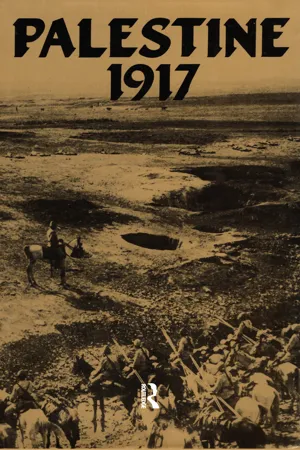
A personal account of all ranks of the Yeomanry regiment, by a soldier who served in Sinai, Palestine and Syria. The Yeomanry regiments were originally raised in 1794, as a part of the volunteer forces, it was administered by the Home Office until 1855 when the War Office took over. The Yeomanry is most part consisted of the 'Yeoman of England, with noblemen and gentlemen as officers'. Wilson often touches upon the daunting conditions which were the ever-present background to the campaigns in which he took part. A likeable and remarkable character of the old yeoman class, his letters and correspondence notes the elation, dejection, of tedium and anxiety of desert warfare.
- 184 pages
- English
- ePUB (mobile friendly)
- Available on iOS & Android
eBook - ePub
Palestine 1917
Chapter 1
On January 19th 1915, my 21st birthday, feeling that at last I was free – and knowing only too well that I should have gone months before – I slipped away to join the Berkshire Yeomanry. Although this was the most crucial day of my life it was also one of the most amusing. There was one other recruit, a man named Cook, a gamekeeper and some years older than me. After having caps without badges banged on our heads and being given uniforms with unpolished buttons, the traditional [King’s] shilling and a railway warrant, we were told to march to the station to join the regiment. The recruiting sergeant had told us that we were now soldiers – a gross overstatement – and that we should now look out for officers and be sure to salute them. So the two new soldiers marched up the main street of Reading with our civilian clothes in a newspaper parcel and, to satisfy our conceit, halted for a few seconds to see our reflections in a shop window. We were so horrified at what we saw that we felt like running to the station.
Officers were plentiful that morning and, when we met the first one, Cookie remembered what the sergeant had told us but, instead, raised his cap – without removing the huge carved pipe from his mouth. I got him to a doorway and told him that no doubt the officer would overlook the raising of his cap as a substitute for a salute but I thought the pipe was going a bit far. He duly changed over to a cigarette and when the next officer appeared Cookie’s hand was halfway to his cap when I said “Your fag, Cookie.” He only succeeded in jamming the burning cigarette into his mouth and spitting and spluttering whilst the officer walked past. Dear Cookie, we parted in 1916 when I got my Commission.
We were in the second line of the Berkshire Yeomanry, the first line being at full strength on mobilisation, and were billeted in a huge mansion called ‘Bearwood’ just outside Reading. My brother Ted had joined us and we were, of course, ‘troopers’. As far as merit was concerned we should have so stayed but due to the fact that our squadron leader was a very close friend, Master of Lady Craven’s Harriers and joint Master of the old Berks Hunt – country in which our farms were situated – we gradually reached the rank of lance corporal – unpaid. As a trooper my first pay day netted me five shillings and fourpence and I told the sergeant major that I thought I was at least in the bob-a-day category but he simply said, “One and eightpence stopped for breakages.” I hadn’t been there long enough to break anything but he showed very commendable foresight as I was, in due course, to break every possible rule that ever appeared in King’s Regulations.
This was soldiering in its very lowest form, far removed from the glamour and heroics that I had pictured during the Boer War when I was six years old. Although we were supposed to be a cavalry regiment we had no horses – but we all had to wear spurs. The recruits from the towns fell over these spurs as often as they fell off their horses when they eventually arrived. Boredom was complete; it all seemed such a waste of time after the busy lives we had led at home.
My brother Ted was bright enough to create a separate command of his own. One of the officers, Captain Crundell, a motor enthusiast, got on very well with Ted and let him tinker about with his cars. So Ted bought a motor bike and suggested that Captain Crundell should persuade the colonel that he really ought to have a despatch rider, and that he knew of one who was already equipped with a motor bike. The colonel was rather flattered and agreed at once. Ted was issued with a pair of goggles, and to all intents and purposes reverted to private life. He never appeared on parade again but would occasionally be seen sailing past, with a pretty Irish nurse from the hospital riding pillion.
As time went on we were issued with rifles which were coated with the most filthy looking grease, so repulsive in appearance and smell that I accepted mine with finger and thumb. The quartermaster was foolish enough to say that they had been stored in that condition for 15 years and no harm had come to them. I decided that mine should remain in that condition for another 15 years and, if any harm should come to it, I couldn’t care less! I certainly wasn’t going to clean the wretched thing; when I was on guard duty I used to borrow one from the cooks. Guard duties were a farce. There were three sentry boxes; one by the main entrance and the other two on minor gateways. The orderly officer was most punctual and always appeared at lOpm; we knew that after that it was safe to leave our posts and withdraw to the guard-room to drink beer and play cards for the rest of the night.
One beautiful spring morning I thought I should like a breath of fresh air and, as everyone else was asleep, I picked up a rifle with bayonet attached, lit my pipe and went for a stroll along the front of the mansion. When it became fighter I realised that I was rather conspicuous, being in full view of all the officers’ windows, so I decided to occupy the sentry box at the main gate. I leant the rifle in one corner, sat down and covered myself with my great-coat preparing for a little beauty sleep. I gradually became aware that I was being observed by someone and it turned out to be none other than Colonel J B Karslake, who I believe was MP for Paddington, was over 6ft 6ins tall, always immaculately turned out and never without a huge monocle and an outsize bicycle that he’d had specially built. I staggered to my feet and picked up the rifle. I remembered that one should present arms to the colonel, but he was standing too close to allow me to get outside so I decided to do the best I could from inside. I flung up the rifle with such zeal that the bayonet stuck firmly in the roof and all my tugging failed to remove it. The best thing I could do was to stand stiffly to attention with the wretched rifle dangling about in front of my face. By this time I had become slightly embarrassed and the fact that the colonel remained absolutely silent, though probably fascinated, by the display, added to my embarrassment. Finally: “What’s your name?” “Wilson, Sir.” “Squadron?” “C Squadron, Sir.” “You will hear more of this.” No doubt he told Major Nickisson, my hunting squadron leader, to have me shot at dawn – but I heard no more about it.
The aim of everyone was to escape the day by day boredom so, when the entire regiment was on the parade ground one afternoon and the squadron sergeant major came up to me and said: “You speak French, don’t you?” I immediately sensed something to my advantage and said “Yes, sir.” Just as the Colonel gave the order “Section: right, quick march” the sergeant major shouted: “Trooper Wilson, fall out.” I dropped to the rear and, when the regiment had disappeared from sight, he came across to tell me to get ready to go into Reading as he wanted to take two Belgian refugee girls out to tea. This was a great improvement on a route march on a cold January afternoon. He explained on the way that I was required simply because his French was not “very hot.” I had grave doubts about my own.
When we arrived at the house, I was saddened to see about twenty Belgian ladies of all ages in the one room. The only furniture was a table which had on it a large pot of jam, two loaves of bread, one knife and one spoon. It was not surprising that the girls wanted to be taken out for tea. My worst fears were realised when we found it quite impossible to exchange a single word as they spoke Flemish. Fortunately the sergeant major knew the names of the two lucky girls, Marie and Marcelle, so we were able to nudge them away from the rest of the party. I don’t think it was mere coincidence that they happened to be the youngest and prettiest of the lot: the old man had obviously carried out some reconnaissance. He was the most gentle NCO I had ever met; a huge man who had represented Britain in the Olympic Games heavyweight boxing. He reached the final and would probably have won but for the fact that he had already fought another tough bout the same day.
The tea party was a great success despite the complete absence of any conversation. The advantage accruing to me was the fact that two or three days a week, and every Saturday, I would get the order to ‘Fall out and prepare for tea.’ This routine continued for some months until we were moved to a camp under canvas.
As the weather improved we moved to Churn Camp where we began to assume a more soldierly outlook. We were under canvas, the horses had arrived and by the end of the summer we were ready to take our place at the front; fit, tough and well-officered. We then experienced a set back, instead of going overseas, as we had hoped, we were moved up to King’s Lynn and dotted about in good billets with its most hospitable population. The flesh-pots were again available, pictures, dances, theatres and, although we were supposed to be in our billets by lOpm, there were no means of ensuring that we were; we soon became soft, disgruntled and discipline just went to the winds. In November 1915 when we were anticipating a snug comfortable winter in our billets, we received a shock. It was decided that the entire regiment would be accommodated in – of all places – the disused workhouse, and the entire regiment decided that it would not. Fatigue parties were sent there daily to get the place tidied up and ready to receive us. This work was always done with “tongue in cheek” as we had no intention of moving in but we underestimated the power and cunning of the regular Regimental Sergeant Major Tommy Lester. He was typical of his rank with an unlimited capacity for beer but always on top of his job and he was to give us a neat and efficient demonstration of how to break up a mutiny.
The order eventually came that we should parade in the Town Gardens situated close to the workhouse at 2 o’clock complete with kit and equipment. That order, of course, had to be obeyed but the fact that it was fixed for a Saturday afternoon indicated at once that our determination not to move had reached the ears of authority, and we scented cowardice as nearly all the officers were on leave at week-ends. This suspicion was confirmed when we found ourselves in the charge of the orderly sergeant. No sign of an officer or the regimental sergeant major – it all seemed so easy. It was fair enough when the orderly sergeant said “Shun”; “Pick up your kit bags” was fair enough too and we obliged; then “Right turn, quick march” and no one moved. He repeated the order three or four times but still no one moved and we felt that we had won the day.
It was at this point that the RSM emerged from an adjacent garden with about ten military policemen. The police lined up behind us, while he took up a position about 20 yards in front. He glared at us with a look of scorn and disgust and applied every adjective in his vocabulary to insult – what he called – the worst bloody example of Fred Karno’s Army he’d ever seen. We were beginning to feel a bit shaken and I was wondering what would happen when he ceased abusing us and gave the order to “Quick march”; but he was too wise an old fox to take that risk. He walked up to a little man, “Tubby” Brown, who was about three files from me, placed his nose within about two inches of Tubby’s and then, with a roar like a lion, yelled: “Brown, pick up your kit and proceed to the workhouse.” Poor Tubby yielded and when he had gone out of sight, the RSM dealt with one or two more in the same way, and eventually the whole mob of us were dribbling away like a host of refugees. I don’t know what would have happened if he had picked on me instead of Tubby Brown and, although I was one of the ring leaders of the revolt and his particular “problem child”, I don’t think I should have had the courage to defy him. However, neither my brother Ted nor I ever spent a night in the new quarters. We came to an arrangement with our landlady to stay on and soon the house was full of cronies who found the damp, cold, evil-smelling workhouse intolerable.
The regimental sergeant major who had dealt so efficiently with this silly situation retired soon afterwards. We had all been very good friends off parade, and when he accepted our invitation to a farewell party we bought him a great deal of beer and sang “For he’s a jolly good fellow” as indeed he was. He was succeeded by another regular soldier with 35 years service and from the start we did no get on well. One incident made matters worse. Four of us wanted to go to the Fatstock Show at Smithfield and, as I knew it would be useless to ask the RSM to get our passes signed, I asked the orderly sergeant to slip them to my friendly squadron leader who I knew would not refuse me.
When the RSM’s attention was temporarily distracted the orderly sergeant handed them to Major Nickisson who just glanced at the names, scribbled his signature and sent them back to me. When the RSM discovered I had pulled a fast one he went up to Major Nickisson and said, “Beg pardon, Sir, but have you just signed some passes?” When told he had done so, the RSM said “We already have about twenty men on the sick list, a lot of extra duties and we are reduced to one man to two horses and it is impossible to allow any more 48 hour passes.” “Oh,” said Major Nickisson, “Get me a blue pencil and fetch the passes back from Wilson.” The look of satisfaction on the RSM’s face was equalled only by the disappointment on mine as I handed them back. He went, collected a blue pencil and returned to Major Nickisson who, again, scribbled on the passes. If ever a man looked like a whipped dog it was poor old RSM Trowbridge that afternoon; written in huge letters from one corner to the other was just one, blue-pencilled word “Special”.
The wrath of the RSM which I knew was to come occupied my mind on the train back to King’s Lynn after the Smithfield show. This journey was also nerve racking for another reason. One of our group, Tylee Norman, had collected a two-gallon jar of home-made sloe gin from his people at the Show and this was obviously a very precious piece of luggage.
The train from Liverpool Street was always over-crowded with soldiers and sailors returning from leave and I was fearful for the jar of sloe gin in such company. I had carried out a reconnaissance before the train set off and found an empty first class compartment in the next carriage. The corridor door was locked to prevent any infiltration from the third class to the first, so the four of us decided that we would have to get out onto the running board as soon as the train started and transfer by that route to the first class compartment.
As usual I was “muggins” and had to go first, with the jar of gin hanging from my shoulder by a strap. The night was pitch black, the train was travelling at sixty or seventy miles an hour and the rush of cold air, smoke and dust that I encountered as soon as I stepped outside nearly unshipped me. I had no control over the jar at all as both hands were fully occupied maintaining a hold, and I could not stop it banging against the windows as I sidled along the running board.
Eventually I reached the end of the carriage and had to negotiate the gap to the next one. Although it was too dark to see anything, I knew that there were bumpers on each carriage which would help me to step from one to the other; with the vacuum hose representing a very chancy safety net. I waited for a few moments to see if I was being followed, straddling between the two carriages, and then progressed until I found the empty compartment. There was still one big problem: the door had to be opened towards me. I was prepared for trouble when the door flew open but the impact was even more violent than I had expected. However, instead of knocking me off the catwalk, it pushed me flat against the train and I was wedged between the door and the window. I could not even spare a hand to jettison the jar which would have been the most sensible thing to do in the circumstances. It seemed that the engine driver was going flat out and must have been having the time of his life. I looked back to see if anyone had tried to follow me but all I could see was a row of heads at the windows I had passed and nearly smashed with the jar.
Some time later the ticket collector came in, touched his hat, and said, “Good evening, Sir.” Then he noticed the one stripe and his attitude changed abruptly. “And how in Hell did you get here?” When I told him he was quite incredulous and said it was not possible. However the jar with the tin mug on the top of it seemed to interest him and he stayed for half an hour in which time we became the best of friends! A pity the rest of the party derived more satisfaction from the survival of the sloe gin than of me.
I was soon to encounter trouble from RSM Trowbridge again. Horses were very scarce and we had a number of remounts from Canada. Not only were they old and unbroken but some were literally wild animals; to groom them required a team of three or four men and to shoe them was virtually impossible. Six of us had been detailed to break them in and we were known as the “Rough Riders”, but I don’t remember if that was an official title or one we had assumed ourselves. One big advantage was that it enabled us to dodge parades.
One brute about 13 years old and of nearly 17 hands had apparently never been touched. We were determined to get some shoes on this particular horse and I had managed to get a rope over his head and armed myself with a shackling peg, half wood and half iron, weighing about 7lbs which I think would have felled him. When I was in control at his head I was to give the others the tip and they would try and get some ropes round his hind legs, so that we could throw him. I took my eyes off him for a fraction of a second, to signal the others, when he turned like a flash and bit my stomach, shook me like a dog would have a rat, and then threw me about ten yards. I was winded and knocked out and, when I was able to look at my stomach, I could see that he had torn off a piece of skin as big as my hand and I was bleeding like a pig. The doctor had to patch me up; and told me that on no account was Ito do any duty for a week.
All men on sick list had to be in their billet by 5pm. It so happened that I had arranged to take one of the sisters from the hospital to the cinema that evening. She was rather late arriving, the cinema was in complete darkness and we were told to take two seats along a certain row. After treading on toes and falling over knees we eventually found the seats and settled down to enjoy the picture. I had just finished telling the sister about my mishap and what the “so and so” sergeant major would do if he knew I was at the pictures when the light went up – she was sitting between me and RSM Trowbridge! He did not speak but, as he and his lady friend got up to leave, he made a special effort to tread on my toes and hit my honey knees.
He sent for me the next morning and I met him with a smile, prepared for anything. “A man who can be in the cinema at 11 o’clock at night is fit to parade in the morning. Saddle up and fall in.” There was to be a parade of the whole division and the regiment was very much below strength. I should have been in hospital and was quite incapable of getting on a horse. To convince him I undid my shirt and showed the blood-stained bandages and terrible bruises. All he said was “Good God” then, “Can you ride a motor bike?” My brother Ted’s despatch riding squad had by now increased to six but there were only four men available – an added headache for poor Trowbridge. I had never ridden a motor bike in my life – except p...
Table of contents
- Cover Page
- Title Page
- Copyright Page
- Table of Contents
- Foreword
- Acknowledgements
- Introduction
- 1. Army experiences in England
- 2. General Introduction to the Middle Eastern campaign and to the Royal Gloucestershire Hussars Yeomanry in particular. En route to Egypt – settling in with the Regiment
- 3. “Baptism of Fire” at Romani, August 1916
- 4. Movements in Egypt: action at Rafa – and wounded
- 5. In hospital Port Said and convalescent at Alexandria. Preliminaries and first two battles for Gaza, Spring 1917
- 6. Summer 1917 – stalemate – the lighter side of desert warfare – General Allenby takes over – on course in Cairo and leave in Alexandria
- 7. Success at Gaza – Cavalry charge at Huj – “Jerusalem by Christmas.”
- 8. 1918 – significant meeting in Cairo – Spring and summer in the Jordan Valley – abortive expedition across the Jordan
- 9. The “Big Push” – the jaws close at Damascus
- 10. Malaria at Baalbek – Macabre adventures in Beirut – end of active service
- 11. Journey home 1919 – “Hero’s welcome?”
- Postscript
Trusted by 375,005 students
Access to over 1.5 million titles for a fair monthly price.
Study more efficiently using our study tools.
Frequently asked questions
Yes, you can cancel anytime from the Subscription tab in your account settings on the Perlego website. Your subscription will stay active until the end of your current billing period. Learn how to cancel your subscription
No, books cannot be downloaded as external files, such as PDFs, for use outside of Perlego. However, you can download books within the Perlego app for offline reading on mobile or tablet. Learn how to download books offline
Perlego offers two plans: Essential and Complete
- Essential is ideal for learners and professionals who enjoy exploring a wide range of subjects. Access the Essential Library with 800,000+ trusted titles and best-sellers across business, personal growth, and the humanities. Includes unlimited reading time and Standard Read Aloud voice.
- Complete: Perfect for advanced learners and researchers needing full, unrestricted access. Unlock 1.5M+ books across hundreds of subjects, including academic and specialized titles. The Complete Plan also includes advanced features like Premium Read Aloud and Research Assistant.
We are an online textbook subscription service, where you can get access to an entire online library for less than the price of a single book per month. With over 1.5 million books across 990+ topics, we’ve got you covered! Learn about our mission
Look out for the read-aloud symbol on your next book to see if you can listen to it. The read-aloud tool reads text aloud for you, highlighting the text as it is being read. You can pause it, speed it up and slow it down. Learn more about Read Aloud
Yes! You can use the Perlego app on both iOS and Android devices to read anytime, anywhere — even offline. Perfect for commutes or when you’re on the go.
Please note we cannot support devices running on iOS 13 and Android 7 or earlier. Learn more about using the app
Please note we cannot support devices running on iOS 13 and Android 7 or earlier. Learn more about using the app
Yes, you can access Palestine 1917 by Robert Wilson, Helen D. Millgate in PDF and/or ePUB format, as well as other popular books in History & Middle Eastern History. We have over 1.5 million books available in our catalogue for you to explore.