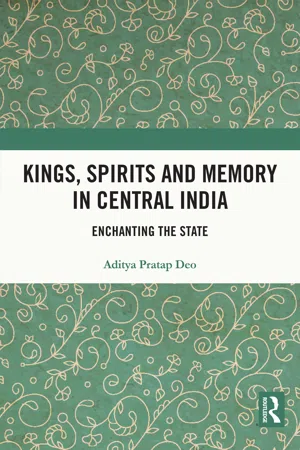
Part anthropological history and part memoir, this book is a unique study of the polity of the colonial-princely state of Kanker in central India. The author, a scion of the erstwhile ruling family of Kanker, delves into the oral accounts given in the ancestral deity practices of the mixed tribe-caste communities of the region to highlight popular narratives of its historical polity. As he struggles with his own dilemmas as ethnographer-king, what comes into view is a polity where the princely state is drawn out amidst a terrain of gods and spirits as much as that of law courts and magistrates, and political power is divided, contested and shared between the raja/state and the people. This study constitutes not only an intervention in the larger debate on the relationship between state formations and tribal peoples, but also on the very nature of history as a knowledge practice, especially the understandings of power, authority and sovereignty in it.
Combining intensive ethnography, complementary archival work and crucial theoretical questions engaging social scientists worldwide, the author charts an unusual explanatory path that can allow us to obtain a meaningful understanding of societies/peoples that have historically been marginalized and seen as different. This book will be of interest to students and researchers of history, anthropology, politics, religion, tribal society and Modern South Asia.
As I set out to explore the ways in which the people of Kanker understand its historical polity through their ancestral deity (anga deo) practices, what I want to begin with is an account of my journey – a personal story – to this project. And that is because this project is deeply bound up with who I am. However, this is an itinerary that I can piece together only from hindsight and with considerable difficulty. What follows is therefore an account constructed through the haze of memory, and from existential doubts and dilemmas albeit an account that seeks to provide as full a personal context to this project as possible because, as will become clear in the following pages, this is of critical importance. The itinerary that I trace back is not about a clear path to a known destination but offers a view of a repeatedly confused movement, and points to the impossibility and even undesirability of, as it were, “getting it right.” The project itself has hardly been any consolation of a destination reached, but has become a tentative vantage from which other horizons beckon, other journeys are intimated. The emplotment of this itinerary is also particular and selective, meant to contextualize this project, and cannot claim to give a comprehensive account of all the things upon which the itinerary touches. This is about how I have struggled to get a sense of my relationship with the project and to understand what it implies both for the project and for me. It is at best, as J. N. Mohanty says, a “frail, always-at-risk self-gathering of a person to come to terms with one’s past, with one’s projects and tradition.”2 This account is then, on one level, a kind of ethnographic memoir, an autobiographical essay, which is how several parts of this work will read. I therefore beg your indulgence.
Early Impressions
My first memories of the anga deo, the ancestral deities of the peoples of Kanker, are from my childhood experience of the annual three-day madai (annual fair) in the town of Kanker in the 1970s. I loved going to the fair with my sister, escorted by our caretaker. Vendors of clothes, ornaments, toys, household implements, sweets and snacks would set up their colorful stalls in a designated area of the town called the madai-bhata (fair-ground) near Garhiya/Qila Pahar (Fortress Hill), a majestic hill that towers over the town and the river Dudh, a seasonal stream that forms a loop around this neighborhood. There was always also a mina bazar in the madai, at the far end of madai-bhata, just at the foot of the hill: a collection of children’s games and amusements, including a magic show and a giant wheel. It was fun being part of the excitement and festivity of the madai and I greatly looked forward to it every year.
However, there was another aspect of the madai that thrilled me but also made me nervous, especially because it happened right in my house, the palace of the raja of Kanker,3 who was my father. The madai began with a ceremony in which the two anga deos kept by our royal family, the brothers Bade Pat and Chhote Pat anga deos (henceforth Bade and Chhote Pat),4 and several others from the villages in the vicinity of Kanker town, were received at the palace and propitiated by my father and other members of our royal family. Bade Pat was housed in the temple of goddess Shitala,5 which had been built and endowed by my ancestors but is now under a public trust, and Chhote Pat was kept in the Old Palace.6 These anga deos, as is their most common form, each comprised two rounded logs of wood joined in the middle by a cross-bar adorned with ornaments, and were carried on the shoulders of four men. Once hoisted on the shoulders of the bearers, the anga deos moved at will.
The anga deos would assemble at the New Palace, where we lived, before the ceremony began and were accompanied by a large crowd of people (Figure 1.1). Many among the people carried dang (tall poles) decorated with flags – gods of various kinds associated with the anga deo – that teetered precariously from one side to another. There were also people who were possessed by different deified spirits and other gods, and they shook their bodies vigorously and hit themselves with sticks and metal chain as they danced to the loud and frantic rhythms of drums. Along with them came the flower-sellers with their baskets of bright yellow and orange marigold flowers: they threw petals on the anga deos and people alike with abandon (Figure 1.2).
Figure 1.1 Anga Deos and people at the Palace for madai. (Source: Personal Collection)
Figure 1.2 The madai scene at the Palace. (Source: Personal Collection)
The anga deos would race into the palace compound and hurtle straight into the central Darbar Hall (audience room) of the palace. Sometimes, one of them would throw a tantrum and stop at the outer gate some distance from the palace and my father had to send the raj-dand (royal scepter) to persuade the sulking anga deo to come to the palace for the madai ceremony. Once inside the palace, they stomped around restlessly. The bodies of the carriers, swaying to the beats of the drums, lurched dangerously from side to side. My mother would be at her wits end, trying to get our servants to control the anga deos so that they did not crash into valuable trophies and other objects with which the rooms of the palace were decorated. Most of the time the servants failed and my father had to hold the anga deos back by the touch of his hand, a touch that I observed was at once gentle and firm. I used to be amazed at the way in which he seemed to become part of the occasion so completely and at how the anga deos responded to his touch.
Eventually, he would have to shepherd them out of the palace rooms and lead them to an open area in the palace compound where the rituals of propitiation were to be conducted. The propitiation, referred to by the terms puja (worship) and seva (service), consisted of offering flowers, sandalwood paste, vermilion, turmeric and oil to the anga deos, and usually took about half an hour, and my father, standing in the middle of a circle of gods, almost locked in, had to attend individually to all the gods surrounding him.
Meanwhile, the drumming and dancing around this central space would reach a fever pitch, and then, suddenly, as the rituals were completed, the gods would begin to leave for the madai-bhata, where they would inaugurate the fair. My father stayed on till he had seen each of the gods off, his raj-dand by his side, but then he too would leave for the madai-bhata to perform the final rituals of propitiation at the site of the madai. The rush of gods and people in a somewhat unwieldy procession meant that all of us who were watching had to clear the path quickly and stay out of their way lest we collide with them. I would heave a sigh of relief as I saw the end of the procession exit the outer gate, and as the sound of the drums faded away in the distance.
Apart from the madai, the anga deos were not a significant presence in my life as a child. I left home to attend boarding school in 1976 when I was aged six years, and came home only for short periods, one of them being the winter holidays in December–January, when the madai was held. My father told me that in the past there was a similar but grander event held during the festival of Dasehra,7 when hundreds of anga deos would come to the palace, but this event had lapsed over time. The royal anga deos were present at all important family functions but in these instances they would lie quietly where they had been placed, with a very different demeanor from that of the madai. At other times, I would see the pujari/gaita (priest) of the royal anga deos visit our home and talk to my father about what seemed clearly to be weighty matters.
Some of the apprehension that I felt regarding the madai would return when I accompanied my parents to the temples where these anga deos were housed, especially that of Chhote Pat in the Old Palace. The room in which the anga deo was housed would be dark and clammy, and filled with an overwhelming aroma of incense mixed with the putrid smell of rotting flowers, both coming from the offerings of devotees that had collected in the precinct over time. The dark limbs of the god, for the logs forming the anga deo were made of black wood, looking even darker against the silver of his ornaments in that closed room, seemed to reach out menacingly. In all, the anga deos were shadowy figures to me, who would burst into the scene during the madai but recede from view for the rest of the year.
When I returned home for holidays now, I was acutely aware of the circumstance in which my family found itself. In 1971, the year following my birth, the Indian Parliament had statutorily abolished the titles of the rulers of the princely states and the Privy Purse and other benefits8 that went with them according to the terms of merger of the princely states into the Union of India in 1947–48.9 This meant that my father had lost his major source of income and the official status of “ruler,” which had given him many privileges. As with other royal families, this led us to search for new incomes, status and identity, and marked the end of much of what our ilk had taken for granted as its right. However, I remember clearly the puzzling continuation of the use of the term “raja” for my father by most people in Kanker town and the villages, and of the many ceremonies of royalty, especially those related to the anga deos. One of these was the madai.
But while I was unsure about the status of my father and these ceremonies, I had developed an even greater doubt about the anga deos. To me they now appeared to be vestiges of primitive superstition. I remember refusing to go with my father to receive the anga deos at the Palace gates during the madai and to participate in the ceremony following. I still wanted to witness the ceremony, but hidden from view, my only concern now being one that had long been my mother’s: to prevent the rowdy anga deos from upsetting the arrangements of the house. At one point, I even asked my father if he actually believed that the anga deos moved on their own or whether their bearers propelled them into action. My father answered that it depended on whether I believed in the anga deos or not. I gradually began to look at those who “believed,” including my father, as superstitious.
I saw less and less of my parental home, and the anga deos, when I left Raipur in 1989 after completing high school to study History at Delhi’s St Stephen’s College. I stayed on in Delhi subsequently, obtaining MA and MPhil degrees in History at Delhi University, and then joining to teach at St Stephen’s in 1995. Life in Delhi, which now became my home, was far removed from that of the princely society from which I had come. Given my education and vocation, I came to be deeply embarrassed by my background and was in denial of it even as there lingered an uncertain connection with Kanker. My princely home became an awkward place for me, out of sync with our times, but still one to which I returned periodically and remained natally tied.
Being “Raja”
I returned to the anga deo ceremony under dramatically changed circumstances and in a different role in 2002. My father had passed away in November 2001 and, while I continued to maintain my teaching position in Delhi, as his eldest son, I was called back to “succeed” to his position. It was a moment I approached with immense trepidation. My return involved, among other things, my participation in ceremonies of the anga deo as raja in place of my father. It portended the beginning of an almost schizophrenic and double life, the anxieties of which I realized had been present in my thoughts for a long time. It was a prospect that frightened me initially but its implications have subsequently, especially in the form of this project, come to instruct and vitalize me, making me face up to the irreducible heterogeneity of identities that marks all our lives, and the need to accept change gracefully.10
I could have refused to “succeed” but I didn’t. There is no simple answer to the question of why I didn’t. Surely, the power that comes with being a raja, however transient and false that sense might be in present times, has its enticements. But I was also with much experience of the other world, and the reality of my life as a teacher was never too far from my mind, so that in some ways I could never be a “proper” raja, whatever that meant. In any case, my intellectual and ideological convictions were too integral to my sense of self, my pride at having made a life of my own too great, and the reality of the abolition of rulership too evident to allow me any permanent illusions in the drama into which I was thrown. And drama is what the anga deo ceremony of the madai seemed to me until I realized the reality of its experience, in many other ways than mine, for the people to whom it was not the indulgence it could be to me, and in which even the pre-eminence of the raja was repeatedly called into question in ways I had scarcely imagined. Even if someone wanted to be raja within that system, it was clear that this meant a great deal of hard work, an almost incessant negotiation with forces beyond one’s control.
Finding myself among the anga deos in the madai, trying hard to inherit miraculously what I had seen was my father’s effortless way with them, I realized that I was hankering after what was not possible, and might not...
Table of contents
Cover
Half Title
Title Page
Copyright Page
Dedication
Contents
List of Illustrations
List of Acronyms and Abbreviations
Acknowledgements
Preface
1 The King as “I”1
2 The Realm of the State
3 Liminal Crossings
4 The World of the Anga Deo
5 The Enchanted Realm
Afterword
Glossary
Bibliography
Index
Trusted by 375,005 students
Access to over 1.5 million titles for a fair monthly price.
Study more efficiently using our study tools.
Frequently asked questions
Yes, you can cancel anytime from the Subscription tab in your account settings on the Perlego website. Your subscription will stay active until the end of your current billing period. Learn how to cancel your subscription
No, books cannot be downloaded as external files, such as PDFs, for use outside of Perlego. However, you can download books within the Perlego app for offline reading on mobile or tablet. Learn how to download books offline
Perlego offers two plans: Essential and Complete
Essential is ideal for learners and professionals who enjoy exploring a wide range of subjects. Access the Essential Library with 800,000+ trusted titles and best-sellers across business, personal growth, and the humanities. Includes unlimited reading time and Standard Read Aloud voice.
Complete: Perfect for advanced learners and researchers needing full, unrestricted access. Unlock 1.5M+ books across hundreds of subjects, including academic and specialized titles. The Complete Plan also includes advanced features like Premium Read Aloud and Research Assistant.
Both plans are available with monthly, semester, or annual billing cycles.
We are an online textbook subscription service, where you can get access to an entire online library for less than the price of a single book per month. With over 1.5 million books across 990+ topics, we’ve got you covered! Learn about our mission
Look out for the read-aloud symbol on your next book to see if you can listen to it. The read-aloud tool reads text aloud for you, highlighting the text as it is being read. You can pause it, speed it up and slow it down. Learn more about Read Aloud
Yes! You can use the Perlego app on both iOS and Android devices to read anytime, anywhere — even offline. Perfect for commutes or when you’re on the go. Please note we cannot support devices running on iOS 13 and Android 7 or earlier. Learn more about using the app
Yes, you can access Kings, Spirits and Memory in Central India by Aditya Pratap Deo in PDF and/or ePUB format, as well as other popular books in Storia & Storia dell'India e dell'Asia meridionale. We have over 1.5 million books available in our catalogue for you to explore.