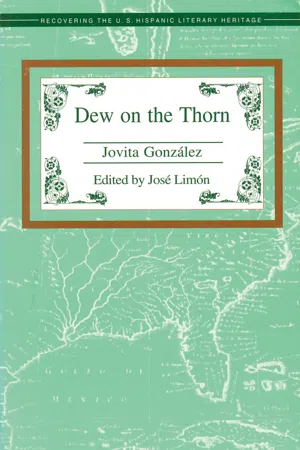
Dew on the Thorn seeks to recreate the life of Texas Mexicans as Anglo culture gradually encroached upon them. González, a former president of the Texas Folklore Society, provides us with a richly detailed portrait of the ranch life of the Olivares clan of South Texas, focusing on the cultural traditions of Texas Mexicans at a time when the divisions of class and race were pressing on the established way of life.
- English
- ePUB (mobile friendly)
- Available on iOS & Android
eBook - ePub
About this book
Information
Print ISBN
9781558851757
Dew on the Thorn
Jovita González
CHAPTER I
The Family of the Olivares
“Soy como el roble, me doblo
pero no me quiebro.”
“Like an oak I may be bent,
but not broken.”
Rich in the traditions of a proud past, and still rich in worldly goods, the year of Our Lord 1904 found the Olivares on the land which His Excellency Revilla Gigedo, Viceroy of New Spain, had deeded to the head of the family in 1764. The grant which extended into territory destined later to become Texas, was located thirty miles east of the Río Grande, and ambled leisurely along through fertile plains and grass-covered prairies to within five miles of the Nueces River.
Yet in spite of their long permanency in the country, this family, as was also true of all the border families, remained more Spanish and more Mexican than if they had lived in Mexico. A series of unfortunate circumstances which had made the Olivares cling tenaciously to the traditions of their people, had also made them look upon all Americans with distrust and dislike.
The first of the Olivares, Don Juan José, had come in 1748 as Surveyor to the Spanish Crown. At that time the Indian infested region north of Nuevo León had been created into the new province of Nuevo Santander. Later, a military expedition led by Don José Escandón was sent by the Viceroy with a two-fold purpose, namely to subdue the warlike Indian tribes and to look for suitable locations for settlements in the region between the Río Grande and the Nueces River.
Efficient and thorough in the work assigned him, Don Juan José accompanied his friend and commander through the wilderness of the Indian country. Together they explored the region, together they braved the dangers of the frontier, and together they fought and subdued the Indian tribes.
“The country must be colonized by all means,” Altamira, the Auditor of War had told them. “Use whatever means you find within your reach, but colonize.” Following the orders of the Viceroy and Altamira, Don Juan José thought of a plan, “Why couldn’t we,” he told Escandón, “get these northern rancheros interested in the movement? Why not offer land to those who want to expand the frontier to the north?”
Escandón approved of the plan and together they interviewed the ranchmen. These frontiersmen, who like new Lots were ever on the lookout for the means of extending their grazing lands, became interested in the colonizing scheme. At their own expense and at no cost to the Crown, these daring ambitious men offered to colonize towns and ranches along the Río Grande in exchange for all the grazing land they desired.
Together again, the Surveyor and the commander founded several missions and towns along the coast and hills of what is now Tamaulipas, and together they saw the foundations of the towns along the Río Grande, Camargo in 1748, and Mier, Revilla and Dolores one year later. While exploring the country Don Juan José learned to like the flower-covered prairies along the Nueces and the brush-covered land of the Río Grande.
He saw many promises in this land that invited him to remain and he asked Escandón, not only for permission to stay, but for a grant of land. Escandón acceded to his wishes, but with regret, for he was greatly attached to the man who had shared with him the dangers of the new frontier.
The Commander returned to the capital of the province; the Surveyor remained. And with the title of Capitán, Don Juan José, accompanied by the other ranchmen, formed the vanguard of this last frontier of the tottering Spanish empire. The need of more land for his rapidly increasing herds of cattle and flocks of goats and sheep, induced him to lead a roaming existence; the outlet for his nomadic wanderings being the grass-covered plains which extended to the east, towards the Nueces River.
He and his friend, Don Blas María de la Garza Falcón, founder of Camargo, drove part of their cattle across the river and established themselves at the Carnestolendas ranch.
By 1761 they advanced to within five miles of the Nueces River where they founded another settlement, the Petronila. Imitating their example, other ranchmen followed them and they also founded ranches in the valley south of the Nueces. Confident that his friend Escandón would approve their actions, Don Juan José, as Captain, encouraged more of the ranchmen in their northward migrations. His confidence in Escandón was well founded, for when the Commander returned, not only did he approve their actions but asked him, Don Juan José, to survey the land that he might legalize their possessions. He fulfilled his promise when La Visita Real issued the Royal grants in 1764.
Like Captain Olivares, the founders of these border towns and ranches were in the majority criollos or Spaniards. They were gente de razón* and the settlements they founded were destined to prosper and succeed because of “the desirable character of its citizens, and because even though small in number they were of good family and well to do.”1
Captain Olivares, as did most of the rancheros, made his headquarters at Mier; the family lived there, but whenever the Indians were at peace he took his family on occasional visits to the ranches across the Río Grande.
A man of great physical strength, he spent most of his time going through his possessions; he loved the sense of ownership. He liked to feel that he had brought to this out-of-the-way corner of the Spanish Empire, the culture and civilization of the Spanish race. Sometimes alone, sometimes accompanied by peones and vaqueros, he traversed the wild Indian country with the same facility as though he were traversing the plains drained by the Guadalquiver** of his native Sevilla. The journeys on horseback, the wounds he had received in the Indian campaigns, the exposures and privations he had suffered in the early days rapidly sapped his strength. At fifty he was almost an old man. Realizing that his days were few, he asked to be taken to Cerralvo where he had first met his friend Escandón. He died there in the bosom of our Mother, the Holy Roman Catholic and Apostolic Church, in the year 1773.
His oldest son Don José Alejandro succeeded him. Carrying out the wishes of his father that he should strengthen his ranches, specially those in the fertile plains beyond the Río Grande, he moved his family there and established himself permanently at what he called El Olivareño, the stronghold of the Olivares. His life, long, and uneventful, was one of peace and contentment. Changes of government meant nothing to him. The Mexican War of Independence came on and passed unnoticed by the rancheros who continued living with easy-going placidity. Thus, Don José Alejandro could tell nothing about the War of Independence, except that he had married during the first year of it (1810) at the age of fifty-seven, and that his son Cesareo had been born one year later. Whether as subject of his Catholic Majesty or citizen of the newly created Mexican republic, his chief interest remained ever the same, to protect his family from the Indian invasions and to increase his holdings. Don José Alejandro died of old age and contentment, at peace with the world and himself, at the age of ninety-three.
His son Cesareo, the child of his old age, now a man of thirty-five, continued his father’s work. As was expected of him, the new leader of the family went to Mier to look for a wife and married Doña Ramona Hinojosa, a girl noted as much for her beauty as for her wealth. As the only heir of her uncle Don Marcelo, she was the richest landowner in northern Mexico.
While at Mier, Cesareo heard the most astonishing news. The country north of the Nueces was being colonized by men who were not of the Mexican race. He was told these men were Americanos, men from the north, who came seeking homes in a land that was not theirs. What surprised him most was that the government in Mexico had given them permission to come. There were rumors also that these blue-eyed strangers wanted to keep the land for themselves and were preparing for war against the country that had given them hospitality. How true, he thought, his father’s homely proverb had been, “Raise crows and they will pluck your eyes out.” He had also heard of a powerful man who was ruling the country, Santa Anna, who, he was told, had as much power as the King of Spain had ever had.
He brought his bride home and life went on as placidly as before. But soon rumors of wars began to spread. The foreigners had openly declared their wish to take the country for themselves and many battles had been fought between them and the Mexicans. One day, a man from San Antonio came. He told them what he himself had seen with his own eyes. Santa Anna had destroyed all the Americans with his army and there was nothing more to fear from them.
Don Cesareo was sorry they had all been killed. Like the good Catholic that he was, he had even said a few prayers for the repose of their souls.
But that was as it should be, he thought. Why should they have come to a land that was not theirs? Did they not have a country of their own? Poor foolish men, these foreigners be, he mused, to think they could take anything away from Mexico. Mexicans were courageous and could fight! Hadn’t they heard how the Mexicans had driven out the mighty armies of the king of Spain from their country? He shuddered at the mere thought of the approach of these Americans. These men who were heretics should not come to Christian territory. He had read in a history his father left him that the Americans were the same as English, and the English had always been the enemies of Spain. One of his ancestors, if he remembered right, a captain of a Spanish galleon, had been killed by the English pirate Drake. Not only were they enemies of Spain but at one time the English had even dared to oppose the Pope, and all because he would not allow their king to have more than one wife. And if history was true the king’s lawful wife had been a Spanish princess. Ah! these Americanos had a deathly heritage. They were the born enemies of every thing Spanish, and consequently they were the enemies of the Mexicans. Certainly, thought Don Cesareo, God, who was a Catholic, could not allow these people who were His enemies to take the land away from them!
When news came that Santa Anna had been defeated and that his troops had been forced to leave the country he felt as though the world was going mad. He could not believe it. It was impossible! How could these interlopers, these vandals take what had been given his ancestors by the king of Spain?
For a while nothing more was heard. Perhaps the news was not true. And then one morning when he and his caporal* were riding through the pastures they had been accosted by a stranger who told them he had come to take possession of their land. And when he had replied that the stranger must be mistaken because he, Don Cesareo, was the rightful owner, the foreigner had taken out his pistol and had killed the caporal without any warning.
“Let that be a lesson to you Mexicans,” the man had said, “that’s how we shall deal with any one who opposes us, and unless you leave the country you shall be treated the same.”
That had been the beginning of the struggle for possession of the land the Mexicans owned and the Americans coveted. During the period of lawlessness that followed, when both Americans and Mexicans stole freely from each other, the latter as a conquered race paid the greater price. While the American ranchmen prospered and profited, the Texas-Mexican landowners were forced to abandon their land. Only a few remained and those that stayed were those too powerful to be disturbed or those whose land was considered worthless. As a natural result frictions were constant along the frontier and the favorite pastime of both Mexican and American ranchmen was to see how much damage they could do to each other. A Mexican found stealing cattle from an American was hung. An American doing the same from a Mexican merely added a few head to his herd.
[Then the Cortina incident occurred. The son of a wealthy Spanish-Mexican family, Juan Nepomuceno, like all the Texas-Mexicans of his time, resented the conquest of their territory. But in spite of his resentment he and the men of his family had become American citizens. One day as he was riding through the streets of Brownsville, he came upon a deputy sheriff dragging a Mexican who had been his, Cortina’s servant. In no gentle terms he asked the deputy to let the man go, and in no gentle terms the officer replied, “I’ll do the same to any ‘greaser’ that crosses my path. I’ll even do it to you.” Cortina’s answer was a shot. He then rescued the prisoner and rode across the river where he was acclaimed as a great hero. He became the self-appointed champion of the Mexican ranchmen in Texas who saw in him the leader that would free them from American domination and rule...
Table of contents
- Cover Page
- Title Page
- Copyright Page
- Contents
- Foreword
- Preface
- Early Life and Education
- Map
- Introduction
- Dew on the Thorn
- Footnotes
Trusted by 375,005 students
Access to over 1.5 million titles for a fair monthly price.
Study more efficiently using our study tools.