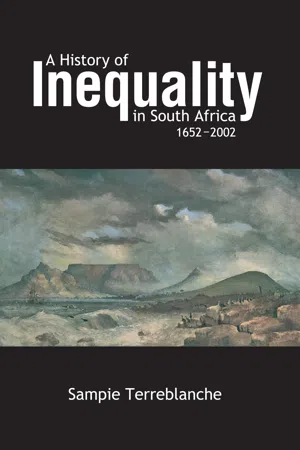
In this major study, Prof. Sampie Terreblanche, a leading Afrikaner academic, provides a systematic account of inequality in South Africa from 1652 to the present day. In a detailed reinterpretation of South African history, he traces the exploitation of indigenous people by dominant settler groups from the advent of European colonialism to the end of apartheid in 1994. Extending his theme to contemporary South Africa, he argues that, while this country's transition to democracy is a significant development, a parallel socio-economic transformation has not yet taken place, and that many of the deep-seated inequalities that developed under colonialism, segregation and apartheid are being perpetuated in the 'new South Africa'. The author points out that almost half of the South African population – mostly blacks – are living in 'abject poverty', and their situation has in fact worsened since 1994. He sharply criticises the ANC government for abandoning its redistributive ideals, and allowing itself to be manoeuvred into a situation where it has relinquished much of its sovereign power to make decisions about socio-economic policy. He criticises the corporate sector, for its ruthless pursuit of its own interests, to the detriment of broader South African society. He also criticises the new black elite, for its crass materialism and its apparent indifference to the plight of the poor. The author warns that the present order is unjust and unsustainable, and that a 'second struggle' may result if it is perpetuated. He advocates a shift towards social democracy that will allow the state to play a more active role in creating jobs, alleviating poverty, and providing social welfare.
- 545 pages
- English
- PDF
- Available on iOS & Android
eBook - PDF
About this book
Information
Table of contents
- Front Cover
- Imprint Page
- Contents
- Figures and tables
- Abbreviations
- About the author
- Acknowledgements
- Part I Power, land,and labour
- PART 2: The transition and the ‘new South Africa’ (1990–2002)
- PART 3: Colonialism, segregation, and apartheid (1652–1994)
- PART 4: An incomplete transformation: what’s to be done?
- Appendix
- The history of democratic capitalism in the liberal capitalist British-American (BA) world, and in social democratic continental European (CE) countries
- References
- Index
- Back Cover
Trusted by 375,005 students
Access to over 1.5 million titles for a fair monthly price.
Study more efficiently using our study tools.
Frequently asked questions
Yes, you can cancel anytime from the Subscription tab in your account settings on the Perlego website. Your subscription will stay active until the end of your current billing period. Learn how to cancel your subscription
No, books cannot be downloaded as external files, such as PDFs, for use outside of Perlego. However, you can download books within the Perlego app for offline reading on mobile or tablet. Learn how to download books offline
We are an online textbook subscription service, where you can get access to an entire online library for less than the price of a single book per month. With over 1.5 million books across 990+ topics, we’ve got you covered! Learn about our mission
Look out for the read-aloud symbol on your next book to see if you can listen to it. The read-aloud tool reads text aloud for you, highlighting the text as it is being read. You can pause it, speed it up and slow it down. Learn more about Read Aloud
Yes! You can use the Perlego app on both iOS and Android devices to read anytime, anywhere — even offline. Perfect for commutes or when you’re on the go.
Please note we cannot support devices running on iOS 13 and Android 7 or earlier. Learn more about using the app
Please note we cannot support devices running on iOS 13 and Android 7 or earlier. Learn more about using the app
Yes, you can access History of Inequality in South Africa by Sampie Terreblanche in PDF and/or ePUB format, as well as other popular books in Politics & International Relations & Politics. We have over 1.5 million books available in our catalogue for you to explore.