- 104 pages
- English
- ePUB (mobile friendly)
- Available on iOS & Android
eBook - ePub
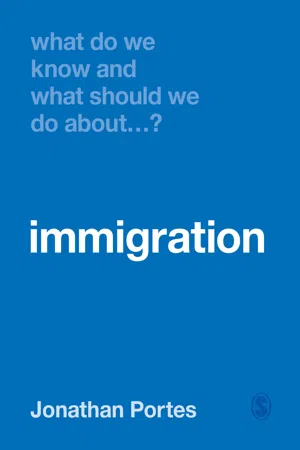
What Do We Know and What Should We Do About Immigration?
About this book
"A short, sharp and compelling book." The Observer
At a time when immigration has once again become a deeply contentious political issue, Jonathan Portes provides some much-needed clarity, taking on misinformation and inaccurate reporting to reveal the true economic and social impact of immigration to the UK.
This important book covers a short history of immigration to the UK, uses the latest research and data to summarise how it is financially beneficial to the economy, considers it?s positive effects on contemporary society, and provides straightforward answers to commonly asked questions such as: does immigration push down wages? Does it reduce job opportunities for those born in the UK? And what impact does it have on the NHS and other public services? Portes then proposes what we should do about immigration, defining what a post-Brexit system should look like, and outlining what, if anything, we should do to promote integration further.
Written by leading social scientists, the What Do We Know and What Should We Do About...? series offers concise, up-to-date overviews of issues often oversimplified, misrepresented or misunderstood and shows you how to enact change.
"If you want to learn a lot about what matters most, in as short a time as possible, this is the series for you."- Danny Dorling, 1971 Professor of Geography, University of Oxford
Information
Publisher
SAGE Publications LtdYear
2019Print ISBN
9781526464422
9781526464415
Edition
1eBook ISBN
9781526479327
1 Introduction
Immigration to the UK over the last two decades has run at historically unprecedented levels, altering the face of our society and economy. About 1 in 7 of us were born abroad, up from less than half that at the turn of the century. As a result, immigration has become a deeply contentious political issue, with many arguing it was the main driving force behind the Brexit vote.
But the UK’s situation is not unique. Although the historic and political contexts are very different, immigration as an important driver of both economic and social change has become central to recent political developments in the United States and across continental Europe. From the election of Donald Trump to the 2015–16 refugee crisis, immigration has shaped the public debate – and will continue to shape the future of our countries on multiple dimensions.
What are the causes and consequences – economic and social – of immigration? In this short book, I focus on the UK, but my analysis draws on research from many other countries. I begin with a brief history of immigration to the UK, which is inevitably both selective and subjective. Although recent immigration levels are indeed far higher than anything we have ever seen before, I explain why the UK has long been a country shaped in many ways by immigration and immigrants, and that political controversy over (and hostility to) immigration is anything but new.
I next discuss what we know – and do not know – about the impact of immigration. I focus on the economics, partly because that is my subject, and partly because the economic impacts are much easier to quantify and analyse in the short term at least. Does immigration reduce job opportunities for those of us who were born here? Does immigration push down wages? What is the impact of immigration on public finances and public services? What has been the impact of free movement of people both in the UK and the rest of the EU?
The fact that we can speak with more certainty about these economic impacts does not, however, mean that wider social impacts are less important. What do we know about the relationship between immigration, diversity and social cohesion? Why is public opinion in the UK generally hostile to immigration, despite the general consensus among economists that it makes us richer?
Finally, I consider what conclusions we can draw from all of this for the future. I look at areas that are high on the agenda for UK politicians and the public. Brexit will herald the largest shakeup of UK immigration policy in at least 40 years. What should a post-Brexit immigration system look like? How do we shape a public and political consensus for a post-Brexit system based on a better public understanding of the costs, benefits and trade-offs inherent in different options? And what, if anything, do we need to promote integration?
Overall, it is a safe bet that immigration will remain a key political issue in the UK and beyond. I argue that Brexit, under any of the numerous scenarios that might play out over the next few years, gives us a chance to change the terms of debate for the better, though it does not give us any clear answers. We have a chance to reframe both the debate and policy constructively; failure to do so could be very damaging indeed. This book therefore is intended as my contribution to a better outcome.
Concepts, definitions and impacts
Before moving on to the main discussion, it is helpful to say a little about what I mean by ‘immigration’ and the effects, direct and indirect, that will be discussed in this book. People have been migrating from the dawn of history, moving in search of a better life, whether that means more plentiful game, more fertile land, job opportunities, or fleeing danger or war. We all trace our ancestry back to Africa, and in this sense all countries are the result of immigration and we are all immigrants or their descendants. But of course that far exceeds the scope of this book. To make sense of a contemporary discussion of immigration, we will need a more focused definition, and in such a contentious debate, definitions are neither neutral nor uncontested. For example, some argue that ‘free movement’ in the EU – the legal right to move from one EU member state to another – is similar to movement within a nation state and is qualitatively different from ‘immigration’ from outside the EU. The recent Windrush scandal has seen the UK government deport long-term UK residents as part of its ‘hostile environment’ policy for people who cannot show they have a legal right to residence, even though they were born in countries that were once part of the British Empire and they are, and have always been, entitled to British citizenship.
Without ignoring these issues, I will generally follow the dictionary definition of immigration, which is the ‘movement of people from one country to another’. This is operationalised for statistical purposes by the United Nations and the OECD as ‘someone who moves from one country to another, intending to stay for more than a year’, so as to exclude travel for tourism, business trips, and so on. However, these boundaries are of course blurred in practice, most obviously in the case of seasonal or temporary migrant workers.
This definition excludes some hugely significant, both economically and historically, movements of people within countries, for example the ‘Great Migration’ of African-Americans from southern to northern states of the United States and that of hundreds of millions of Chinese, mostly from inland agricultural regions to the more industrialised and prosperous coastal provinces. Also, while migration is often not entirely voluntary, some choice over the decision to migrate or where to migrate is generally involved. So I also exclude the transatlantic slave trade which, while involving the movement of people from one country to another and being of enormous historical significance, was not what we normally mean by immigration.
Why do people move? Most obviously, for economic reasons (positive or negative) to take up a specific job, to take advantage of economic opportunity more generally or to escape high unemployment or poverty in their country of origin. These were the key drivers behind, for example, the large-scale movement of Europeans to the Americas in the nineteenth century. But people also choose to move for broader reasons such as education (usually temporary, but can often become permanent), or for family reasons, such as to join a spouse or other family members. There is also forced migration involving political persecution, war (especially civil war) and ‘ethnic cleansing’. The boundaries between these different categories are often blurred, which in turn poses a problem for policy and makes it much easier to deal with cases that can be easily and clearly categorised.
Since labour is a factor of production – probably the most important factor of production in both classical and Marxist economics – the movement of people on a large scale is likely to have very significant economic effects. It directly reduces labour supply in the source country and increases it in the destination one. The economic impacts will be strongest for the immigrants themselves, but will also impact others, in particular workers already resident in the destination country.
But this is only part of the story, as we will discover later on. Perhaps the most important concept in the economics of immigration is the ‘lump of labour fallacy’. While immigration does increase labour supply, it is simply wrong to claim, as many do, that it must in turn reduce wages or job opportunities for non-immigrants by the laws of supply and demand. In a functioning economy and labour market, immigrants, directly or indirectly, add to labour demand as well as labour supply; they earn money and spend it. So I will focus very much on what the data actually says about the overall effects. Moreover, labour market impacts are by no means the whole story. Large-scale immigration is likely to affect almost all other economic outcomes too: growth, productivity, public finances, and so on.
Immigrants are not just workers. They are also, first and foremost, people. So the broader impacts of immigration are just as important, if not more so, than the economic ones, even if we can be less definitive. Immigration will increase population size and, usually, diversity – not just ethnic but across a number of other dimensions also. Even more controversially, immigration is likely to change a country’s culture and identity in unpredictable ways. So over the long term, different levels and patterns of immigration will affect almost everything about how a country develops. This is easy enough to see from history if we compare the very different economic, social and cultural trajectories followed by the United States, Australia, Argentina and Greenland, for example.
These economic and social impacts will, in turn, have political implications. Immigration is usually, but not always, unpopular with large proportions of the resident population, even where that resident population is descended in large part from relatively recent immigrants. It is unclear why that is the case, or what drives attitudes in different countries, but there is plenty of evidence that the political attitudes to immigration reflect at least in part systematic misperceptions of its scale and impacts. Much depends on the speed and nature of assimilation or integration. Immigrants, or their children, eventually get to vote too.
Looking forward, the longer term drivers of immigration are not going to go away and, if anything, are likely to intensify. Demographic pressures involve both supply (very large numbers of young people in developing countries, especially in some African countries with limited job opportunities) and demand sides (low fertility rates and ageing populations in most developed countries). Armed conflicts, particularly civil wars or endemic violence in ‘failed states’, will continue to drive refugee flows in unpredictable ways. In addition to these, climate change may result in further large forced movements in the medium to long term.
Finally, before moving on to the main discussion, a personal note. Immigration is an emotive topic and our attitudes are inevitably shaped by our own backgrounds and histories. I am an empirical economist – I work with evidence and data. As best I can, in what follows I summarise accurately and objectively the evidence and analysis that we have on the impacts of immigration. My views on what immigration means for jobs, wages, and so on, are based on that evidence and are aligned with the overwhelming consensus of economists working in this field. But I make no claims to objectivity overall. My parents and my partner’s parents were immigrants to this country, as are many of my extended family and friends. I am a Londoner, a city that has in my view benefited hugely from immigration over the half century I have been living here. So bear this in mind as we now move on to discuss the history of immigration to the UK, from the Norman Conquest to the present day.
2 background
In this chapter, I will give a brief and selective overview of immigration to the UK (history may be too grand a word). Rather than being comprehensive, I have focused on episodes which I think cast some light, directly or indirectly, on today’s debates. For a more in-depth read, I would recommend Robert Winder’s Bloody Foreigners: The Story of Immigration to Britain.
At the risk of belabouring the obvious, the UK is a country of immigration. The myth of a genetically and culturally homogeneous ‘white’ population, to which was added a Jewish element in the late nineteenth and early twentieth centuries, and a non-white element after the Second World War, is worse than just an oversimplification: it is positively misleading. The UK has always been relatively open and the UK population is now, as it always has been, the result of successive influxes of immigrants and the racial and cultural intermixture of those immigrants with those already there.
It is also reasonably clear, though impossible to quantify, that the UK has benefited considerably in both economic and cultural terms as a result. In retrospect, those benefits are widely accepted. Few (even those who do not have some Jewish or Huguenot ancestry!) would dispute that the Huguenots and the Jews have made major contributions to the UK economy and society. Indeed, there is by now even a welcome degree of consensus that the UK has benefited from post-war immigration from the New Commonwealth, and the current economic consensus is that over the past 20 years migration has, overall, been broadly positive for the UK economy across a range of outcomes and indicators.
However, those benefits were rarely recognised at the time. We may pride ourselves in retrospect on our hospitality towards Jewish refugees, at the turn of the century and during the Nazi era; in fact, the actual record was mixed at best and positively shameful in some respects. Similarly, blatantly racist attitudes towards immigrants from the New Commonwealth came not just from extremists or working-class communities, but from politicians and policy makers at the highest level. Most recently, the economic benefits did not prevent the UK from voting for Brexit, in a large part because of the association of EU membership with free movement and high levels of inward EU migration.
With Brexit we are now moving into a new phase. Will the relative openness of recent years be perceived as a historical aberration? Or will it continue in a different form, as Brexit throws into even sharper relief what is required to make a success of ‘global Britain’ outside the EU?
Public or popular discussion of immigration in the UK often appears to assume that large-scale immigration is a new phenomenon that began after the Second World War, or even after the expansion of the EU in 2004, and that therefore it is possible to choose a date at which the British Isles were populated only by ‘indigenous’ inhabitants, and to describe everybody who arrived after that date, or their descendants, as non-indigenous.
For example, in 1999, the then leader of Kent County Council wrote to the Minister for Immigration to complain about the number of asylum seekers, mentioning that Kent had ‘no prior history of multicultural diversity’. In fact, Dover itself was represented in Parliament by Thomas Papillon, a Huguenot refugee, back in the seventeenth century. This reflected an ignorance of history rather than malice.
However, such attitudes often either shade into racism or encourage it, even, sadly, in my own profession. More recently, Sir Paul Collier, a development economist who entered the field of immigration studies, wrote in the Daily Mail that ‘indigenous Britons’ had become a minority in London, ‘their own capital’ (Collier, 2013). Since this is only true if you restrict the definition of ‘indigenous Britons’ to white people, he was making an explicit choice to label even second- or third-generation black or mixed-race Britons as somehow foreign, not an attitude that we generally regard as acceptable in current public discourse.
In fact, ever since the British Isles were separated from mainland Europe in approximately 7000 BC, there have been continuous movements of people in and out of these islands. While those associated with conflict are best known, namely the Roman invasion and the raids of the Danes, there was also of course much in the way of trade and commerce. Even before the Roman invasion, there were well-established trade routes linking the British Isles with the Mediterranean. The Celts, who arrived in the first millennium BC, are believed to have originated on the Russian steppes, and so the language(s) spoken here have long been part of the Indo-European family, derived from Sanskrit and which includes Hindi and Punjabi as well as French and Greek.
After the Romans left Britain in the fifth century following the fall of the Roman Empire, there were numerous invasions and armed incursions, first from what is now Germany and the Netherlands (the Angles and the Saxons and others) and later from Scandinavia. King Canute, or Cnut, was a Dane. So by the time of the Norman Conquest in 1066, the population of the British Isles was a mix of Britons, Angles, Saxons, Celts, Danes, and so on – in no particular order and with a great deal of intermixture. The Normans, while intermarrying freely, brought with them perhaps for the first time a distinctive racial/linguistic (as opposed to tribal) identity that took a considerable amount of time to assimilate. Indeed, the tension between the descendants of ‘indigenous’ Anglo-Saxons and Norman ‘invaders’ had not completely dissipated even by the seventeenth century, as Christopher Hill notes in Puritanism and Revolution (1997).
The Normans and the Jews
The Norman Conquest is an appropriate point at which to commence a discussion of British migration policy (as opposed to migration per se) since William the Conqueror invited and encouraged the immigration to England of a substantial number of Jews. This arguably represents the first immigration policy decision taken by an English ruler. His motivations were economic; unlike Christians, Jews were not debarred from usury (moneylending) and were thus able to provide important financial services to the king and rul...
Table of contents
- Cover
- Title Page
- Copyright Page
- contents
- titles in the series
- about the series
- about the author
- 1 Introduction
- 2 background
- 3 what do we know about immigration? economics
- 4 what do we know about immigration? beyond economics
- 5 what should we do about immigration?
- 6 conclusion
- appendices
- appendix A: the east african asians
- appendix B: emigration – the impacts on countries of origin
- appendix C: free movement in the eu
- further reading
- References
- Index
Trusted by 375,005 students
Access to over 1.5 million titles for a fair monthly price.
Study more efficiently using our study tools.
Frequently asked questions
Yes, you can cancel anytime from the Subscription tab in your account settings on the Perlego website. Your subscription will stay active until the end of your current billing period. Learn how to cancel your subscription
No, books cannot be downloaded as external files, such as PDFs, for use outside of Perlego. However, you can download books within the Perlego app for offline reading on mobile or tablet. Learn how to download books offline
Perlego offers two plans: Essential and Complete
- Essential is ideal for learners and professionals who enjoy exploring a wide range of subjects. Access the Essential Library with 800,000+ trusted titles and best-sellers across business, personal growth, and the humanities. Includes unlimited reading time and Standard Read Aloud voice.
- Complete: Perfect for advanced learners and researchers needing full, unrestricted access. Unlock 1.5M+ books across hundreds of subjects, including academic and specialized titles. The Complete Plan also includes advanced features like Premium Read Aloud and Research Assistant.
We are an online textbook subscription service, where you can get access to an entire online library for less than the price of a single book per month. With over 1.5 million books across 990+ topics, we’ve got you covered! Learn about our mission
Look out for the read-aloud symbol on your next book to see if you can listen to it. The read-aloud tool reads text aloud for you, highlighting the text as it is being read. You can pause it, speed it up and slow it down. Learn more about Read Aloud
Yes! You can use the Perlego app on both iOS and Android devices to read anytime, anywhere — even offline. Perfect for commutes or when you’re on the go.
Please note we cannot support devices running on iOS 13 and Android 7 or earlier. Learn more about using the app
Please note we cannot support devices running on iOS 13 and Android 7 or earlier. Learn more about using the app
Yes, you can access What Do We Know and What Should We Do About Immigration? by Jonathan Portes,Author in PDF and/or ePUB format, as well as other popular books in Social Sciences & Emigration & Immigration. We have over 1.5 million books available in our catalogue for you to explore.