Alongside burgeoning global business, which asserts its legality, ethics and social responsibility, there exists a dark side of shadow trades manifesting various shades of legitimacy. Not only do the latter's corrupt practices, dubious supply chains and other illicit operations run in tandem with global business, these borderless trades intersect with economic structures and contribute to systems adopted by corporations, endorsed by neoliberal capitalism, that are often condoned by governments and unwittingly sustained by consumers. In a very real sense, all of us may be implicated in shadow trades through our work, consumption and citizenship.
Even before we can begin to confront and constrain shadow trades, their business models first need to be identified and analysed in all their networked complexity, interconnectivity with global business and embeddedness within the world economy. Numerous hard questions need to be raised around enabling circumstances and responsibilities of stakeholders, as well as the winners and losers resulting from business globalisation and socio-economic inequities within and between countries.
Providing background, evidence and analysis on select exemplars of shadow trades, this book provides graduate students of business, plus scholars in the social sciences, together with practitioners and policymakers, consumer groups and civil society, with an indispensable resource for critical engagement. Only through knowledge gained by research and advocacy for transparency can we begin to shed light on this dark side of global business, enabling all of us to grapple with activism against and collaborative action towards undermining all shadow trades.
Amos Owen Thomas was a Docent / Reader in Marketing and International Business at Stockholm University until his recent retirement
Evidence of shadow trades is often hidden in plain sight, in the products and services we avail ourselves of in contemporary societies worldwide. These could be the workers in nail bars, fast-fashion in department stores, fruit in supermarkets, transplant surgeries in hospitals, chocolate confectionary, jewellery, ubiquitous smartphones, and so on endlessly. So how does one extricate the illicit operations such as exploited labour, conflict minerals, arms sales and tax evasion from the legitimate organisations that deliver these? Does lack of economic opportunity, discrepancy between law and enforcement, and high prices for desired goods and services stimulate the growth of shadow trades? If illicit trade is symbiotic with or parasitic on legitimate corporations, are there gradations in legitimacy and what could be the catalysts for change? This book represents a long quest, over a decade in gestation, prompted by periodic exposés in news-magazines and television-documentaries which led to a search for further sources of information, such as were available. Inter-government and non-government organisations have done laudable work researching and advocating on issues related to shadow trades such as in arms, drugs, organ harvesting, and conflict minerals that know no borders. Of late, a few authors and editors have written and compiled research on selected illicit operations and transnational crime, though seldom on illicit operation intersects with legitimate entities from a critical global business perspective, as this book seeks to.
Scanning the Horizon
Timeless Trades
Nothing is altogether new about a dark side to global business since illicit practices have existed side-by-side with legitimate trade in goods and services down through history. The trans-Atlantic slave trade of the 17th to 19th centuries was an intrinsic part of legitimate trade in cotton, sugar and other goods between the so-called Old World and New. Similar trade in humans existed across the Sahara and from Arabia down the east coast of Africa alongside trade in salt, gold and textiles. In Asia, opium was exported by colonial powers from India to China in exchange for tea and silk, among other legitimate products desired in Europe. Armed conflicts have often been waged to gain control of the sourcing and logistics of natural resources to support industry and economy. The current deficit in business research would seem to imply that such trades no longer exist, are relatively insignificant today, or at least do not impinge on legitimate global business. Yet the very globalisation of markets in the late 20th and early 21st centuries, through lowered barriers to the movement of finance, information, goods and people worldwide, is at the heart of the burgeoning shadow trades as well. Just as in the past and regardless of extant laws prohibiting these, the illicit businesses today share the same supply chains and are being incorporated into goods for legitimate markets, with this entwining characterising the shadow trades.
Despite all the focus on explicating international trade in recent decades, scant attention has been paid to the concurrent growth of a dark side in human trafficking, money laundering, waste dumping, arms exporting and the like, although such trade taints many legitimate global businesses. These are not just ethical issues for sociologists, political scientists, geographers, environmental engineers and lawyers alone to concern themselves with, but for political advocates of free trade, business academics and management practitioners as well. Drawing on information on these trades in the public domain, the news media, as well as other academic sources in the social sciences, humanities, even physical and medical sciences, this book endeavours to analyse the catalysts of present-day shadow trades in terms of economic differentials, corporate culpability and government negligence. While some secondary data are available on the shadow trades, given their nature, these are of necessity estimates needing to be triangulated or otherwise harmonised for reliability. Primary data remains far more limited given the significant risk, cost and opacity challenging all who attempt its collection, whether researchers or journalists, but this deficiency ought to be no barrier to revealing the dark side to global business and addressing the accompanying socio-economic injustice.
Attention Deficits
Much has been published about the liberalisation of international trade and its generally positive benefits for regional economies and multinational corporations involved. Yet scarce mention is made of the unofficial and dubious trades that thrive within the same world economy. Although illicit and legitimate businesses are inextricably intertwined, whether by design or default, scant research has been done in the business and management disciplines, with the possible exception of economics and finance on the arms trade and money laundering. Within academia, research on some exemplars of the shadow trade phenomenon are published, primarily by researchers mostly from the social sciences and sometimes the natural sciences. Drugs smuggling and human trafficking have received considerable attention in criminology and public policy. Toxic waste dumping and human organ harvesting are largely covered by the environmental and medical sciences, respectively. While there have been books focusing on specific shadow trades, such as the arms industry, sex trade, art smuggling and human trafficking, these have largely been written by journalists. It is regrettable that these trades have seldom been addressed collectively, not least from a business perspective. Given this relative indifference to the shadow trades, this book highlights the opportunity for academics to collaborate with industry, civil society and government towards tackling the environments that enable as well as the business models underpinning them.
By and large, public and corporate advocates of the free market in international trade do not appear to address the immorality of shadow trades that thrive within its far-flung operations across borders. It has taken civil society activists and non-government organisations to spearhead the requisite of social responsibility and sustainability to which corporations are being held. Perhaps legitimate businesses need likewise to be educated into distancing themselves from illicit ones that nonetheless share the same supply chains, financial institutions, communications technologies and favourable trade treaties, tarnishing consumers and citizens alike. Far more than corporate social responsibility narrowly defined and practised, the need is for corporate advocacy, even activism, against all forms of shadow trade – including those at some geographic or economic distance from one’s own industry. If corporations seem recalcitrant in distancing themselves and governments negligent in monitoring the shadow trades, then civil society and non-government organisations have a vital role to play in goading the former entities into responsible action against these pernicious businesses. That current approaches of regulation, law enforcement and charity do not adequately address the growth of the shadow trades is manifestly evident. It would make for a refreshing change if business and other social science academics would be radically outspoken on socio-economic justice issues, and actively involved against the scourge of shadow trades still ongoing in the 21st century.
Conscience Cognizant
The aim of business research into the dark side of global business ought to be primarily for equipping people in their roles as citizens, consumers, workers, union officials, government policy-makers and administrators, business executives and civil society groups to work better at addressing the very real human fallout. But a major impediment to research has been the lack of transparency about the shadow trades for the obvious reasons of their illicit and illegal nature. It is extremely difficult to separate the contribution of unethical transactions to legitimate sectors of the economy, such as mining and transplant surgery. Furthermore quasi-legal industries including arms sales and waste dumping tend to avoid declaring or to under-declare their transactions so as not to attract public attention. Still, scope exists instead for research of particular shadow trades or illegal business or at least illicit operations in a particular country or between countries, based on secondary data obtained in cooperation with governmental and non-governmental sources plus innovative primary data-gathering, and all subject to rigorous critical analysis. Examining the borderless networks of the shadow trades ought to serve to motivate all stakeholders in the legitimate economy to retaliate with similar creativity.1 This book’s call for research is predicated on having findings that serve ultimately to bring about positive social change and economic justice, not merely inputs for an academic sub-discipline.
Theories of business ethics generally do not encompass the shadow trades, but only legitimate enterprises that might face ethical conundrums in some part of their operations. The cases that graduate students and in-service executives are exposed to in business ethics courses seem to have somewhat neat demarcations of the extent of culpability of the firm, which are far from accurate reflections of the real world of global business. It would be convenient if the shadow trades introduced above could be clearly distinguished from legitimate ones, but that is plainly not the case. Thus the average consumer is invariably ignorant that the perfectly legal products and services on the market that he or she uses may have the taint of illegitimate businesses and/or illicit operations. While proponents of shadow trades might exploit loopholes in the diversity of legal systems governing commerce across national borders, there is near-universality of moral standards that should apply to their consequent victims. Thus more comprehensive models and realistic cases need to be generated, if business, government and civil society decision-makers are to be adequately equipped to operate worldwide against shadow trades. Recognisably, such educative endeavours could prove challenging to establish with multi-constituent products globally, and to work effectively in developing and emergent economies, even among their affluent consumers.
Gauging Quantum
Figures Reckoned
The quantum of any shadow trade, whether money laundering, human trafficking, organ harvesting, contraband smuggling, toxic waste disposal, conflict minerals or small-arms sales, makes them significant global businesses in their own right. Although each might seem miniscule vis-à-vis the legitimate international trade in merchandise and commercial services, the inroads of such shadow trades into those sectors of the world economy taint numerous products and services, and unwittingly their end-users, consumer and industrial. The major impediment to uncovering these shadow trades is the characteristic lack of transparency of illicit businesses across borders, although commendable research has been done by non-government organisations (NGOs) and inter-government organisations (IGOs). Less than 5 percent of the millions of containers tend to be physically inspected and 80 percent of international trade uses open account transactions that provide the facilitating financial institutions with little information on amounts and identities. Further documentation of this dark side of global business comes via investigative journalism in the news media, rather than business media, but generally not from academic publications. Nonetheless estimating the extent of these shadow trades is foundational for ethical engagement to mitigate their adverse societal impact by action directed at undermining their business model as the key.
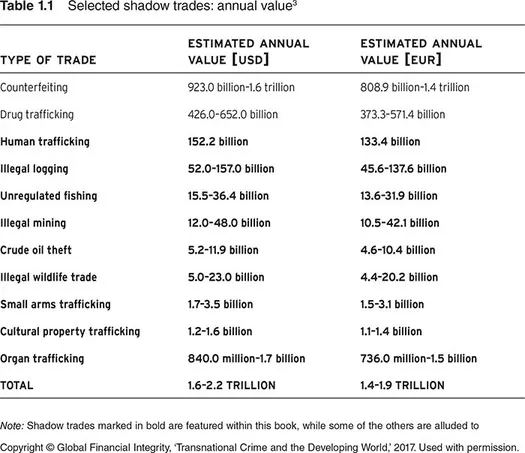
Estimates of shadow trades such as human trafficking, organ harvesting, resource plunder and small-arms sales typically have a range of value (Table 1.1). Further estimates for these and other shadow trades covered in this book such as waste disposal, tax evasion and large arms will be dealt with in their specific chapters. The largest – counterfeiting and drugs trafficking – have received considerable research attention elsewhere and so are not dealt with in depth here except for their intersects with the shadow trades covered. Money laundering, corruption and organised crime tend not to be estimated separately given their overlap with, and/or derivation from, other shadow trades.
The value of shadow trades might seem miniscule vis-à-vis global merchandise exports which totalled USD17.4 trillion, while commercial services were USD5.25 trillion and e-commerce USD27.7 trillion, as accounted by the World Trade Organization (WTO)2. However, as this book will argue, it is highly problematic to separate the contribution of illicit transactions to legitimate sectors of the world economy such as mining, agriculture, finance and health industries. Even quasi-legal sectors of the capitalist world system, such as arms sales and waste dumping, have much incentive to under-declare their transactions so as not to attract public attention and rancour. For obvious reasons the illegality and secrecy surrounding substantial parts of shadow trades constitute a major hurdle to formal research and the collection of definitive statistics. Nonetheless given the high socio-economic costs to the countries impacted, the virtual silence – whether incidentally, accidentally or deliberately – on involvement of legitimate business in various shadow trades ought not continue unchallenged.
Notable examples of shadow trades that have come to international attention through the media include forms of resources mining in conflict zones used to fund civil wars, such as in West and Central Africa. Diamonds, other gems, gold, other metals and rare earths are not easily detected in their transport across borders and hence they are useful also in laundering profits and funding purchases of arms and military equipment. Arms industries in the industrialised world, subsidised and supported diplomatically by their governments as being legitimate, yet periodically make the headlines over corruption. Less is made in the media of their connection with well-publicised conflict, refugees and consequent human trafficking and people smuggling. Yet another shadow trade is the growing and smuggling of hard drugs such as cocaine from Bolivia and Columbia via other Latin American and Caribbean states into North America, or heroin from Afghanistan and Myanmar via Central Asian countries into Europe. Likewise, some of this goes to fund warlords, insurgencies and ethnic strife to the detriment of the people’s lives and their countries’ economies. Relatively little mention is made of the shadow trade in medical tourism and questionable pharmaceuticals which, while raking in profits for their suppliers, risk the lives and health of users, resulting in an economic and social cost borne usually by governments of the least developed countries. Pure shades of black and white in international trade rarely exist, as many legitimate businesses might be involved partially, indirectly or possibly unwittingly in illicit operations, and vice versa.
Although the media are the mo...
Table of contents
Cover
Half Title
Endorsements
Title Page
Copyright Page
Acknowledgements
Contents
Table List
Illustration List
About the Author
Chapter 1 Charting the Borderless
Chapter 2 Darkness Enlightened
Chapter 3 Irregular Migration & Labour Exploitation
Access to over 1.5 million titles for a fair monthly price.
Study more efficiently using our study tools.
Frequently asked questions
Yes, you can cancel anytime from the Subscription tab in your account settings on the Perlego website. Your subscription will stay active until the end of your current billing period. Learn how to cancel your subscription
No, books cannot be downloaded as external files, such as PDFs, for use outside of Perlego. However, you can download books within the Perlego app for offline reading on mobile or tablet. Learn how to download books offline
Perlego offers two plans: Essential and Complete
Essential is ideal for learners and professionals who enjoy exploring a wide range of subjects. Access the Essential Library with 800,000+ trusted titles and best-sellers across business, personal growth, and the humanities. Includes unlimited reading time and Standard Read Aloud voice.
Complete: Perfect for advanced learners and researchers needing full, unrestricted access. Unlock 1.5M+ books across hundreds of subjects, including academic and specialized titles. The Complete Plan also includes advanced features like Premium Read Aloud and Research Assistant.
Both plans are available with monthly, semester, or annual billing cycles.
We are an online textbook subscription service, where you can get access to an entire online library for less than the price of a single book per month. With over 1.5 million books across 990+ topics, we’ve got you covered! Learn about our mission
Look out for the read-aloud symbol on your next book to see if you can listen to it. The read-aloud tool reads text aloud for you, highlighting the text as it is being read. You can pause it, speed it up and slow it down. Learn more about Read Aloud
Yes! You can use the Perlego app on both iOS and Android devices to read anytime, anywhere — even offline. Perfect for commutes or when you’re on the go. Please note we cannot support devices running on iOS 13 and Android 7 or earlier. Learn more about using the app
Yes, you can access Shadow Trades by Amos Owen Thomas,Author in PDF and/or ePUB format, as well as other popular books in Betriebswirtschaft & Wirtschaftssethik. We have over 1.5 million books available in our catalogue for you to explore.