The Wilderness Cure
eBook - ePub

The Wilderness Cure

  1. 352 pages
  2. English
  3. ePUB (mobile friendly)
  4. Available on iOS & Android
eBook - ePub

The Wilderness Cure

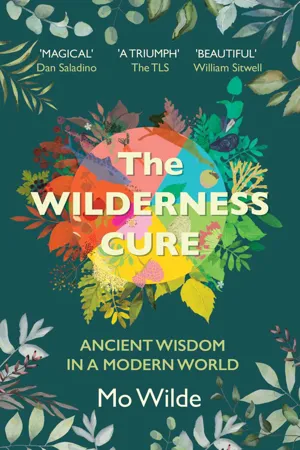
About this book

Winner of the John Avery Award at the André Simon Awards 2022

'A triumph' The TLS

'This special and magical book has changed the way I see the world' Dan Saladino


'Inspiration and delight sparkle from every page … This book [is] a revelation of joy to the general reader for whom wild food is another country' John Wright, author of the River Cottage handbooks
 
A captivating and lyrical journey into our ancestral past, through what and how we eat.

Mo Wilde made a quiet but radical pledge: to live only off free, foraged food for an entire year. In a world disconnected from its roots, eating wild food is both culinary and healing, social and political. Ultimately, it is an act of love and community. Using her expert knowledge of botany and mycology, Mo follows the seasons to find nutritious food from hundreds of species of plants, fungi and seaweeds, and in the process learns not just how to survive, but how to thrive. Nourishing her body and mind deepens her connection with the earth – a connection that we have become estranged from but which we all, deep down, hunger for.

This hunger is about much more than food. It is about accepting and understanding our place in a natural network that is both staggeringly complex and beautifully simple. THE WILDERNESS CURE is a diary of a wild experiment; a timely and inspiring memoir which explores a deeper relationship between humans and nature, and reminds us of the important lost lessons from our past.
 

Frequently asked questions

Yes, you can cancel anytime from the Subscription tab in your account settings on the Perlego website. Your subscription will stay active until the end of your current billing period. Learn how to cancel your subscription.
No, books cannot be downloaded as external files, such as PDFs, for use outside of Perlego. However, you can download books within the Perlego app for offline reading on mobile or tablet. Learn more here.
Perlego offers two plans: Essential and Complete
  • Essential is ideal for learners and professionals who enjoy exploring a wide range of subjects. Access the Essential Library with 800,000+ trusted titles and best-sellers across business, personal growth, and the humanities. Includes unlimited reading time and Standard Read Aloud voice.
  • Complete: Perfect for advanced learners and researchers needing full, unrestricted access. Unlock 1.4M+ books across hundreds of subjects, including academic and specialized titles. The Complete Plan also includes advanced features like Premium Read Aloud and Research Assistant.
Both plans are available with monthly, semester, or annual billing cycles.
We are an online textbook subscription service, where you can get access to an entire online library for less than the price of a single book per month. With over 1 million books across 1000+ topics, we’ve got you covered! Learn more here.
Look out for the read-aloud symbol on your next book to see if you can listen to it. The read-aloud tool reads text aloud for you, highlighting the text as it is being read. You can pause it, speed it up and slow it down. Learn more here.
Yes! You can use the Perlego app on both iOS or Android devices to read anytime, anywhere — even offline. Perfect for commutes or when you’re on the go.
Please note we cannot support devices running on iOS 13 and Android 7 or earlier. Learn more about using the app.
Yes, you can access The Wilderness Cure by Mo Wilde in PDF and/or ePUB format, as well as other popular books in Biological Sciences & Natural History. We have over one million books available in our catalogue for you to explore.

PART ONE
WINTER

CHAPTER ONE
THE DAY BEFORE

‘I went to the woods because I wished to live deliberately, to front only the essential facts of life, and see if I could not learn what it had to teach, and not, when I came to die, discover that I had not lived.’
Henry David Thoreau, Walden: or Life in the Woods
I’m quietly scrubbing beetroot over the kitchen sink. An observer might say, ‘in a mournful way’, and I guess there is an element of that, but I would say, ‘with reverence’. Beetroot is not usually something that I pay this much attention to. In fact, when I was a child, pickled school beetroot was my nemesis and I got into real trouble when I smuggled it, uneaten, out of the dining hall tucked into my knickers. The bright red juice bled through my lightweight, turquoise, summer uniform dress causing a major panic when I was spotted, and rushed off to the school nurse. I was only seven years old at the time! Half a century later, beetroot and I have made our peace. In fact, I quite like it. Roasted until the edges are sweetly chewy or blitzed with mint and cream into a dip, I would even go so far as to say that I’m going to miss it. Suddenly, I appreciate this very large root. Even two or three small ones will make a meal.
I’ll miss it because from tomorrow, I am going to eat only wild food for one whole year. And so, this beetroot will be my ‘last supper’.
I am acutely aware, on this rainy November morning, of exactly how many wild plants I will need to gather to equal the calorific value of this beetroot. I am also conscious of the irony that, although wild beet was commonly found in abundance by our ancestors, at the time it didn’t have a swollen root. This was a modification brought in by the ancient Romans who highly valued the beetroot as an aphrodisiac. I’m told that the frescos on the walls of the Lupanar (the official Roman brothel in Pompeii) depict abundant beetroots, nestled between copulating couples, attesting to its popularity. So it was the Romans who first hybridised this vegetable to produce the swollen, edible root that we enjoy today.
Like our Stone Age ancestors, I love wild beet leaves. Steamed with a little melted butter… and there’s another problem. How far back am I going to go? Will I include butter? Butter is not wild, but humans have been keeping goats and sheep for at least 12,000 years. I can see that I am going to have to establish some very clear ground rules.

THE CONDITIONS

The Collins dictionary definition of ‘foraging’ is ‘the acquisition of food by hunting, fishing or the gathering of plant matter’, to which I would also add fungi and seaweeds. I’ve been teaching people how to do this for about fifteen years now and the number one question people always ask me is: ‘Could you live entirely off the land for a year?’
I’ve thought about this for a long time and I do think it is possible, as long as four conditions are met:
  1. This isn’t TV, so unlike wilderness adventurer Bear Grylls, I would not be dropped into a landscape I have no knowledge of. Instead, I must be familiar with the land – in all its seasons. Like us, other species have strong preferences as to where they live, so knowing the habitat is essential to survival.
  2. I must have access to roam over a variety of terrains: seashore, hedgerow, forest and the right to harvest whatever food I find because, as the seasons change, the locations of wild foods change too. Thankfully, in Scotland we have the Right to Roam.
  3. Although my main focus is plants, seaweeds and fungi, I may need to eat wild meat and fish, so that I don’t completely starve in the winter. Until now I’ve been 90 per cent vegetarian but I must be prepared to eat anything –few bananas grow in Scotland.
  4. The experiment should start after the spring equinox, to give me enough time to prepare for the winter. (Well, I’ve already blown this one!)
Unlike my ancestors, though, I do have three particular modern advantages.
  • Electricity: a dehydrator, a fridge and a freezer – these make it possible to store food over the winter.
  • Fuel: an oven and a car – without the latter my ability to travel to areas where I might find food and carry it home would be my toughest challenge.
  • Shelter: a well-insulated home with a roof over my head – without which I would need far more calories just to stay warm and not freeze to death during the winter months.

THE RULES

  1. I will eat only wild food. This includes native or naturalised species that have gone wild. For example, hairy bittercress is native, but ground elder, feral apples and fuchsias were initially cultivated but escaped from cultivation and now also grow wild.
  2. The food will be local to the habitats I travel through during the year – no foraged bananas! I won’t be growing vegetables either this year.
  3. No money! I can’t buy anything. All my food must be picked, hunted, gifted, traded or swapped for my skills. Any gifted food should be made by the person gifting it with wild harvested ingredients and not be bought or commercially produced.
  4. Although our ancestors would have eaten wild birds’ eggs it is illegal and unsustainable to do so now. So I am going to substitute wild eggs with eggs from my own free-range, organic hens. However, my rule is that I only eat them in the same season that wild birds are laying eggs.
  5. When the goat kids are born in the spring, I may try to trade for some milk with a crofter or smallholder. This reflects our pastoral nomadic past.
  6. Ideally, I’ll be eating food that is seasonal. However – especially during winter – I will also eat wild food that I picked earlier in the year and either froze, dried or preserved.

THE EXCEPTIONS

In retrospect, it’s a tough challenge to begin my wild year in the winter when foragable food is scarce, with little planning and proper preparation, but I am impetuous. And, with so many daily reports on the threats to the natural world, I feel an urgency that cannot wait another year.
  1. With winter already upon us, I’ve had to buy some hazelnuts from a British orchard to supplement my own, as I didn’t know that I would take this path in September when the nuts were ready to pick. Next summer and autumn, I will collect the same weight myself, to show that this can be done in the wild. I have an allowance of twenty nuts per day until mid-April. I also had to buy 3 kilos of nut flour because I left all mine too long in the back of my van; the nuts sprouted before I could process them into flour. I vow to gather the equivalent in the next season. I’ll keep a list of all the stores and calculate, over the course of the year, anything bought in advance versus everything collected and make an end-of-year tally.
  2. My one and only non-native exception is olive oil. Much of the food that I preserve each year is pickled and preserved in oil. For instance, common hogweed shoots and various wild mushrooms are lightly boiled in a solution of home-made vinegar and brine, drained and then packed into glass jars and topped up with olive oil. As well as preserving the food, the oil negates the strong taste of vinegar. I will use the olive oil out of the jars to cook with as it would be a waste to throw it away. The Celts have been trading with Europe for at least 2,500 years or more and possibly some of the Etruscan jugs that made their way from Sumerian potters to the ancient Celts had olive oil in them!
  3. Finally, I don’t want to waste anything that was picked and lovingly preserved in previous years. So a bilberry jam, for example, may have been made with wild bilberries and a little sugar. Whilst I won’t be buying or using sugar, if I have made jam which might not keep, then I won’t let it go to waste. Everything that will keep for a year is now boxed up in the attic.

SOME SCIENCE

Having read a lot about the difference in gut microbiomes of ancestral people like the Hadza1 (a Tanzanian tribe who still follow an exclusively foraged diet) compared to your average Westerner, I thought my wild food diet would also be an interesting scientific experiment. So I’m sending a stool sample to a laboratory to analyse my gut bacteria on ‘day one’. I’ll repeat this at intervals as the seasons change to see if and how my gut microbiome changes.
I’m also monitoring my weight, my fat-to-muscle ratio, and my blood pressure and blood oxygen levels. I could stand to lose a few kilos, and while this journey is not about losing weight – it’s about discovering what life has to teach me – this could be the most drastic diet yet!

MY PRECONCEPTIONS

Food

Never has this simple word generated so much passionate debate as in this century. As essential to our survival as air and water, nowadays food seems such a complicated issue. With low-fat diets, low-carb diets, vegan, pegan and many more, food is always in the news.
On the rare occasion that I visit a modern supermarket, at first glance it seems as if there is infinite choice. There are acres upon acres of food in brightly coloured packaging, and yet really the selection is limited. Over the course of our collective history there is evidence that mankind has eaten over 7,000 plant species. Ethnobotanical research shows that many hunter-gatherer communities tuck into anything from 100 to 350 species over the course of a year. Today however, over 50 per cent of the world’s daily calorie intake comes from just three species – wheat, corn and rice. At 60 per cent add in soy products from the soybean, and I’m sure the potato is not far behind because 80 per cent of calories come from just twelve species. Yet all of these are winter carbohydrates that once we might only have eaten in the winter months.
Obesity is leading to increased rates of heart disease, diabetes, metabolic diseases, cancer and an ecological footprint that dramatically increases our need for resources. On the other hand we also have a newly classified psychological condition – orthorexia.2 A type of starvation caused by a fixation with eating only healthy, or ‘raw’ and ‘pure’ foods. Those affected run the risk of becoming severely undernourished. We live in a world where children and adults still die of starvation and malnutrition while millions of others are obese; tragically this includes children. Obesity and diet fads can also hide malnutrition, leading to ill health of epidemic proportions. It seems that we really have lost our way with the most basic, fundamental and instinctive human need – that of feeding and nourishing our bodies while enjoying food without angst or anxiety.
What happened? To understand how we became so divorced from our annual food cycle, perhaps it helps to trace our evolution and remind ourselves where we came from.
Humans, in our earliest incarnation, before Homo sapiens even evolved as a distinct hominin species, harnessed fire and learnt to cook some 1.5 to 2 million years ago. Whether eating raw meat or cooking it,3 unlike other animal species we weren’t confined to a narrow range of foods and we didn’t need to spend hours a day grazing. Nor, unlike our monkey relatives, did we need such long intestines to digest all that fruit and fibre, sitting around for hours as it worked its way through our stomachs. Thus we had time to play, to invent, to explore… to migrate north – out of Africa. Even Neanderthals gathered around the hearth for a Sunday roast that they’d speared with a home-knapped flint blade. They became extinct 10,000 years after we joined them on the Mediterranean coast, and little is left of them other than a 2 per cent to 3 per cent contribution to European and Asian DNA. We fished, hunted and survived the northern winters when vegetation disappeared under the snow. We learnt to eat almost anything. And our numbers grew.
Judging from fossils, friendly wolves evolved into domesticated dogs between 33,000 years ago (Siberia)4 and 11,000 years ago (Israel). They helped us to round up herds for hunting and by around 10,400 years ago5 we were certainly herding flocks of sheep and goats, to keep our food close at hand. Around 8,000 years ago humans began to cultivate the land, leaving our Palaeolithic past for a new Neolithic era of farming.6 This didn’t happen overnight. Archaeological remains show that both hunter-gatherer and farming groups coexisted for at least 2,000 years.7 Hunter-gatherers held out for a while, as agricultural labour takes up so much more time than foraging, but as the land was claimed and defended by farmers their range decreased. Human bodies adapted a little. For instance, many groups started to develop a tolerance for milk proteins. But overall, we haven’t changed much biologically. For the first few thousand years, farming provided us with winter calories, but we continued to eat a wide range of foraged fruit, vegetables and herbs that provided the flavour and nutritional elements of our diet.
As we became experts at farming we stopped moving around and, growing larger by extending the period that we ate ‘winter calories’, we also increased the size of our families. The population expanded dramatically, land use became fixed to one place and the foragers, nomads and hunters were gradually squeezed out to the margins of society.
Around 5,500 years ago the first cities started to develop.8 Concepts of ownership were now firmly established and we were born, not into a small tribe of relatively equal members, but as kings or slaves depending on the accident of our birth. As land continued to be claimed, the concept of nation states emerged. Medieval man was no longer free to roam nomadically but was tied to the land. Most men were slaves, beneath the lords, and women were down there with the animals. After the Enclosure Acts of the seventeenth century,9 when common land and open field systems were abolished thus ending self-sufficiency, many of the landless poor flocked to live in cities. Yet food storage logistics meant that it was still predominantly seasonal – except for the wealthy. Despite these challenges, the cities still grew.
By the eighteenth century, overcrowding, lack of good-quality fresh food, poor sanitation and poverty encouraged disease to spread. Only the rural folk or the rich had a wide variety of vegetables and, for the latter, meat was how you proved your worth. Venison, ox, mutton and pork graced the banqueting table. Vegetables were often an afterthought.
The Industrial Revolution speeded up the pace of change again as we moved from a plant-based organic economy to a fossil-fuel economy.10 In the nineteenth century, sanitation saved the day11 and dramatically improved the nation’s exposure and resistance to infectious diseases. New drugs were pioneered at the turn of the century and by the 1940s, the launch of antibiotics was heralded as a new era, when mankind would soon see ‘the end of all disease’. We pretty much eradicated polio, leprosy, smallpox and (for a while) tuberculosis yet now one in two of us born after 1960 will get cancer.12 The post-war industrialisation of food since the 1950s changed the food scene dramatically and for ever.13, 14
Every day, when you open a magazine or flick through TV channels, you will instantly find recipes, features and programmes on what to cook and how to cook it. Chefs are the new superstars and restaurants cater for every taste. Food is flown daily around the globe in our quest for greater choice. Modern life features a proliferation of diet plans. Some are just barmy, but others get results. Although many dieters may thrive on the...

Table of contents

  1. Cover
  2. Title Page
  3. Dedication
  4. Introduction
  5. Part One: Winter
  6. Part Two: Earrach
  7. Part Three: Spring
  8. Part Four: Summer
  9. Part Five: Autumn
  10. Part Six: Final Days
  11. Appendix
  12. Species Table
  13. Calendar
  14. Acknowledgements
  15. Notes
  16. Index
  17. Copyright