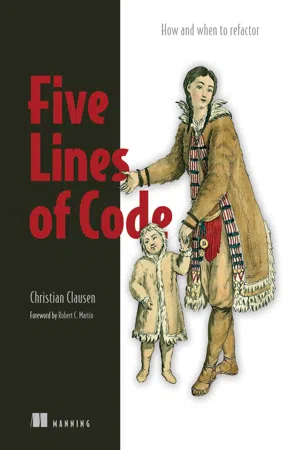
Five Lines of Code teaches refactoring that's focused on concrete rules and getting any method down to five lines or less! There’s no jargon or tricky automated-testing skills required, just easy guidelines and patterns illustrated by detailed code samples.
In Five Lines of Code you will learn:
The signs of bad code
Improving code safely, even when you don’t understand it
Balancing optimization and code generality
Proper compiler practices
The Extract method, Introducing Strategy pattern, and many other refactoring patterns
Writing stable code that enables change-by-addition
Writing code that needs no comments
Real-world practices for great refactoring
Improving existing code—refactoring—is one of the most common tasks you’ll face as a programmer. Five Lines of Code teaches you clear and actionable refactoring rules that you can apply without relying on intuitive judgements such as “code smells.” Following the author’s expert perspective—that refactoring and code smells can be learned by following a concrete set of principles—you’ll learn when to refactor your code, what patterns to apply to what problem, and the code characteristics that indicate it’s time for a rework.
Foreword by Robert C. Martin.
About the technology
Every codebase includes mistakes and inefficiencies that you need to find and fix. Refactor the right way, and your code becomes elegant, easy to read, and easy to maintain. In this book, you’ll learn a unique approach to refactoring that implements any method in five lines or fewer. You’ll also discover a secret most senior devs know: sometimes it’s quicker to hammer out code and fix it later!
About the book
Five Lines of Code is a fresh look at refactoring for developers of all skill levels. In it, you’ll master author Christian Clausen’s innovative approach, learning concrete rules to get any method down to five lines—or less! You’ll learn when to refactor, specific refactoring patterns that apply to most common problems, and characteristics of code that should be deleted altogether.
What's inside
The signs of bad code
Improving code safely, even when you don’t understand it
Balancing optimization and code generality
Proper compiler practices
About the reader
For developers of all skill levels. Examples use easy-to-read Typescript, in the same style as Java and C#.
About the author
Christian Clausen works as a Technical Agile Coach, teaching teams how to refactor code.
Table of Contents
1 Refactoring refactoring
2 Looking under the hood of refactoring
PART 1 LEARN BY REFACTORING A COMPUTER GAME
3 Shatter long function
4 Make type codes work
5 Fuse similar code together
6 Defend the data
PART 2 TAKING WHAT YOU HAVE LEARNED INTO THE REAL WORLD
7 Collaborate with the compiler
8 Stay away from comments
9 Love deleting code
10 Never be afraid to add code
11 Follow the structure in the code
12 Avoid optimizations and generality
13 Make bad code look bad
14 Wrapping up
- 336 pages
- English
- ePUB (mobile friendly)
- Available on iOS & Android
eBook - ePub
About this book
Information
Subtopic
Object Oriented ProgrammingIndex
Computer ScienceTable of contents
- inside front cover
- Five Lines of Code
- Copyright
- dedication
- brief contents
- contents
- front matter
- 1 Refactoring refactoring
- 2 Looking under the hood of refactoring
- Part 1. Learn by refactoring a computer game
- 3 Shatter long functions
- 4 Make type codes work
- 5 Fuse similar code together
- 6 Defend the data
- Part 2. Taking what you have learned into the real world
- 7 Collaborate with the compiler
- 8 Stay away from comments
- 9 Love deleting code
- 10 Never be afraid to add code
- 11 Follow the structure in the code
- 12 Avoid optimizations and generality
- 13 Make bad code look bad
- 14 Wrapping up
- Appendix A. Installing the tools for part 1
- index
- inside back cover
Trusted by 375,005 students
Access to over 1.5 million titles for a fair monthly price.
Study more efficiently using our study tools.
Frequently asked questions
Yes, you can cancel anytime from the Subscription tab in your account settings on the Perlego website. Your subscription will stay active until the end of your current billing period. Learn how to cancel your subscription
No, books cannot be downloaded as external files, such as PDFs, for use outside of Perlego. However, you can download books within the Perlego app for offline reading on mobile or tablet. Learn how to download books offline
Perlego offers two plans: Essential and Complete
- Essential is ideal for learners and professionals who enjoy exploring a wide range of subjects. Access the Essential Library with 800,000+ trusted titles and best-sellers across business, personal growth, and the humanities. Includes unlimited reading time and Standard Read Aloud voice.
- Complete: Perfect for advanced learners and researchers needing full, unrestricted access. Unlock 1.5M+ books across hundreds of subjects, including academic and specialized titles. The Complete Plan also includes advanced features like Premium Read Aloud and Research Assistant.
We are an online textbook subscription service, where you can get access to an entire online library for less than the price of a single book per month. With over 1.5 million books across 990+ topics, we’ve got you covered! Learn about our mission
Look out for the read-aloud symbol on your next book to see if you can listen to it. The read-aloud tool reads text aloud for you, highlighting the text as it is being read. You can pause it, speed it up and slow it down. Learn more about Read Aloud
Yes! You can use the Perlego app on both iOS and Android devices to read anytime, anywhere — even offline. Perfect for commutes or when you’re on the go.
Please note we cannot support devices running on iOS 13 and Android 7 or earlier. Learn more about using the app
Please note we cannot support devices running on iOS 13 and Android 7 or earlier. Learn more about using the app
Yes, you can access Five Lines of Code by Christian Clausen in PDF and/or ePUB format, as well as other popular books in Computer Science & Object Oriented Programming. We have over 1.5 million books available in our catalogue for you to explore.