How social and intellectual changes undermine our justifications for the welfare state
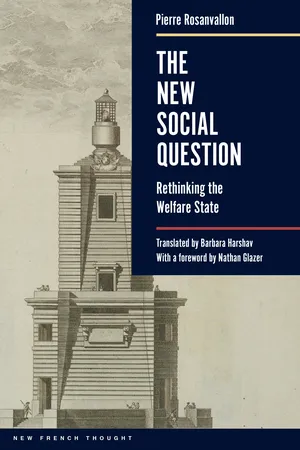
The welfare state has come under severe pressure internationally, partly for the well-known reasons of slowing economic growth and declining confidence in the public sector. According to the influential social theorist Pierre Rosanvallon, however, there is also a deeper and less familiar reason for the crisis of the welfare state. He shows here that a fundamental practical and philosophical justification for traditional welfare policies—that all citizens share equal risks—has been undermined by social and intellectual change. If we wish to achieve the goals of social solidarity and civic equality for which the welfare state was founded, Rosanvallon argues, we must radically rethink social programs.
Rosanvallon begins by tracing the history of the welfare state and its founding premise that risks, especially the risks of illness and unemployment, are equally distributed and unpredictable. He shows that this idea has become untenable because of economic diversification and advances in statistical and risk analysis. It is truer than ever before—and far more susceptible to analysis—that some individuals will face much greater risks than others because of their jobs and lifestyle choices. Rosanvallon argues that social policies must be more narrowly targeted. And he draws on evidence from around the world, in particular France and the United States, to show that such programs as unemployment insurance and workfare could better reflect individual needs by, for example, making more explicit use of contracts between the providers and receivers of benefits. His arguments have broad implications for welfare programs everywhere and for our understanding of citizenship in modern democracies and economies.
- 176 pages
- English
- ePUB (mobile friendly)
- Available on iOS & Android
eBook - ePub
About this book
Information
Publisher
Princeton University PressYear
2021Print ISBN
9780691265773
9780691016405
eBook ISBN
9781400823482
Topic
FilosofiaSubtopic
Filosofia politicaTable of contents
- Cover Page
- Title Page
- Copyright Page
- Contents
- Foreword by Nathan Glazer
- Introduction: The New Social Question
- Part One: Reorganizing Solidarity
- Part Two: Rethinking Rights
- Conclusion: Rethinking Social Progress
- Notes
- Index
Trusted by 375,005 students
Access to over 1.5 million titles for a fair monthly price.
Study more efficiently using our study tools.
Frequently asked questions
Yes, you can cancel anytime from the Subscription tab in your account settings on the Perlego website. Your subscription will stay active until the end of your current billing period. Learn how to cancel your subscription
No, books cannot be downloaded as external files, such as PDFs, for use outside of Perlego. However, you can download books within the Perlego app for offline reading on mobile or tablet. Learn how to download books offline
Perlego offers two plans: Essential and Complete
- Essential is ideal for learners and professionals who enjoy exploring a wide range of subjects. Access the Essential Library with 800,000+ trusted titles and best-sellers across business, personal growth, and the humanities. Includes unlimited reading time and Standard Read Aloud voice.
- Complete: Perfect for advanced learners and researchers needing full, unrestricted access. Unlock 1.5M+ books across hundreds of subjects, including academic and specialized titles. The Complete Plan also includes advanced features like Premium Read Aloud and Research Assistant.
We are an online textbook subscription service, where you can get access to an entire online library for less than the price of a single book per month. With over 1.5 million books across 990+ topics, we’ve got you covered! Learn about our mission
Look out for the read-aloud symbol on your next book to see if you can listen to it. The read-aloud tool reads text aloud for you, highlighting the text as it is being read. You can pause it, speed it up and slow it down. Learn more about Read Aloud
Yes! You can use the Perlego app on both iOS and Android devices to read anytime, anywhere — even offline. Perfect for commutes or when you’re on the go.
Please note we cannot support devices running on iOS 13 and Android 7 or earlier. Learn more about using the app
Please note we cannot support devices running on iOS 13 and Android 7 or earlier. Learn more about using the app
Yes, you can access The New Social Question by Pierre Rosanvallon, Barbara Harshav in PDF and/or ePUB format, as well as other popular books in Filosofia & Filosofia politica. We have over 1.5 million books available in our catalogue for you to explore.