Revisiting the Past in Museums and at Historic Sites demonstrates that museums and historic spaces are increasingly becoming "backdrops" for all sorts of appropriations and interventions that throw new light upon the objects they comprise and the pasts they reference.
Rooted in new scholarship that expands established notions of art installations, museums, period rooms, and historic sites, the book brings together contributions from scholars from intersecting disciplines. Arguing that we are witnessing a paradigm shift concerning the place of historic spaces and museums in the contemporary imaginary, the volume shows that such institutions are merging traditional scholarly activities tied to historical representation and inquiry with novel modes of display and interpretation, drawing them closer to the world of entertainment and interactive consumption. Case studies analyze how a range of interventions impact historic spaces and conceptions of the past they generate. The book concludes that museums and historic sites are reinventing themselves in order to remain meaningful and to play a role in societies aspiring to be more inclusive and open to historical and cultural debate.
Revisiting the Past in Museums and at Historic Sites will be of interest to students and faculty who are engaged in the study of museums, art history, architectural and design history, social and cultural history, interior design, visual culture, and material culture.
Reimagining space and relations in the wake of Black Lives Matter
Hannah Scruggs and Tiya Miles
DOI: 10.4324/9781003147695-3
Historically (and flagrantly during the term of President Donald J. Trump), the United States has abetted rather than rejected self-serving impulses of the ruling elite, resulting in unchecked capitalism, deep-seated racism, and disregard for the lives of people without financial or political power. In the late spring and summer of 2020, multiracial protests swept the country to forcefully reject this status quo and articulate an oppositional set of values. The uprising began in response to the graphic, digitally recorded killing of George Floyd, an unarmed African American man, by police officers in Minneapolis on May 25, 2020. Despite the risks posed by a deadly health crisis caused by the novel coronavirus and militarized urban streets that aimed to curtail their action, protestors marched by the tens of thousands to defend the dignity of George Floyd and other deceased African Americans, including Breonna Taylor, Ahmed Aubrey, and more, whose lives were cut short by police brutality. Though controversial and at times accompanied by looting and the destruction of private and public property, these protests nevertheless sparked hope among some for a new American culture that might center a vision of racial justice.
Amid this nearly inconceivable widespread social eruption, the likes of which had not been experienced in the United States since the 1960s and 1970s, Black Lives Matter signs began appearing across the physical and cultural landscape. In our everyday lives during that long and tumultuous summer in which the country was being compelled to confront its clouded history of race relations, racial discrimination, and racialized violence, we, a museum professional and an academic, noticed how these potent yet controversial words – “Black Lives Matter” – were taken up in many corners of American life. The mantra appeared in massive letters hand-painted on the front of aging barns in New England, on banners hanging in front of expensive private schools in the Washington, DC, area, and on professionally printed yard signs posted before large, multimillion-dollar mansions in predominantly white neighborhoods in many cities. This slogan, or carefully scripted versions of it, flooded the email inboxes of citizens and consumers in the form of corporate statements that seemed directed toward signaling virtue while advertising brands. We agreed, though, that the strangest place we encountered this political rallying cry was on the home page of Berkeley Plantation, a luxurious and professionally operated southern estate and house museum. While we were both inspired by the dramatic political intervention of the protests, we felt that the eager adaptation (and corporate cooptation) of Black Lives Matter proclamations during that season of racial reckoning often seemed facile rather than self-reflexive.
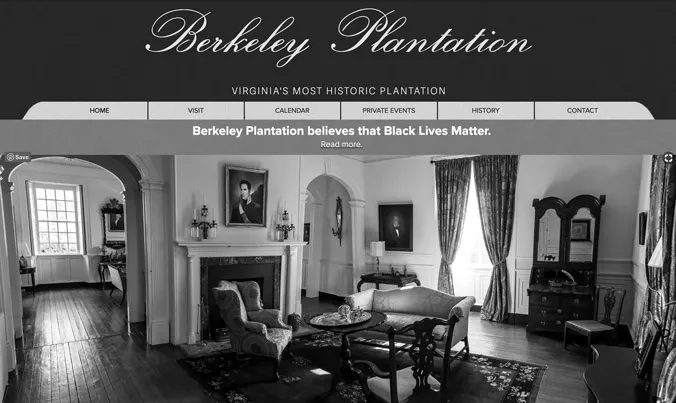
We had been working together on orienting undergraduate summer fellows to methods and tools in public history when one of us happened to mention the Berkeley Plantation as an example of a long-standing plantation business. Afterward, the second member of our pair visited the organization’s website and promptly shared a discovery via text message. This iconic historic site had joined the cultural chorus proclaiming that Black Lives Matter. Berkeley Plantation, a National Historic Landmark that bills itself as “Virginia’s Most Historic Plantation,” is situated along the James River in Virginia, a colony and then state that enslaved thousands of Africans and African Americans to produce lucrative tobacco crops before contributing to a mass forced migration of nearly a million African Americans into the formerly Indigenous cotton lands of the Old Southwest in the early 1800s. Berkeley Plantation’s home page features the romanticized language and images that tourists anticipate and scholars of plantation tourism have long analyzed and critiqued: wealthy white owners, ornate architecture, splendid gardens, fine antiques, and decorous housewares.1 At Berkeley, the famous former residents who are highlighted include Virginia Governor Benjamin Harrison and President William Henry Harrison. The genteel domestic setting is enhanced, the home page text extols, by “enthusiastic guides in period costume.” The website indicates that visitors will step into an Old South fantasy, a typical kind of idealization that obscures how slavery shaped the site economically, socially, politically, and culturally. But in that moment of public foment, the Berkeley Plantation website also foregrounded a bold banner across the top of the screen proclaiming: “Berkeley Plantation believes that Black Lives Matter” (Figure 1.1).
Figure 1.1 Berkeley Black Lives Matter.
Source: Screenshot by Scruggs, July 7, 2020.
As public historians intimately familiar with two plantation museums and loosely familiar with many more, we were stunned to see this claim posted above photographs of manicured grounds once maintained by enslaved people and formal parlors with antique furnishings and portraits of slaveholders gracing the walls. It struck us as ironic, and even perhaps insensitive, that an estate once dependent on the exploited labor and devalued lives of African Americans and Native Americans was now purporting to honor Black existence. Given that this was a volatile and unpredictable moment when not weighing in on massive street protests challenging systemic racism exposed businesses and cultural institutions to public criticism, we suspected the Berkeley Plantation leadership of disingenuity and even opportunism. Clicking on the banner and finding a lengthy statement that addressed the harm done to Black and Indigenous residents on those grounds softened our immediate reaction. The statement opened with the assertion: “We believe that Black Americans, Indigenous People and their descendants deserve justice” and continued with an admission of responsibility as well as an aspirational action plan. The text went on to state: “We recognize that enslaved people were present at Berkeley plantation,” and vowed: “We are working with researchers and historians to uncover all aspects of this site’s past and there is much work and responsibility ahead to make this site a place for healing and awareness.” We were persuaded that Berkeley Plantation’s current operators do care about the history of slavery and present-day legacies at their site.
Nevertheless, staff members at the Berkeley Plantation face an obstacle that seems nearly insurmountable. No matter their intentions and internal evolution prompted by their own research and the course of current events, they are stewarding a racist landmark among an entire class of public memorials – plantation estates – on a scale greater than the Confederate statues that were vandalized or removed between August 2017 and the summer of 2020 national reckoning with anti-democratic symbols.2 As Patricia J. Williams stated in a September 2019 piece in The Nation on plantation weddings: these iconic homes and landscapes are “monuments to slavery.”3 The relevant question is not whether any site staff believes in their hearts that Black life is valuable – but, rather, what caretakers of plantation sites and visitors to these historic places will do differently as a result of this belief.
We have both spent what would amount to months of time touring and considering plantations: one of us, Hannah Scruggs, spent two years working at the plantation museum James Madison’s Montpelier as a research associate and recalls countless grade school field trips to plantation sites in Virginia, including places where her family was likely enslaved; and the other, Tiya Miles, wrote a history of a plantation and Georgia state historic site in the former Cherokee Nation as well as a book on dark tourism in Louisiana, Georgia, South Carolina, and Mississippi.4 We both understand the explanatory power that comes from telling the story of people, enslaved or otherwise, in the places where they lived, labored, loved, and died. As public historians who work in a museum setting and university environment, we have watched first-hand over the last two decades as plantation museums and other sites of slavery began trying to interpret the legacies of slavery honestly. Numerous studies of plantation tourism, such as Jennifer Eichstedt and Stephen Small’s classic 2002 sociological study, “Representations of Slavery,” found that plantation sites (especially those that are privately owned) tend toward Eurocentric portrayals of the past that participate in a process of “symbolic annihilation” in which Black presence is ignored or marginalized.5 Geographers E. Arnold Modlin, Derek Alderman, and Glenn Gentry argued in the journal Tourist Studies that even when plantation museums incorporate African Americans into tour narratives, they often do so in a distant manner that reduces Black experience to a cold recitation of population numbers, ages, and work tasks, rather than elevating Black residents to the level of white owners through stories that induce empathetic responses in visitors.6 In 2014, the National Science Foundation funded a team of geographers and historians headed by David Butler, and including Perry Carter, Amy Potter, Derek Alderman, Matthew R. Cook, and Stephen Hanna, to conduct the most systematic study to date of a famous cluster of cotton estates known as the River Road Plantations spanning the Mississippi–Louisiana border, as well as plantations in Charleston, South Carolina, and in the James River area of Virginia.7 The team members found that even at sites that have made an effort to interpret enslaved people’s presence, features of the built environment, such as the location and size of the front-facing “big house” in comparison to “slave quarters” in the rear of a property, emphasize elite white experiences to the detriment of others.8 Using a method called narrative mapping, Stephen Hanna, a member of Butler’s team, discovered that these narratives are still kept largely separate 20 years after Eichstedt and Small’s study was published.
Tourists who enter these plantation landscapes often bring romanticized notions in keeping with what veteran curator Fath Davis Ruffins, at the Smithsonian National Museum of American History, has described as “the American public memory of slavery [that] is largely one of amnesia or a ‘moonlight and magnolias’ view of the Old South.”9 These expectations are affirmed in the typical spatial arrangement and interpretive focus of the present-day plantation museum, which idealizes white spaces (such as the big house) and relegates Black spaces to the margins or shadows. Miles has found in her research on southern ghost tourism, recounted in the book Tales from the Haunted South, that a handful of privately run plantation sites and walking tours market Black suffering in the form of horrific tales of sexual abuse and murder trivialized as ghost stories. It is heartbreaking and noteworthy, as well, that plantations can be heritage sites for white supremacists. Dylann Roof, who killed nine people participating in Bible study at Charleston’s Mother Emanuel AME Church in 2015, visited South Carolina plantations in the months leading up to his racially motivated attack.10 On top of this, plantations continue to profit from the past labor of enslaved people that built their sites and the present knowledge and contributions of African Americans, often descendants, without acknowledging, much less giving back, to the living descendants of the enslaved. For example, most plantation sites charge a fee to visit the main house (built by enslaved people) or the grounds (historically cleared and landscaped by enslaved people). Sites retain these proceeds, profiting even today from enslaved people’s past labor when they might instead use part of the funds to offer scholarships or other payments to the descendants whose ancestors built the site. By continuing to uphold the false narrative of a romanticized Old South and benefiting from the unrecognized contributions of unfree people, plantation businesses and museums perpetuate the historical wrong of slavery in another form, limiting the possibilities for intra-racial and interracial healing and stymying the ability for local communities and the nation as a whole to move forward.
Plantation tourism has changed slowly but substantially over the last decade, particularly with the 2014 opening of the innovative, privately owned Whitney Plantation in Louisiana, which consciously centers African and African American experiences, and the 2015 reopening of the McLeod Plantation in South Carolina, which is operated by Charleston County and interprets Black experiences before and after the Civil War. These sites are models for how the plantation museum experience has been reimagined, and yet they have remained in the minority of southern estate museums. The opening of Whitney and the gradual shift at McLeod have provoked resistance from white visitors who have expressed resentment at tours that address racial subjugation.11 ...
Table of contents
Cover Page
Half Title Page
Series Page
Title Page
Copyright Page
Contents
List of contributors
Space unlocked, history unfrozen: revisiting the past in museums and at historic sites
Section I Historic sites
Section II Museums
Section III Period rooms
Index
Trusted by 375,005 students
Access to over 1.5 million titles for a fair monthly price.
Study more efficiently using our study tools.
Frequently asked questions
Yes, you can cancel anytime from the Subscription tab in your account settings on the Perlego website. Your subscription will stay active until the end of your current billing period. Learn how to cancel your subscription
No, books cannot be downloaded as external files, such as PDFs, for use outside of Perlego. However, you can download books within the Perlego app for offline reading on mobile or tablet. Learn how to download books offline
Perlego offers two plans: Essential and Complete
Essential is ideal for learners and professionals who enjoy exploring a wide range of subjects. Access the Essential Library with 800,000+ trusted titles and best-sellers across business, personal growth, and the humanities. Includes unlimited reading time and Standard Read Aloud voice.
Complete: Perfect for advanced learners and researchers needing full, unrestricted access. Unlock 1.5M+ books across hundreds of subjects, including academic and specialized titles. The Complete Plan also includes advanced features like Premium Read Aloud and Research Assistant.
Both plans are available with monthly, semester, or annual billing cycles.
We are an online textbook subscription service, where you can get access to an entire online library for less than the price of a single book per month. With over 1.5 million books across 990+ topics, we’ve got you covered! Learn about our mission
Look out for the read-aloud symbol on your next book to see if you can listen to it. The read-aloud tool reads text aloud for you, highlighting the text as it is being read. You can pause it, speed it up and slow it down. Learn more about Read Aloud
Yes! You can use the Perlego app on both iOS and Android devices to read anytime, anywhere — even offline. Perfect for commutes or when you’re on the go. Please note we cannot support devices running on iOS 13 and Android 7 or earlier. Learn more about using the app
Yes, you can access Revisiting the Past in Museums and at Historic Sites by Anca I. Lasc, Andrew McClellan, Änne Söll, Anca I. Lasc,Andrew McClellan,Änne Söll in PDF and/or ePUB format, as well as other popular books in Art & Museum Studies. We have over 1.5 million books available in our catalogue for you to explore.