The prominent civilized nations, such as the Babylonians, Egyptians, Hebrews, and Hindoos, the inhabitants of Iran and of Persia, the Greeks and the Romans as well as the Teutons and others, all began at an early stage to glorify their heroes, mythical princes and kings, founders of religions, dynasties, empires or cities, in brief their national heroes, in a number of poetic tales and legends. The history of the birth and of the early life of these personalities came to be especially invested with fantastic features, which in different nations even though widely separated by space and entirely independent of each other present a baffling similarity, or in part a literal correspondence. Many investigators have long been impressed with this fact, and one of the chief problems of mythical research still consists in the elucidation of the reason for the extensive analogies in the fundamental outlines of mythical tales, which are rendered still more enigmatical by the unanimity in certain details, and their reappearance in most of the mythical groupings.
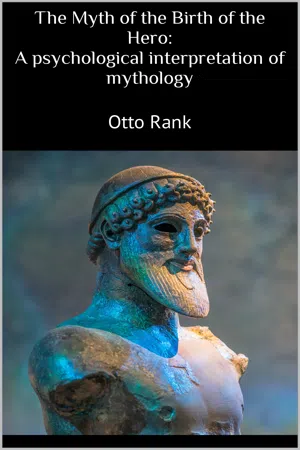
eBook - ePub
The Myth of the Birth of the Hero: A psychological interpretation of mythology
- 145 pages
- English
- ePUB (mobile friendly)
- Available on iOS & Android
eBook - ePub
The Myth of the Birth of the Hero: A psychological interpretation of mythology
About this book
Information
FOOTNOTES:
[1]
A short and fairly complete review of the general theories of mythology and its principal advocates is to be found in Wundt’s “Völkerpsychologie,” Vol. II, Myths and Religion. Part I [Leipzig, 1905], p. 527.
[2]
“ Das Beständige in den Menschenrassen und die Spielweise ihrer Veränderlichkeit.” Berlin, 1868.
[3]
“ Die Kyros Sage und Verwandtes,” Sitzb. Wien. Akad. , 100, 1882, p. 495.
[4]
Schubert. Herodots Darstellung der Cyrussage, Breslau, 1890.
[5]
Compare E. Stucken, “Astral mythen,” Leipzig, 1896-1907, especially Part V, “Moses.” H. Lessmann, “Die Kyrossage in Europe,” Wiss. beit. z. Jahresbericht d. städt. Realschule zu Charlottenburg , 1906.
[6]
“ Naturgeschichte d. Sage.” Tracing all religious ideals, legends, and systems back to their common family tree, and their primary root, 2 volumes, Munich 1864-65.
[7]
Some of the important writings of Winckler will be mentioned in the course of this article.
[8]
Zeitschrift f. d. Oesterr. Gym. , 1891, p. 161, etc. Schubert’s reply is also found here, p. 594, etc.
[9]
Lessmann, “Object and Aim of Mythological Research,” Mythol. Bibliot. , 1, Heft 4, Leipzig.
[10]
Winckler, “Die babylonische Geisteskultur in ihren Beziehungen zur Kulturentwicklung der Menschheit,” Wissenschaft u. Bildung , Vol. 15, 1907, p. 47.
[11]
Of course no time will be wasted on the futile question as to what this first legend may have been; for in all probability this never had existence, any more than a “first human couple.”
[12]
As an especially discouraging example of this mode of procedure may be mentioned a contribution by the well-known natural mythologist Schwartz, which touches upon this circle of myths, and is entitled: “Der Ursprung der Stamm und Gründungssage Roms unter dem Reflex indogermanischer Mythen” [Jena, 1898].
[13]
Frobenius, Das Zeitalter des Sonnengotten, Berlin, 1904.
[14]
Siecke, “Hermes als Mondgott,” Myth. Bibl. , Vol. II, Pt. 1, p. 48.
[15]
Compare for example, Paul Koch, “Sagen der Bibel und ihre Ubereinstimmung mit der Mythologie der Indogermanen,” Berlin, 1907. Compare also the partly lunar, partly solar, but at any rate entirely one sided conception of the hero myth, in Gustav Friedrich’s “Grundlage, Entstehung und genaue Einzeldeutung der bekanntesten germanischen Märchen, Mythen und Sagen” [Leipzig, 1909], p. 118.
[16]
Translated by Dr. A. A. Brill. Macmillan Co.
[17]
The fable of Shakespeare’s Hamlet also permits of a similar interpretation, according to Freud. It will be seen later on how mythological investigators bring the Hamlet legend from entirely different view points into the correlation of the mythical circle.
[18]
In Journal of Nervous and Mental Disease, 1912. Also collected in this Monograph Series, No. 15.
[19]
Compare Lessmann (Mythol. Bibl., I, 4). Ehrenreich alone (loc. cit., p. 149) admits the extraordinary significance of dream-life for the myth-fiction of all times. Wundt does so likewise, for individual mythical motives.
[20]
Stucken [Mose, p. 432] says in this sense. The myth transmitted by the ancestors was transferred to natural processes and interpreted in a naturalistic way, not vice versa. “Interpretation of nature is a motive in itself” [p. 633, annotation]. In a very similar way, we read in Meyer’s History of Antiquity, Vol. V, p. 48: In many cases, the natural symbolism, sought in the myths, is only apparently present or has been secondarily introduced, as often in the Vedda and in the Egyptian myths; it is a primary attempt at interpretation, like the myth-interpretations which arose among the Greeks since the fifth century.
[21]
For fairy tales, in this as well as in other essential features, Thimme advocates the same point of view as is here claimed for the myths. Compare Adolf Thimme, “Das Märchen,” 2d volume of the Handbücher zur Volkskunde, Leipzig, 1909.
[22]
Volume II of the German translation, Leipzig, 1869, p. 143.
[23]
Of this myth-interpretation, Wundt has well said that it really should have accompanied the original myth-formation. (Loc. cit., p. 352.)
[24]
See Ignaz Goldziher, “Der Mythus bei den Hebräern und seine geschichtliche Entwickelung” [Leipzig, 1876], p. 125. According to the writings of Siecke [“Hermes als Mondgott,” Leipzig, 1908, p. 39], the incest myths lose all unusual features through being referred to the moon, and its relation to the sun. The explanation being quite simple: the daughter, the new moon, is the repetition of the mother [the old moon], with her the father [the sun] [also the brother, the son] becomes reunited.
[25]
Is it to be believed? In an article entitled “Urreligion der Indogermanen” [Berlin, 1897], where Siecke points out that the incest myths are descriptive narrations of the seen but inconceivable process of nature, he objects to a statement of Oldenburg [“Religion der Veda,” p. 5] who assumes a primeval tendency of myths to the incest motive, with the remark that in the days of yore the motive was thrust upon the narrator, without an inclination of his own, through the forcefulness of the witnessed facts.
[26]
The great variability and wide distribution of the birth myths of the hero results from the above quoted writings of Bauer, Schubert and others, while their comprehensive contents and fine ramifications were especially discussed by Husing, Lessmann, and the other representatives of the modern direction.
Innumerable fairy tales, stories, and poems of all times, up to the most recent dramatic and novelistic literature, show very distinct individual main motives of this myth. The exposure-romance is known to appear in the following literary productions: The late Greek pastorals, as told in Heliodor’s “Aethiopika,” in Eustathius’ “Ismenias and Ismene,” and in the Story of the two exposed children, Daphnis and Chloe. The more recent Italian pastorals are likewise very frequently based upon the exposure of children, who are raised as shepherds by their foster-parents, but are later recognized by the true parents, through identifying marks which they received at the time of their exposure. To the same set belong the family history in Grimmelshausen’s “Limplizissimus” (1665), in Jean Paul’s “Titan” (1800), as well as certain forms of the Robinson stories and Cavalier romances (compare Würzbach’s Introduction to the Edition of “Don Quichote” in Hesse’s edition).
[27]
The various translations of the partly mutilated text differ only in unessential details. Compare Hommel’s “History of Babylonia and Assyria” (Berlin, 1885), p. 302, where the sources of the tradition are likewise found, and A. Jeremias, “The Old Testament in the Light of the Ancient Orient,” II edition, Leipzig, 1906, p. 410.
[28]
On account of these resemblances, a dependence of the Exodus tale from the Sargon legend has often been assumed, but apparently not enough attention has been paid to certain fundamental distinctions, which will be taken up in detail in the interpretation.
[29]
The parents of Moses were originally nameless, as were all persons in this, the oldest account. Their names were only conferred upon them by the priesthood. Chapter 6, 20, says: “And Amram took him Jocabed his father’s sister to wife; and she bare him Aaron and Moses” [and their sister Miriam, IV, 26, 59]. Also compare Winckler, “History of Israel,” II, and Jeremias, l. c., p. 408.
[30]
The name, according to Winckler (“Babylonian Mental Culture,” p. 119), means “The Water-Drawer” (see also Winckler, “Ancient Oriental Studies,” III, 468, etc.), which would still further approach the Moses legend to the Sargon legend, for the name Akki signifies I have drawn water.
[31]
Schemot Rabba, fol. 2, 4. Concerning 2, Moses 1, 22, says that Pharaoh was told by the astrologers of a woman who was pregnant with the Redeemer of Israel.
[32]
The Hindu birth legend of the mythical king Vikramâdita must also be mentioned in this connection. Here again occur the barren marriage of the parents, the miraculous conception, ill-omened warnings, the exposure of the boy in the forest, his nourishment with honey, finally the acknowledgment by the father. (See Jülg, “Mongolian Fairy Tales,” Innsbruck, 1868, p. 73, et seq.)
[33]
“ Hindu Legends,” Karlsruhe, 1846, Part II, pp. 117 to 127.
[34]
“ Hindu Legends,” l. c.
[35]
See Röscher, concerning the Ion of Euripides. Where no other source is stated, all Greek and Roman myths are taken from the Extensive Dictionary of Greek and Roman Mythology, edited by Röscher, which also contains a list of all sources.
[36]
According to Bethe, “Thebanische Heldenlieder,” the exposure on the waters was the original rendering. According to other versions, the boy is found and raised by horse herds; according to a later myth, by a countryman, Melibios.
[37]
The entire mate...
Table of contents
- The Myth of the Birth of the Hero: A psychological interpretation of mythology
- Introduction
- Sargon
- Moses
- Karna
- Œdipus
- Paris
- Telephos
- Perseus
- Gilgamos
- Kyros
- Tristan
- Romulus.
- Hercules [60]
- Jesus
- Siegfried
- Lohengrin
- FOOTNOTES:
- Copyright
Trusted by 375,005 students
Access to over 1.5 million titles for a fair monthly price.
Study more efficiently using our study tools.
Frequently asked questions
Yes, you can cancel anytime from the Subscription tab in your account settings on the Perlego website. Your subscription will stay active until the end of your current billing period. Learn how to cancel your subscription
No, books cannot be downloaded as external files, such as PDFs, for use outside of Perlego. However, you can download books within the Perlego app for offline reading on mobile or tablet. Learn how to download books offline
Perlego offers two plans: Essential and Complete
- Essential is ideal for learners and professionals who enjoy exploring a wide range of subjects. Access the Essential Library with 800,000+ trusted titles and best-sellers across business, personal growth, and the humanities. Includes unlimited reading time and Standard Read Aloud voice.
- Complete: Perfect for advanced learners and researchers needing full, unrestricted access. Unlock 1.5M+ books across hundreds of subjects, including academic and specialized titles. The Complete Plan also includes advanced features like Premium Read Aloud and Research Assistant.
We are an online textbook subscription service, where you can get access to an entire online library for less than the price of a single book per month. With over 1.5 million books across 990+ topics, we’ve got you covered! Learn about our mission
Look out for the read-aloud symbol on your next book to see if you can listen to it. The read-aloud tool reads text aloud for you, highlighting the text as it is being read. You can pause it, speed it up and slow it down. Learn more about Read Aloud
Yes! You can use the Perlego app on both iOS and Android devices to read anytime, anywhere — even offline. Perfect for commutes or when you’re on the go.
Please note we cannot support devices running on iOS 13 and Android 7 or earlier. Learn more about using the app
Please note we cannot support devices running on iOS 13 and Android 7 or earlier. Learn more about using the app
Yes, you can access The Myth of the Birth of the Hero: A psychological interpretation of mythology by Otto Rank in PDF and/or ePUB format, as well as other popular books in Psychology & History & Theory in Psychology. We have over 1.5 million books available in our catalogue for you to explore.