The second edition of Agile Change Management provides essential tools to build change manager capabilities and ensure change initiatives are embedded effectively throughout the organization.
This book is a comprehensive resource for creating a roadmap that is flexible and unique to each organization to manage any type of change initiative. Detailing all the processes, activities and information needed, from creating the right environment for change to completing iterative tasks, it shows how to respond to different needs as they arise, reducing the potential for wasted time and resources.
The updated second edition features chapters on behavioural change and decomposition in planning iterations, and new material on prototyping for business needs and virtual leadership. Whether implementing a large-scale transformation or working through projects at micro-level, Agile Change Management provides tools, frameworks and examples necessary to adapt to and manage change effectively.
eBook - ePub
Agile Change Management
A Practical Framework for Successful Change Planning and Implementation
- English
- ePUB (mobile friendly)
- Available on iOS & Android
eBook - ePub
Agile Change Management
A Practical Framework for Successful Change Planning and Implementation
About this book
Information
01
Concept
Explaining agile change management
Agile change management is designed to realize benefits from change as early as possible, by ensuring that the changes are prioritized according to their business value. The aim for organizations is to be agile in their approach to change – to have the ability to move quickly and easily.
Why are organizations adopting an agile approach?
In a world of complex and continuous change, many organizations have realized that hierarchical structures and lengthy decision-making processes can prevent them from achieving the full benefits of change.
Change is complex because the environment in which we operate has become complex. There are high levels of interconnectivity between data, systems, processes, and performance measures within our organizations and within our suppliers and customers. It is not possible to predict with any certainty what changes will be required, because it is not possible to predict how one change will trigger further changes.
Change is continuous because high levels of uncertainty politically and economically, coupled with rapid changes in technological capability and customer requirements create high volumes of change. As each change triggers further changes, it not only makes the process more complex, but it shortens the life span for how things are done. Existing practices are superseded by new ideas and continuous innovation leads to continuous obsolescence.
Change initiatives are no longer special situations, planned and resourced separately from business. Change is no longer only conceived and implemented ‘top down’. Change involves everyone, as we are all responsible for doing our job and at the same time coming up with ideas for how we can improve our work and response to change. As shown in Figure 1.1, this leads to a continuous cycle of change. These ideas form a stream of continuous improvement, managed by those initiating them, or if the impact will be felt more widely across the organization and its ecosystem, then the initiative is given more specialist resources.
Figure 1.1 Increase in the pace of change
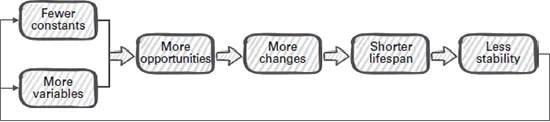
Figure 1.1 details
The details of the change cycle are as follows: the fewer constants and more variables lead to more opportunities, which lead to more changes, changes lead to shorter lifespan, which leads to less stability. Less stability again leads fewer constants and more stability.
Agile change is a way to identify, plan and implement change, applying principles from the Agile community and techniques from the change management profession. The purpose is to align the project activities that create tangible change with emotional and psychological support that encourages the adoption of new ways of working. This agility ensures that the changes we create continue to evolve to meet the needs of our organizations and have the greatest possible chance of realizing the benefits that are promised and expected.
Figure 1.2 Change is formed of two elements
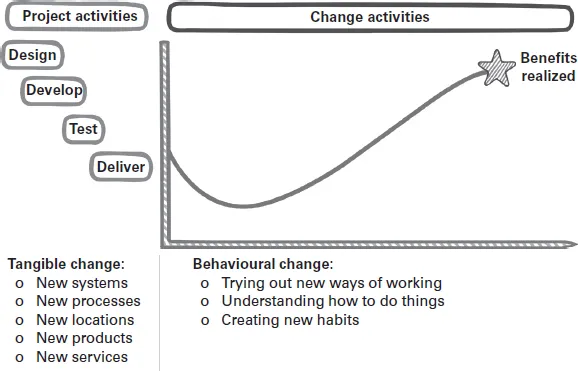
Figure 1.2 details
The details of the graph are as follows: the project activities beside the vertical axis reads design, develop, test and deliver the horizontal axis represents change activities. An increasing curve shows the benefits realized. The tangible changes are new systems, new processes, new locations, new products and new services and the behavioural changes are trying out new ways of working, understanding how to do things and creating new habits.
Project and change activities are often delivered by two different parties and using different methods as shown in Figure 1.2:
- Tangible change is created by project teams, developers, engineers, facilities staff and professional services staff including regulators, HR and accountants. Whatever their role, their objective is to create the deliverables according to technical quality standards. They are often incentivized and/or performance managed on their ability to deliver on time and on budget with the minimum number of errors.
- Behavioural change can only be achieved by individuals deciding that they will start doing things differently. This means those responsible for behavioural change are all those required to work in a new way and incorporate the tangible changes into their ways of working. It is a conscious decision to ‘forget’ old habits and to start practising new ways of working.
Behavioural change is much harder to predict than the creation of tangible change because it is a psychological and emotional process that doesn’t follow a linear path. Everyone sees change differently, some greeting it with enthusiasm, full of opportunities and advantages, and some seeing it as a threat to their current ability and status. As shown in Figure 1.2, the vertical axis represents productivity, which reduces at the beginning of a change process, because we go slowly when we do things for the first time, and we make mistakes that take time to correct. Repetition of the new ways of working builds familiarity and competence and productivity rises again, creating more benefits for the organization than before. How many times we need to repeat something, and the period of time before it becomes ‘normal’, depends on how we learn, the complexity of the new ways of working and our commitment to the change.
Figure 1.3 Project and change activities
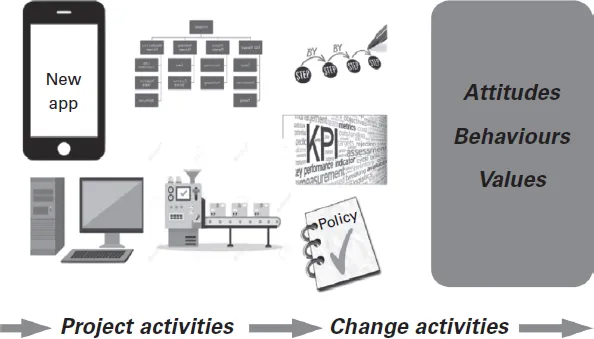
Combining tangible and behavioural change is core to agile change management, as benefits can only be achieved when things are used. Tangible outputs, created via project activities, do not realize benefits by themselves. They can only make a positive difference when they become part of how work is carried out, which is the result of the change activities. Figure 1.3 shows examples of tangible change on the left, including new IT systems, new production line or restructuring of an organization, each of which triggers on the right of the diagram the creation of new processes, policies and key performance indicators. These elements formalize the use of the deliverables, but it is the establishment of new attitudes and behaviours and the values that support them that is key to achieving long-term, sustained change.
Five concepts of agile change management
Agile change management is formed of five concepts that use agile principles combined with psychological techniques for creating new behaviours:
- Collaboration
- On-time delivery
- Evolving solution
- Business need
- Iterative approach
Each concept relies upon the application of the other concepts. To select only some of these concepts risks the success of your change. The following sections will explore these concepts in more detail.
Collaboration
Collaboration is a general term derived directly from the Latin words for ‘working together’. It means organized sharing of information and activities.
WHAT DOES IT INVOLVE?
- Collaboration creates shared understanding of what is needed between those creating the tangible changes, those involved in designing the new ways of working, and all those who will need to work in new ways. It involves joint participation in the creation and implementation of new ways of working.
- The level of participation varies from person to person but making the change a reality is a team effort. It’s important that it is not forced upon others; it is their choice to become involved.
- Collaboration relies on relationship building and teamwork, where everyone is responsible for building relationships with everyone else. It involves curiosity about the ideas and perspec...
Table of contents
- 1 Concept
- 2 Roadmap
- 3 Business need
- 4 Relationship building
- 5 Environment
- 6 Coaching for Change
- Appendix 1 Change roles
- Appendix 2 Change management documents
- Appendix 3 Communication activities
- Further reading
- Index
Trusted by 375,005 students
Access to over 1.5 million titles for a fair monthly price.
Study more efficiently using our study tools.
Frequently asked questions
Yes, you can cancel anytime from the Subscription tab in your account settings on the Perlego website. Your subscription will stay active until the end of your current billing period. Learn how to cancel your subscription
No, books cannot be downloaded as external files, such as PDFs, for use outside of Perlego. However, you can download books within the Perlego app for offline reading on mobile or tablet. Learn how to download books offline
Perlego offers two plans: Essential and Complete
- Essential is ideal for learners and professionals who enjoy exploring a wide range of subjects. Access the Essential Library with 800,000+ trusted titles and best-sellers across business, personal growth, and the humanities. Includes unlimited reading time and Standard Read Aloud voice.
- Complete: Perfect for advanced learners and researchers needing full, unrestricted access. Unlock 1.5M+ books across hundreds of subjects, including academic and specialized titles. The Complete Plan also includes advanced features like Premium Read Aloud and Research Assistant.
We are an online textbook subscription service, where you can get access to an entire online library for less than the price of a single book per month. With over 1.5 million books across 990+ topics, we’ve got you covered! Learn about our mission
Look out for the read-aloud symbol on your next book to see if you can listen to it. The read-aloud tool reads text aloud for you, highlighting the text as it is being read. You can pause it, speed it up and slow it down. Learn more about Read Aloud
Yes! You can use the Perlego app on both iOS and Android devices to read anytime, anywhere — even offline. Perfect for commutes or when you’re on the go.
Please note we cannot support devices running on iOS 13 and Android 7 or earlier. Learn more about using the app
Please note we cannot support devices running on iOS 13 and Android 7 or earlier. Learn more about using the app
Yes, you can access Agile Change Management by Melanie Franklin in PDF and/or ePUB format, as well as other popular books in Business & Management. We have over 1.5 million books available in our catalogue for you to explore.