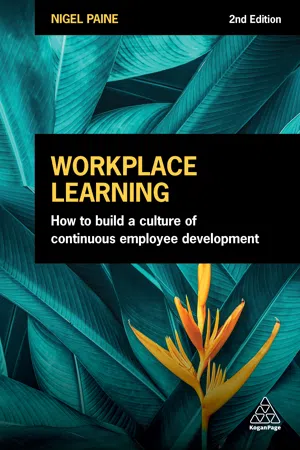
How can I develop an effective workplace learning culture to drive employee and business success? This new edition of Workplace Learning provides the knowledge and tools to create an outstanding learning culture in the new world of work.
It's no longer enough for Learning and Development professionals to only offer a catalogue of workplace learning courses: competing effectively in today's business environment requires organizations and their employees to adapt and learn daily. Providing an evidence-based model for identifying key areas of focus and measuring success, Workplace Learning is a practical guide that shows how to build and embed a culture that continuously encourages and engages employees in learning and achieve business success.
The updated second edition features new material on organizational and self-determined learning, and case studies from Microsoft, Novartis and PwC. Packed with practical suggestions, tools and tips, Workplace Learning is an essential resource for establishing an outstanding continuous learning culture in all parts of the organization.
- English
- ePUB (mobile friendly)
- Available on iOS & Android
eBook - ePub
About this book
Information
Part One
Exploring the concepts of learning culture and learning organization
01
What is a learning culture?
Intelligence is traditionally viewed as the ability to think and learn. Yet in a turbulent world, there is another set of cognitive skills that might matter more: the ability to rethink and unlearn. (Grant, 2021: Chapter 1: Prologue)
The world is fundamentally made of relations and events rather than permanent substances. Where we, as every other thing around us, exist in our interactions with one another. (Carlo Rovelli Helgoland)
This book, which is essentially on ‘learning culture’, deliberately steps away from the detail of learning in organizations, in order to look more holistically at how learning can impact day-to-day work. I needed a helicopter view to see clearly the swirls and patterns of interactions that learning sets up in organizations. This would have been impossible had I remained embedded in the flow of learning and development (L&D). The book is an extended conversation between the bigger flows of organizational life and the tributaries of learning and development. I wanted to explore the symbiotic relationship between the two and show how moving learning more firmly and conceptually into work could enhance that relationship in a way that impacted the performance of the whole operation. How we conceive and deliver learning inside organizations is much more complex than some assume, because it cannot be extracted from the context in which it takes place.
What I realized, as I began this exploration process, was that, in many instances, a huge gap existed between what organizations really needed to become productive and what an inwardly focused learning and development function thought was necessary and was able to deliver. The concept of a learning culture was a bridge across that chasm.
The more I looked, the more disappointed I became, as I realized that countless learning teams had missed a big opportunity to really transform the organizations that employed them. If you made no attempt to understand the organization you worked in, at a profound level, it was very difficult to do more than tinker around the edges of productivity and effectiveness. By focusing only on the three Cs of compliance, competence and content, you missed three additional Cs: culture, connection and commitment. There was little point in developing competence without building commitment, solidifying the culture of compliance without building a broader culture of learning, and focusing on delivering and developing content without building community in which to share it. Here was an entirely new agenda and it had to be fully worked out. That was the genus of the Workplace Learning book, and to deliver it I was forced to take a very challenging, alternative journey to the one I was used to and comfortable doing. I had to move outside the L&D function, looking at complex organizational flows. I was asking different questions and engaging more widely across the body corporate.
My research indicated that if you could build a learning culture and foster a commitment to self-development and curiosity, new ideas would inevitably be brought into the organization. If you could foster a strong sense of community and respect, within a climate of psychological safely and trust, those insights could be shared rapidly around the organization. New insights shared at speed would allow whatever action was necessary to be taken quickly. If you could constantly adjust the levers of the organization and draw on the diversity of the entire workforce, it would be possible to build something akin to an engaged organizational brain. At this point, the speed of action and the collective intelligence would exist in the connections between people, not simply in the smartness of individuals working alone. The whole was substantially greater than the sum of the parts.
When I interviewed the then CEO of Microsoft, Bill Gates, in 1995, I asked him what he saw as his main role in the company. He replied that Microsoft employed a ton of smart people, and smart people are convinced that their view is the only one worth considering. His role, he went on to explain, was simply to ensure that one, plus one, plus one of smart people added up to more than three. It has taken me years to fully understand what he was talking about! Ironically, it has taken a new CEO at Microsoft, Satya Nadella, for those words to be put into dramatic relief. And the key to it all turned out to be learning.
The brain analogy
There are about 100 billion neurons in the human brain, but each neuron is capable of making over 1,000 connections. Those connections are the seat of human knowledge and intelligence. It is the density of those connections that builds cognition (Herculano-Houzel, 2012). And indeed, by extension, not all brains are the same. The scaling up of brain mass does not lead to an equal scaling of neuron density (Herculano-Houzel, 2012), and equally, organizational brains are not all built in the same way and are not identical. The difference is that organizational knowledge is defined by cultural and structural decisions, not just the smartness of the employees. And for a learning organization, just like a human brain, it is the complexity of the connections that matters most. Knowledge can lie in the space between people, and what matters is not what one person knows, but the connections that qualify and amplify that knowledge. The organizational whole is far greater than the sum of its individual staff parts. A learning organization is not just about building a continuous process of individual learning, but ensuring that these individuals are better connected and more willing to share, so that knowledge is amplified and resonates. In that climate, the learning is triggered by curiosity, not compulsion, and can almost take care of itself. There is a habit of learning, not a catalogue of courses.
A dichotomy between individuals learning in an organization, and organizational learning, exists. The complexity of organizational learning is directly related to the number and density of the connections that individuals have, and how easy it is to exploit those connections to check, plan and problem solve. Organizational learning is the way the organization responds to turbulence, gets things done, and realigns. It is obvious that individual learning has to feed into organizational learning: you cannot have high levels of organizational learning but poorly skilled and equipped staff. But when you have an organization full of confident learners, who are empowered to learn but also willing to share that learning, and to ask smart questions when they do not know, you enter another dimension of capability. This goes beyond individual capability into organizational capability. Nothing could be more fundamental for a learning culture. What differentiates it from a culture of learning is the second dimension of sharing and questioning. An organization can offer lots of learning opportunities and encourage staff to avail themselves of those opportunities, but it remains locked in individual expertise rather than collective insight.
Firing and wiring
It is the connections between learners that transform an organization, allowing it to adapt and innovate in order to create something powerful and new. The power lay in the jet fuel of insight across the organization. At the heart of a learning culture was a learning organization. Rather like a human brain, it is the connection that the synapses make to each other that creates the complexity of consciousness, not the individual neurons. As Donald Hebb stated before he had any evidence that this was empirically valid, ‘cells that fire together wire together’ (Hebb, 1949). Memory and knowing are based on the formation of complex neural pathways. This is not a one-off instance, unless it is an extremely powerful event, but the pathways are created by the repeated firing of those neurons until they form links and strong connections. As Julia Krupic put in an article in the journal Science:
Thus, neural connection must show some sort of plasticity – i.e., an ability to be modified based on the mutual firing patterns of interconnected neurons – in order to form memories and associations. Indeed, it has been shown that brief (hundreds of milliseconds) stimulations of interconnected neurons significantly improve signal transmission between the two, a phenomenon known as long-term potentiation (LTP). (Krupic, 2017)
In the same way, organizational plasticity aids organizational memory and intelligence and builds long-term potential. It is the process of sharing knowledge and expertise that creates the coherence and resilience in organizations and their workforces.
However, if you look at traditional organizational learning, there is very little focus or concentration on building those connections. It is mostly predicated on the development of individual competence. The network building is seen as a happy by-product. In some ways the advent of newer learning models, such as e learning, has reinforced the focus on solitary learning undertaken by individuals largely in isolation. The traditional learning community, which is an organic, batch-processing model, has been supplanted by a mass production of single cells of learning. Success is judged by the speed and efficiency of individual completion. This is often the only metric. If you take this to its logical extreme, it pushes people away from each other rather than connecting them, and it leads to competition between individuals and a lack of concern for one another’s success.
Many organizations still reward individuals for beating other individuals, and teams are rewarded for doing better than other teams. A learning organization is a long way from this model! In a learning organization, the focus and the rewards are linked to rapidly sharing knowledge and insight, and the collective well-being of the organization. Teams that share rapidly gain greater recognition (and reward) than teams that hoard their knowledge. And to parody Donald Hebb, teams that fire together with other teams wire the organization together. Access to help is readily offered, and managers gain kudos, not by their own performance, but by how much progress and development their team achieves. Therefore, a learning culture, by definition, spawns an organization that is greater than the sum of the smart people who work there.
Chris Argyris and the origins of organizational learning
The primacy of organizational learning was an essential conclusion developed by Harvard professor Chris Argyris when he first started working on knowledge transfer in organizations during the 1980s. His powerful conclusions are encapsulated in his 1992 book On Organizational Learning. And you could argue that we still have not entirely come to terms with those concepts today. His focus was far more on the way organizations were structured, and whether that structure inhibited or enhanced problem solving and productivity, than on individual learning excellence and skills development as a formal process inside organizations:
Organizations do not perform the actions that produce learning. It is individuals acting as agents of organizations who produce the behaviour that leads to learning. Organizations can create conditions that may significantly influence what individuals frame as the problem, design as a solution, and produce as action to solve a problem. (Argyris, 1992: 8)
He has much more to say about the conditions than the processes. His focus was more on explaining the power and the contribution of social learning before it had been named (Argyris, 1992)!
Argyris preferred to define the outputs of organizational learning rather than the process. He claimed that organizational learning manifested itself in:
organizational adaptability, flexibility, avoidance of stability traps, propensity to experiment, r...
Table of contents
- Preface
- Acknowledgements
- Introduction
- PART One Exploring the concepts of learning culture and learning organization
- 01 What is a learning culture?
- 02 Where did a learning culture come from?
- 03 Senge and The Fifth Discipline
- 04 Bob Garratt and The Learning Organization
- 05 What are the core components of a learning culture?
- PART TWO Case studies: learning culture in action
- 06 Lubricating learning: a case study of the WD-40 Company
- 07 Taking the medicine: Novartis and curiosity
- 08 Happy Ltd and HT2: learning culture in action
- 09 Flourishing in a learning culture: Cotton On Group
- PART THREE Building a learning culture: a gyroscope for organizational effectiveness
- 10 Work and learning
- 11 Why technology is an essential component of a learning culture
- 12 What are the essential components of a learning culture?
- Appendix 1 – Learning Culture Instrument
- Learning Culture Self Assessment Tool Further Reading
- Index
Trusted by 375,005 students
Access to over 1.5 million titles for a fair monthly price.
Study more efficiently using our study tools.
Frequently asked questions
Yes, you can cancel anytime from the Subscription tab in your account settings on the Perlego website. Your subscription will stay active until the end of your current billing period. Learn how to cancel your subscription
No, books cannot be downloaded as external files, such as PDFs, for use outside of Perlego. However, you can download books within the Perlego app for offline reading on mobile or tablet. Learn how to download books offline
Perlego offers two plans: Essential and Complete
- Essential is ideal for learners and professionals who enjoy exploring a wide range of subjects. Access the Essential Library with 800,000+ trusted titles and best-sellers across business, personal growth, and the humanities. Includes unlimited reading time and Standard Read Aloud voice.
- Complete: Perfect for advanced learners and researchers needing full, unrestricted access. Unlock 1.5M+ books across hundreds of subjects, including academic and specialized titles. The Complete Plan also includes advanced features like Premium Read Aloud and Research Assistant.
We are an online textbook subscription service, where you can get access to an entire online library for less than the price of a single book per month. With over 1.5 million books across 990+ topics, we’ve got you covered! Learn about our mission
Look out for the read-aloud symbol on your next book to see if you can listen to it. The read-aloud tool reads text aloud for you, highlighting the text as it is being read. You can pause it, speed it up and slow it down. Learn more about Read Aloud
Yes! You can use the Perlego app on both iOS and Android devices to read anytime, anywhere — even offline. Perfect for commutes or when you’re on the go.
Please note we cannot support devices running on iOS 13 and Android 7 or earlier. Learn more about using the app
Please note we cannot support devices running on iOS 13 and Android 7 or earlier. Learn more about using the app
Yes, you can access Workplace Learning by Nigel Paine in PDF and/or ePUB format, as well as other popular books in Business & Human Resource Management. We have over 1.5 million books available in our catalogue for you to explore.