SHORTLISTED: CMI Management Book of the Year 2017 - Management Futures Category
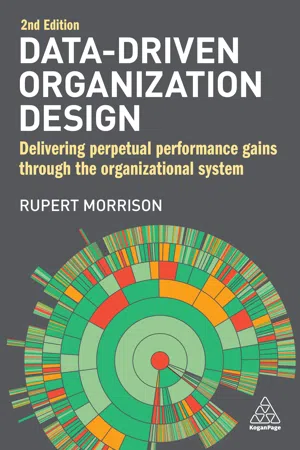
Understand how to drive business performance with your organizational data and analytics in the second edition of Data-Driven Organization Design.
Using data and analytics is a key opportunity for businesses to transform performance and achieve success. With a data-driven approach, all the elements of the organizational system can be connected to design an environment in which people can excel and attain competitive advantage. Data-Driven Organization Design provides a practical framework for HR and organization design practitioners to build a baseline of data, set objectives, carry out fixed and dynamic process design, map competencies, and right-size the organization. It shows how to collect the right data, present it meaningfully and ask the most relevant questions of it to help complex, fluid organizations constantly evolve and meet moving objectives.
This updated second edition contains new material on organizational planning and analysis, role design and job architecture, position management lifecycle and delta reporting. Alongside this, new case studies and examples will show how these approaches have been applied in practice. Whether planning a long-term transformation, a large redesign or an individual small project, Data-Driven Organization Design will demonstrate how to make the most of your organizational data and analytics to drive business performance.
eBook - ePub
Data-Driven Organization Design
Delivering Perpetual Performance Gains Through the Organizational System
- English
- ePUB (mobile friendly)
- Available on iOS & Android
eBook - ePub
Data-Driven Organization Design
Delivering Perpetual Performance Gains Through the Organizational System
About this book
Information
Part One
Introduction
1.1
Data-driven organization design
War is ninety per cent information.
NAPOLEON BONAPARTE
I have written this book because I believe the current methods of organization design are falling behind the needs of the modern-day organization. Too many leaders treat organization design as an exercise in moving boxes around PowerPoint slides. Too many analysts spend their time in unwieldy Excel contraptions that fail to give an understanding of organizational reality. Too many employees are unclear about what their role in their organization really is. Too much siloed behaviour occurs because it has historically proven too challenging to pull all the elements of the organization together. Too much time is wasted designing and changing organizations, with limited value. Organizations are struggling to understand where they are, let alone realize their plans and aspirations for the future. There is a better way.
Organizations must adapt to survive. They are a constantly evolving system made up of objectives, value chains to meet customer needs, processes to meet objectives, and people with skills and behaviours to do the work required. All of this is ordered into a governance structure that goes far beyond the reporting lines of an organization chart. It determines how people work together and agree on what needs to happen, from day-to-day, to year-on-year. Even though the organization structure is dynamic and constantly moving, you must find a way to understand it. The only way to do this is to visualize it, because if you can’t see it then how can you understand it?
The organization must enable people to perform, for only when everyone performs to their potential do you have a hope of the organization perpetually performing and achieving business objectives. If the organization fails to provide an environment in which people are sufficiently challenged, then motivation wanes, talent and intellectual capacity are wasted, and ultimately people leave. It’s vital that the organization system incorporates a clear competency framework to drive engagement and motivation.
People often struggle to perform and meet their objectives, even outside the context of large organizations. Every year on 1 January millions of people resolve to lose weight and try to get fit. We all know it’s not rocket science: eat a balanced, calorie-deficit diet and exercise regularly (although the science is fascinating and to make a transformative step change, it helps to understand it – more on this in Chapter 4.2). And yet 92 per cent of people who make these resolutions fail to achieve their goal, with over 50 per cent giving up after just six months.1 If we struggle as individuals, how can we expect to fare when implementing change in organizations where we can be dealing with hundreds to many thousands of people? It’s like getting fit: the theory isn’t complicated, but putting it into practice is hard.
Leaders of organizations must stop relying on old-fashioned Office tools and fixating on structural organization charts when defining how to organize themselves to meet their strategic ambitions. Not only are the techniques used to create and deliver organization designs outdated, they don’t go nearly deep enough to transform the organization system so that both minor improvements and step-change gains in performance can be realized. They are superficial and not geared towards execution. How many organization designs are effectively just redrawn organization charts? My observation, based on looking at hundreds of designs and organizations, is the vast majority. It’s all too easy for leaders to believe they are transforming their organizations by moving boxes around on a PowerPoint chart.
I have written this book for anyone who works with or needs to understand people data, workforce planning, organization design and budgeting. You may consult in this field or work in human resources (HR), organization design, strategy, consulting or financial planning and analysis (FP&A). Whether you are a chief people officer (CPO), an HR business partner, work as part of an organizational effectiveness team, or are one of the growing number of organizational planning analysts (I talk more about this relatively new, forward-looking role below), this book is your roadmap to navigating the challenges of designing an organization system that enables people and businesses to perform to their potential.
The path to fearless performance design
Organizations are, by their nature, difficult to design and manage as they are affected by internal and external forces. They are constantly in flux; growing and shrinking, changing focus and direction, and developing both intentionally and (more often) unintentionally. The rise of technology, globalization and the knowledge economy means organizations are having to adapt in order to deal with new business demands. As Jay Galbraith has said,2 organizations that used to be relatively simple and stable in terms of their structure are having to become increasingly multifaceted to survive in today’s complex world. Organizations have been evolving over time to deal with changes in markets, geography and technology. With the information age upon us, it is more important than ever for companies to be able to effectively design, control and manage their organizations. The consequence of the increasing rate of evolution is that organization design is moving away from being a one-off intervention to becoming an ongoing, continuous undertaking that is never ‘finished’.
It is no surprise that organizations are struggling to cope with this pace of change. In my personal experience of working on numerous design projects and research across a range of organizations, few (if any) leaders felt they had been on top of their organization system. Over and above this, organizations are struggling to understand themselves in a data-driven way:
- 95 per cent of organizations believe that poor data quality undermines business performance.3
- Very few companies are successfully implementing HR analytics and in two-thirds of organizations, time is wasted on consolidating, repairing and manipulating data instead of analysing it.4
- 50 per cent of organizations are unable to track and monitor business performance as they would like.5
- Only 30 per cent of the 37 companies surveyed by the Corporate Research Forum in 2015 said it was ‘true’ or ‘mainly true’ that their workforce strategy/plan had adequate breadth and depth to provide the necessary workforce information for making good decisions.6
As a consultant, founder and CEO I have encountered these challenges many times. By using a data-driven approach, my aim is to help leadership teams design a fearless future so they can feel confident in their ability to keep up with a constantly disrupting world.
Managing organizations without data is fraught with misinformation, blind spots and risk. If that doesn’t raise fear amongst leaders, then it should. Without data, leaders can lack clarity on where the organization is heading, the results that need to be achieved, and how well it is set up to deliver necessary outcomes today and in the future. They do not know if the right people are accountable for the right work, or if people possess the skills to perform today and fulfil tomorrow’s requirements.
By taking a data-driven, informed approach to decision-making, leaders can take control, make forward-looking decisions and have a high level of confidence that actions decided upon will deliver intended outcomes. Organizations can plan for the best and prepare for the worst, and thrive, not just in spite of but because of creative disruption. In short, putting data at the centre of organization design helps leaders to build the organization they want tomorrow, today. I call this fearless performance design.
The core beliefs of data-driven organization design
The objective of data-driven organization design (or D-DOD, as I shall refer to it throughout this book) is straightforward: it is to ensure organizations have the right people, with the right skills, doing the right work, in the right way in the right numbers with real alignment to achieve strategic objectives.This is workforce planning, and the benefits are clear. Research carried out in 2019 by the Centre for Economics and Business...
Table of contents
- About the author
- A note on the second edition
- Foreword
- Acknowledgements
- PART ONE Introduction
- 1.1 Data-driven organization design
- 1.2 Challenges
- 1.3 Core foundations and methods
- 1.4 The data goldmine
- PART TWO Macro operating design
- 2.1 Introduction
- 2.2 Articulating your strategy and setting your design principles and criteria
- 2.3 Structural options and business case
- PART THREE Micro detailed design
- 3.1 Introduction
- 3.2 Role design
- 3.3 Objectives management
- 3.4 Activity analysis and design
- 3.5 Competency management
- 3.6 Rightsizing
- 3.7 Structure and positions
- PART FOUR Making it real
- 4.1 Making it Real
- 4.2 Perpetual performance gains
- Glossary
- Index
Trusted by 375,005 students
Access to over 1.5 million titles for a fair monthly price.
Study more efficiently using our study tools.
Frequently asked questions
Yes, you can cancel anytime from the Subscription tab in your account settings on the Perlego website. Your subscription will stay active until the end of your current billing period. Learn how to cancel your subscription
No, books cannot be downloaded as external files, such as PDFs, for use outside of Perlego. However, you can download books within the Perlego app for offline reading on mobile or tablet. Learn how to download books offline
Perlego offers two plans: Essential and Complete
- Essential is ideal for learners and professionals who enjoy exploring a wide range of subjects. Access the Essential Library with 800,000+ trusted titles and best-sellers across business, personal growth, and the humanities. Includes unlimited reading time and Standard Read Aloud voice.
- Complete: Perfect for advanced learners and researchers needing full, unrestricted access. Unlock 1.5M+ books across hundreds of subjects, including academic and specialized titles. The Complete Plan also includes advanced features like Premium Read Aloud and Research Assistant.
We are an online textbook subscription service, where you can get access to an entire online library for less than the price of a single book per month. With over 1.5 million books across 990+ topics, we’ve got you covered! Learn about our mission
Look out for the read-aloud symbol on your next book to see if you can listen to it. The read-aloud tool reads text aloud for you, highlighting the text as it is being read. You can pause it, speed it up and slow it down. Learn more about Read Aloud
Yes! You can use the Perlego app on both iOS and Android devices to read anytime, anywhere — even offline. Perfect for commutes or when you’re on the go.
Please note we cannot support devices running on iOS 13 and Android 7 or earlier. Learn more about using the app
Please note we cannot support devices running on iOS 13 and Android 7 or earlier. Learn more about using the app
Yes, you can access Data-Driven Organization Design by Rupert Morrison in PDF and/or ePUB format, as well as other popular books in Negocios y empresa & Estrategia empresarial. We have over 1.5 million books available in our catalogue for you to explore.