- 294 pages
- English
- ePUB (mobile friendly)
- Available on iOS & Android
eBook - ePub
About this book
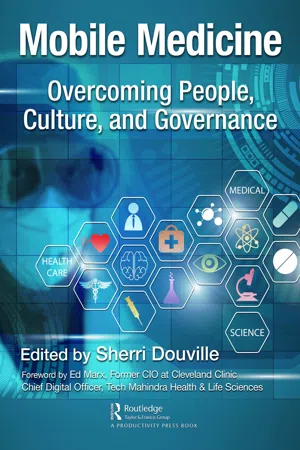
No topic in healthcare technology is more urgent and yet more elusive to date than mobile computing in medicine. It adheres to no boundaries, stagnates in silos, and demands not just the attention of dedicated professionals, but also teams of teams.
Information
1
WHERE WE’VE BEEN WITH MOBILE IN MEDICINE AND WHAT TO LOOK FORWARD TO
Chapter 1 Why Mobile Is Missing in Medicine—and Where to Start
Jeff Bargmann
Medigram
DOI: 10.4324/9781003220473-2
Contents
- The Evolution of Culture
- Perspective: Where I’m Coming from, as a Recognized Expert in Mobile
- Reframing the Evolution: Why Mobile Is Missing in Medicine
- What’s Next, What’s Now: Adapting Mobile and Medicine
- Resolving the Friction: “It’s Not You, It’s Me”
- Better Together: A Difference of Methods
- Culture and Collaboration: Making 1 + 1 = $30B
- Medical vs. Consumer Grade
- Attribute: Reliability
- Attribute: Physical Environments/Scenarios
- Attribute: Security, Compliance
- Attribute: Legal and Risk
- Management: Trust and Perception
- Management: Project Proposals and Milestones
- Management: Communication Skills
- Management: Deployment (Rollout)
- Venture Capital Side Note: Sales Cycle and Funding When Working with Startups
- Conclusion
- References
The Evolution of Culture
We’re here, at the time of this writing, in the year 2021. Mobile apps are everywhere. We pay for things using Apple Pay, we hear about the world on the go with Twitter, order dinner with DoorDash, and take a ride with Lyft/Uber. These beautifully manicured apps only get better and better. Meanwhile, in the medical industry, we wonder: Where is this revolution?
Leaders in healthcare systems, potentially yourself, have been frustrated with the lack of progress, lack of conviction from stakeholders, and lack of clarity on how to make change happen. Why isn’t that technology here, why can’t we seem to make it happen? Rather than be frustrated, we do need to ask ourselves the question: Why?
Our key is in understanding the phases that brought us here, so that we can understand where we are, why we’re here, and how to move forward.
Perspective: Where I’m Coming from, as a Recognized Expert in Mobile
To help set the context, some brief background on me and my motivations for writing this chapter. I’m Jeff, a serial entrepreneur, now venture investor and company operator. I have worked in healthcare and have built and sold a mobile-first company in the middle of this revolution. I spend my time acting as Product lead for companies such as Medigram to help get them to Product Market Fit and invest in healthcare startups for a living. I’m exposed to dozens of innovation pitches each week.
I know about ideation and innovating as it is my business. However, this isn’t an “I” activity, and that’s the point. As we’ll describe in this chapter, this is exclusively a “we” endeavor. This is about what we are all going to build together. My business only goes forward when healthcare advances—and we only make that happen by learning to combine our expertise, contributing the unique perspectives we each have to give, to create something great. This is why I wanted to write this chapter.
Reframing the Evolution: Why Mobile Is Missing in Medicine
So, look closely: This is not a fair game I’d presented above, comparing the success of the consumer environment to the medical setting. It might also not be a fair expectation you may have set for yourself or your organization.
Those examples above of “mobile success” are of consumer applications, which have been iterating friction-free in the consumer marketplace for over a decade. This wave, starting in 2008, consisted of early adopters and continues to be a market characterized by (1) low barriers to entry,(2) low cost of failure, and(3) low friction for experimentation and growth. In this consumer space, the market gave them the time and environment to grow, succeed, and indeed lay the bedrock for everything that would come. So it seems right they’ve come this far. This was the initial part of the process.
As new consumer user-interaction patterns began to establish, emerging from this primordial soup, we saw this newfound technological comfort facilitate the next age—B2B. Essentially: consumer applications, built for consumer-like use patterns, which happened to coincide with business functionality. Rocket ship, away we go! Office employee tools like Slack, Expensify, and DocuSign. Applications built using the same casual, consumer-centric mentality, tech expertise, and patterns that had refined over the prior decade. Critically: In these environments, like with consumer apps, workflows are often broadly applicable to the market, and generally, failures are tolerated provided that it works eventually. Move fast, break stuff: Now in the business setting. This is the culture evolution that got us here. And this is where we are today.
If this is all feeling quite different from the environment and the solutions market you’re used to seeing in healthcare, that feeling would be correct: There is a gap. This is our job now, and this is our time to adapt this technology to us.
What’s Next, What’s Now: Adapting Mobile and Medicine
What we need to understand are the differences between the characteristics that got us here and the characteristics of ourselves.
Let’s understand: hard-industry businesses like ours, like many other physical trades, have much more rigorous needs, expectations, and specifications than the stages that got us here. These businesses have deeply ingrained, tedious manual processes often involving numerous specialists/experts. Experts with ad hoc processes that currently work very well for them—and nearly all proprietary. These are highly tuned businesses on the frontier of competitiveness.
From overseas freight (Flexport), to trucking (Convoy), to farming (FarmLogs), each of these hard-industries face very specific mission critical needs—where recklessly introduced technology could quickly prove catastrophic. Change is coming for these industries now only as a function of competitive pressures, successively forcing firms to look, calculate, and leap.
These hard-industry firms have demanding expectations. There is friction between the two sides: our needs as a business, and the innovation methods that got us here. “Adaption” is the process of applying and managing that friction, to wear away our differences, and to make the two sides fit. Once that friction process is complete, then on we go.
Resolving the Friction: “It’s Not You, It’s Me”
The most difficult part to understand is that: really, it’s us. Another thing that these hard-industry firms have in common is a large gap in culture between the transforming-industry itself (us) and those most proficient at advancing these innovations (tech creatives mentioned above). It is the pioneers here who are the ones most unprepared. However, that’s not their fault. That’s just how they got there and it’s what works for them. We need to understand this, appreciate their work, and help bring them in to prepare our organizations for impact. It’s a question of familiarity. We’re a new culture. Let’s bring them in, if they’re adaptable to learning and have the humility required to partner in this environment.
As consumers themselves, tech workers are intuitively familiar with consumer tech. Business tech is something they live every day as they file reports (Expensify), sign documents (DocuSign), and chat (Slack). Tech workers are smart and adaptive; however, tech workers are not at all familiar with the insides of a hospital or health care system. Anyone might think they know how a heart works until they’re in there with a scalpel. They have no notion of the level of care, patience, security requirements, and sophistication required to deploy into that environment. An indication of our progress so far educating this workforce on our environment’s challenges: There are no health systems on Forbes’ list of top 100 digital employers (Forbes 2021). At any meaningful scale, avenues for natural growth from computer culture and expertise into medicine simply do not exist. Hospital staff meanwhile, from those on the front lines up to our top leadership, are unfamiliar—and frankly uncomfortable—with the disciplines that it took to make mobile what we have today. These best practices look a lot different than what it takes to succeed day to day in a hospital setting. Each side gaining empathy for what it looks like for the other side begins with recognizing, and respecting, that this cultural difference exists.
Better Together: A Difference of Methods
Besides the structural barriers mentioned, a keyword to focus on from the paragraph above: an innovator’s “discipline”. Innovation, to many, does not look like a process that resembles discipline. What it does look like from the outside, often, is chaotic, unstructured, and ungoverned. While in ways this is true, as any technologist will share with varying degrees of credibility, there is a method to their madness. Regarding your organization’s reception: When it comes to working across cultures, as we know, what you don’t know actually can hurt you.
Culture wise, you’ll be finding out the hard way that innovators need room to create. Your job as a leader is not “to tolerate”, “to accept”. It’s “to embrace”, “to help guide”. For the sake of the innovator, setting up, revising, and maintaining guideposts on your behalf can help steer toward a productive direction.
Otherwise, as cliche as it sounds, technology is art first engineering second when it comes to building something new. The personalities of people who may come into these roles may differ necessarily from the ones we’re used to in a hospital or administrative setting. On your end, as long as everyone expects this situation and is aware that it’s more of a positive (diversity of thought!) than a negative, then all is well.
Just as there is a discipline in achieving the lowest possible error rate in an ER, there is an artistic discipline on making innovation where there is currently nothing. It’s very reasonable to feel skepticism about this coming from the viewpoint of a rigorous health facilitator. It’s not only reasonable: it’s a correct and important viewpoint to express at the table. If there’s one takeaway you should have from this chapter, it is this: The key to success as a leader is in combining and coming to grasp that you are both right, in both your highlights and concerns. The challenge is to respect and solve for both sets of constraints simultaneously.
Culture and Collaboration: Making 1 + 1 = $30B
This paragraph may sound remedial; however, it must be noted: The word “collaboration” has lost all meaning these days with its over(mis)use. Throughout this book and this chapter, I hope you’ll see that by collaboration, we mean coming to an understanding that two groups do things differently, and that it’s expected. It’s a feature, not a bug, and with it, you can do something more. What’s next to understand is that each group is coming to the table with their own unique experiences and resulting perspectives. They each bring certain superpowers to the table, as well as weaknesses and blindspots. And each piece, whether positive or negative, offers a small fragment of the whole. No one can see the whole thing themselves. It’s your job to lead the process of solving this puzzle. This is an escape room that can only be solved together.
Medical vs. Consumer Grade
The root of why we don’t see more mobile use in health system environments comes down to the difference in nature between medical grade and consumer grade production. Let’s dive into what that means.
Attribute categories we’ll observe:
- Reliability
- Physical environments
- Security, compliance
- Legal, risk Project management considerations we’ll touch upon:
- Trust and perception
- Project proposals and milestones
- Communication skills
- Deployment (rollout)
Something to remember here is that when we look at a physical good we can feel in our hands, or a process we can see with our eyes, judging it as “medical grade” is a more straightforward analysis. To most of us, however, computer networks, user interfaces, and everything in between are a black box. We could barely tell a knock off from the top of the line besides the marketing material or perhaps kicking the tires. Where to even start?
Consumer/B2B-natured developments are the round peg to the square hole of medical environments. Often, neither side is acutely aware of the nature of the non-fit. Hence, the problem perpetuates itself to everyone’s bewilderment. The technology side thinks it’s adapting to the medical side, but does not fully appreciate what this means. The medical side likewise is not sure where to look. Hospital admins, frustrated, effectively trying to jam that round peg home. This section is meant to help us assess these non-fits, communicate this information to others in the organization, and make our projects a success.
Since there are a number we’ll go through, we’ll be brief in this chapter and allow us to dive in further elsewhere in the book. Nonetheless, reflect on this list. Do any of them seem familiar, in terms of what might be stifling innovation in your organization? If so, what can you do regarding your vendor, your staff, or your framing to improve expectations?
Attribute: Reliability
Think about a time an app crashed for you in a personal setting. Frustrating! Maybe you even switched apps, because there was an alternative. On the mobile web, for example, it’s been shown that users abandon websites that take over 3 seconds to load (Akamai Developer 2016), and at least one study has indicated 62% of users will uninstall your app if they experience crashes or freezes (DCI 2017). Keep in mind however that these observations are for getting users to start using your product (“adoption”) rather than keeping them once they are users (“retention”). Once a user has become a regular user in consumer or B2B, crashes are more tolerated, with technical issues thereafter dropping to just 5% of uninstalls (Karns 2019). At that point: as long as it’s roughly doing the job, most of the time, then it’s doing the job.
If you’re feeling your eye twitch, it’s because this notion, in a hospital setting, is terrifying. “As long as it’s…roughly doing its job?” In medicine, every second counts, every delay or error can cost a life. If a m...
Table of contents
- Cover
- Half Title
- Title Page
- Copyright Page
- Dedication Page
- Table of Contents
- Foreword
- Preface: Today Is Not Your Father’s Desktop World
- Acknowledgments
- Editor
- Contributors
- Introduction
- Section 1 Where We’ve Been with Mobile in Medicine and What to Look Forward To
- Section 2 Enabling Organizational Effectiveness
- Section 3 Driving Regulatory and Compliance Success
- Section 4 Managing Risks to Success
- Section 5 Aspirational to Operational: Rapidly Upgrade People Skills
- Section 6 Envision Your Organization’s Mobile Tech-Enabled Future
- Closing Thoughts
- Index
Trusted by 375,005 students
Access to over 1.5 million titles for a fair monthly price.
Study more efficiently using our study tools.
Frequently asked questions
Yes, you can cancel anytime from the Subscription tab in your account settings on the Perlego website. Your subscription will stay active until the end of your current billing period. Learn how to cancel your subscription
No, books cannot be downloaded as external files, such as PDFs, for use outside of Perlego. However, you can download books within the Perlego app for offline reading on mobile or tablet. Learn how to download books offline
Perlego offers two plans: Essential and Complete
- Essential is ideal for learners and professionals who enjoy exploring a wide range of subjects. Access the Essential Library with 800,000+ trusted titles and best-sellers across business, personal growth, and the humanities. Includes unlimited reading time and Standard Read Aloud voice.
- Complete: Perfect for advanced learners and researchers needing full, unrestricted access. Unlock 1.5M+ books across hundreds of subjects, including academic and specialized titles. The Complete Plan also includes advanced features like Premium Read Aloud and Research Assistant.
We are an online textbook subscription service, where you can get access to an entire online library for less than the price of a single book per month. With over 1.5 million books across 990+ topics, we’ve got you covered! Learn about our mission
Look out for the read-aloud symbol on your next book to see if you can listen to it. The read-aloud tool reads text aloud for you, highlighting the text as it is being read. You can pause it, speed it up and slow it down. Learn more about Read Aloud
Yes! You can use the Perlego app on both iOS and Android devices to read anytime, anywhere — even offline. Perfect for commutes or when you’re on the go.
Please note we cannot support devices running on iOS 13 and Android 7 or earlier. Learn more about using the app
Please note we cannot support devices running on iOS 13 and Android 7 or earlier. Learn more about using the app
Yes, you can access Mobile Medicine by Sherri Douville in PDF and/or ePUB format, as well as other popular books in Medicine & Information Management. We have over 1.5 million books available in our catalogue for you to explore.