Understanding Game Scoring explores the unique collaboration between gameplay and composition that defines musical scoring for video games.
Using an array of case studies reaching back into the canon of classic video games, this book illuminates the musical flexibility, user interactivity and sound programming that make game scoring so different from traditional modes of composition. Mack Enns explores the collaboration between game scorers and players to produce the final score for a game, through case studies of the Nintendo Entertainment System sound hardware configuration, and game scores, including the canonic scores for Super Mario Bros. (1985) and The Legend of Zelda (1986).
This book is recommended reading for students and researchers interested in the composition and production of video game scores, as well as those interested in ludo-musicology.
Have you ever turned a video game into a musical instrument? That is, have you ever decided to — temporarily — change your competitive goals to musical ones, while playing a game? My guess is that I am not alone in indulging in this activity, because gaming is a mimetic art form that involves different modes of cognitive and sensory interaction. One of these modes of interaction is musical, but the musical experience of gaming is different from traditional music listening, and the way video game music composers or “game scorers” write music for games is different from traditional musical scoring activities.
In this book, I study the act of composing music for — and through — gaming, or what I refer to as “game scoring.” As with film scoring, game scoring supports and elucidates the visual aspects of a broader narrative medium — in this case, video games. However, any further resemblances between game scoring and film scoring are illusory, in my opinion.1 A host of unique technical and aesthetic priorities and concerns faces game scorers today. Most obviously, game scores must remain flexible and interactive in response to gameplay. They are only finally “realized” — that is, game scores only ever exist as something other than imperceptible digital bits — through gameplay. Game scorers also compose for particular sound hardware configurations, and so their compositional activity is structured in its entirety by the limited set of aesthetic possibilities each console’s particular audio processing Unit (APU) affords. If it cannot be programmed into a console’s APU, it simply cannot exist as part of a game score. As such, game scoring most closely resembles software programming.2
Actually, game scoring is software programming. This does not mean, though, that it is therefore somehow aesthetically impoverished, being so limited by the dictates of a single variety of modern consumer electronics. In fact, since game scoring is structured in its entirety by gaming technology, it constitutes a unique compositional mode that should be understood as a variety of so-called “aleatoric composition.”3 Aleatoric composition includes all compositional activity in which one or more musical elements are left to chance, as well as compositions in which some degree of improvisational freedom is afforded to performers. Musikalisches Würfelspiel (“musical dice game”), for instance, qualifies as aleatoric because it uses dice to randomly “generate” music from pre-composed options.4 In this case, the chance operation involved in the music’s composition is a roll of the dice, and the element of composition that chance determines is the order in which the pre-composed sections of the piece are performed.5 Similarly, any composition with improvisatory sequences is at least partially aleatoric. For example, Ornette Coleman’s Free Jazz (1961) was the first album-length improvisation, making it at least partially aleatoric.
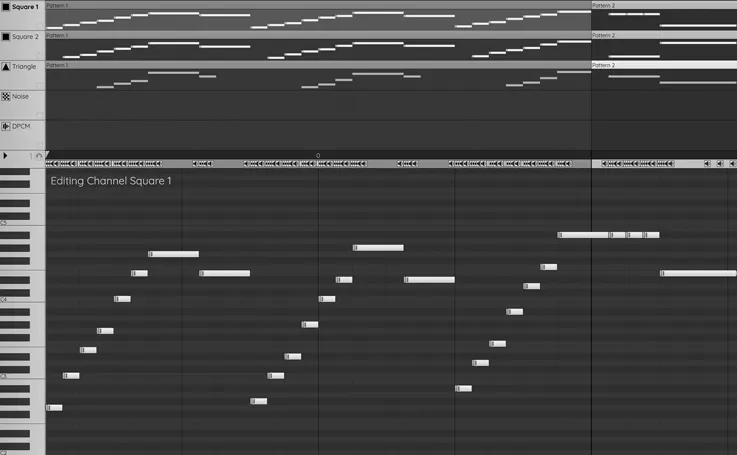
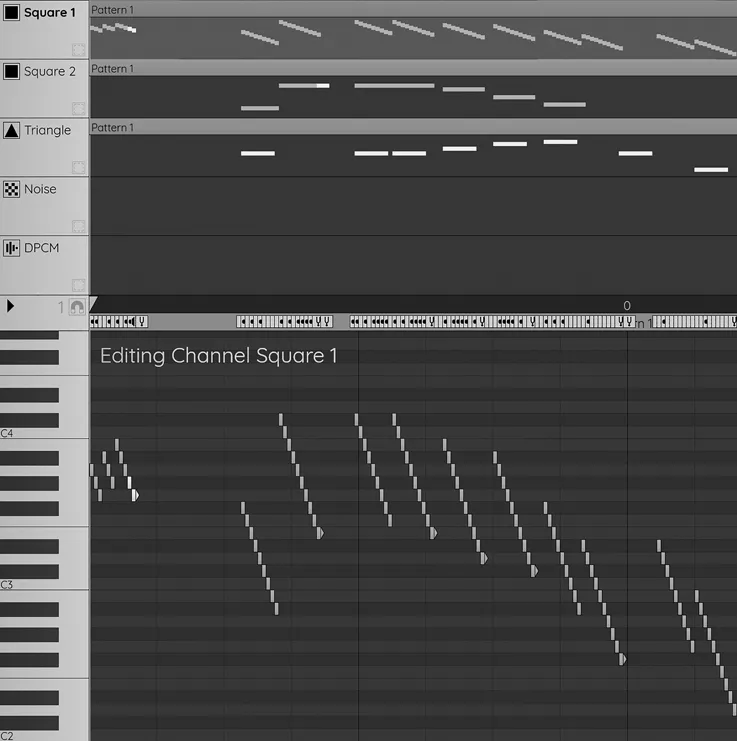
Game scoring includes both of these “types” of aleatoric composition. That is, a game score involves both chance operations and a degree of improvisation. In fact, game scoring is a peculiar type of composition because the “performer” of a game score is not a musical performer but a “ludal” one — a “gamer” apparently involved in a non-musical activity. Sound, visuals and controls, or “haptics,” inform the gamer’s gameplay choices, and so game scores are open to improvisatory and chance operations that only the combination of these elements enable. In other words, game scorers arguably collaborate with players to produce the final score for a game. In Super Mario Bros. (1985), for instance, the thematic content of each composition’s conclusion is determined by whether or not players successfully complete a level. If players “beat” a level, the score triggers the “Flagpole Fanfare” theme, a triumphant ascending melody (see Figure 1.1). Players who fail to conquer that same level, on the other hand, hear the “Death Sound,” a comedic descending riff instead (see Figure 1.2).6 Thus, whether or not the “Flagpole Fanfare” theme ever sounds, and how often, is up to the gamer.
FIGURE1.1 The “Flagpole Fanfare” theme, heard when a player successfully completes a level in Super Mario Bros. The ascending melody has a triumphant or victorious thematic content.
FIGURE1.2 The “Death Sound” that plays when a player loses a life and fails to “beat” a level. The descending riff evokes disappointment, but is notably shorter than the “Flagpole Fanfare” theme and adds a comedic element through syncopated percussion. The “Death Sound” in SMB is archetypal for its effectiveness in encouraging the player to attempt the level again, even after “dying” multiple times.
To be clear, my definition of “game scoring” encompasses the organization of sound, its encoding as software via programming and, most importantly, its actualization through gameplay. I make this distinction to emphasize the difference between what I call “game scores,” which are actively created through gameplay, and video game soundtracks. I will explore this difference in greater detail in Chapter 5 of this book.
As a means of concretizing the theoretical terrain I intend to cover in this book, I offer the following case study, specifically, of Richard Vreeland’s game score for the 2012 Xbox Live Arcade “puzzle-platform” game FEZ. This theoretical terrain is drawn largely from work by Whalen (2004) and Collins (2013), both of whom pose salient questions about the interactive nature of game scoring. Whalen’s (2004: 2) “Play Along – An Approach to Videogame Music” relates the concept of player immersion to game scoring:
The interactive element of videogames [sic] requires its own analysis […] Cognitive theories of perception and questions of immersion versus engagement as a means of understanding ‘flow’ or pleasurability in games allows for a richer understanding of the complex communication involved in videogame [sic] music.7
Collins (2013) suggests that new media, such as video games, provide instances of interactive sound that are unique for their diffused sources of composition. In interactive sound design, she argues, not only does the composer have a hand in the compositional process, but also the designer, programmer and even the gamer. Collins’ (2013) argument is useful as a basis for a study of game scoring, and so will provide a model for my “ludo-musicological” analysis of game scoring. Ludo-musicology is a relatively new field of research which focuses exclusively on video game music, as opposed to music composed for the non-performative visual arts or non-interactive film, for instance. As Collins (2013) notes, and as I will now demonstrate, it is the “performative” and “interactive” aspects of video games that create the unique challenges and concerns that game scorers must address through their work.
Disasterpeace and FEZ: a case study of game scoring
In what follows, I examine some aspects of the compositional process Richard Vreeland — also known as Disasterpeace — undertook to compose his celebrated score for FEZ, a puzzle-platformer video game released for Xbox Live Arcade in 2012. All of what follows, including screenshots of and technical information about the music system for FEZ, is drawn from a conference presentation entitled “Philosophy of Music Design in Games,” given by Vreeland himself at the 2012 Game Audio Network Guild Summit.8 This case study is by no means an exhaustive examination. Here I simply examine some aspects of game scoring, and demonstrate that they resemble software programming more than anything traditionally described by the moniker of “music composition.”
FEZ was developed by the independent software company Polytron Corporation, which includes the game’s creator and designer Phil Fish, and its programmer Renaud Bédard. They were responsible for most of the development of the game: Fish determined the creative vision for the project by designing its gameplay mechanics and visual style, while Bédard made that vision a reality through programming. It was only until after the game’s gameplay and visuals were designed and programmed that Vreeland was invited to compose and produce the game’s celebrated score. Therefore, his task was to compose music that elucidates a pre-conceived visual world with its own spatial limitations, mechanics, aesthetics and logic, and to provide a score to represent, complement and sonically realize that world.
The world of FEZ is highly dynamic. Its “levels” consist of non-Euclidean9 spaces known as “Rooms.” At the outset of the game, Gomez, the game’s “protagonist,” is a two-dimensional creature who lives in a two-dimensional world. Much like the Mario Bros., the protagonists in the classic 8- and 16-bit Super Mario Bros. “platformer” series, Gomez has impressive jumping abilities that serve as the main element of gameplay in a world composed of various types of platforms. Eventually, after a short “tutorial” introduction, Gomez encounters a mysterious being known as the Hexahedron, who grants him a “magical fez hat” that allows him to perceive a third dimension, and that allows players to rotate the gameplay perspective at will, ninety degrees at a time. As players direct Gomez to experiment with his new abilities, the Hexahedron unexpectedly fractures and explodes, causing the game to glitch, freeze and reboot, complete with a Basic Input/Output System, or (BIOS) screen. Gomez awakens in his room with his ability to perceive and manipulate a third dimension intact, and is charged with the task of recovering the scattered fragments of the Hexahedron before the world is torn apart.
Even after Gomez acquires the ability to perceive the third dimension, gameplay in FEZ remains largely two-dimensional. Depth, or the Z-axis, is only visible to the player in the rotation of perspectives, and is not a factor in the actual obstacles and chasms that Gomez must traverse. The player must manipulate these perspectives to explore the world of FEZ and collect 32 cubes in the form of “cube bits,” “whole cubes” or “anti-cubes.” In so doing, Gomez performs actions that would normal...
Table of contents
Cover
Half Title
Series Page
Title Page
Copyright Page
Table of Contents
List of figures
List of tables
Preface
1 An introduction to game scoring
2 Game scoring’s interactive multimedia context
3 Game scoring and gaming technology
4 Game design and game scoring as software programming
5 Game scoring: gameplay as performance of aleatoric composition
6 Game scoring: conclusion
Index
Trusted by 375,005 students
Access to over 1.5 million titles for a fair monthly price.
Study more efficiently using our study tools.
Frequently asked questions
Yes, you can cancel anytime from the Subscription tab in your account settings on the Perlego website. Your subscription will stay active until the end of your current billing period. Learn how to cancel your subscription
No, books cannot be downloaded as external files, such as PDFs, for use outside of Perlego. However, you can download books within the Perlego app for offline reading on mobile or tablet. Learn how to download books offline
Perlego offers two plans: Essential and Complete
Essential is ideal for learners and professionals who enjoy exploring a wide range of subjects. Access the Essential Library with 800,000+ trusted titles and best-sellers across business, personal growth, and the humanities. Includes unlimited reading time and Standard Read Aloud voice.
Complete: Perfect for advanced learners and researchers needing full, unrestricted access. Unlock 1.5M+ books across hundreds of subjects, including academic and specialized titles. The Complete Plan also includes advanced features like Premium Read Aloud and Research Assistant.
Both plans are available with monthly, semester, or annual billing cycles.
We are an online textbook subscription service, where you can get access to an entire online library for less than the price of a single book per month. With over 1.5 million books across 990+ topics, we’ve got you covered! Learn about our mission
Look out for the read-aloud symbol on your next book to see if you can listen to it. The read-aloud tool reads text aloud for you, highlighting the text as it is being read. You can pause it, speed it up and slow it down. Learn more about Read Aloud
Yes! You can use the Perlego app on both iOS and Android devices to read anytime, anywhere — even offline. Perfect for commutes or when you’re on the go. Please note we cannot support devices running on iOS 13 and Android 7 or earlier. Learn more about using the app
Yes, you can access Understanding Game Scoring by Mack Enns in PDF and/or ePUB format, as well as other popular books in Media & Performing Arts & Programming Games. We have over 1.5 million books available in our catalogue for you to explore.