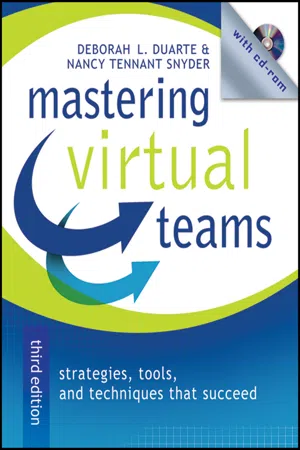
This third edition of the best-selling resource Mastering Virtual Teams offers a toolkit for leaders and members of virtual teams. The revised and expanded edition includes a CD-ROM with useful resources that allow virtual teams to access and use the book's checklists, assessments, and other practical tools quickly and easily. Deborah L. Durate and Nancy Tennant Snyder include updated guidelines, strategies, and best practices for working effectively with virtual teams across time and distance to see a project through. The useful tools, exercises, and real-life examples show how anyone can master the unique dynamics of virtual team participation in an environment where the old rules no longer apply.
eBook - ePub
Mastering Virtual Teams
Strategies, Tools, and Techniques That Succeed
- English
- ePUB (mobile friendly)
- Available on iOS & Android
eBook - ePub
Mastering Virtual Teams
Strategies, Tools, and Techniques That Succeed
About this book
Information

PART ONE
UNDERSTANDING VIRTUAL TEAMS

CHAPTER ONE
CRITICAL SUCCESS FACTORS FOR VIRTUAL TEAMS
In today’s business environment, organizations must adapt quickly or die. Gaining competitive advantage in a global environment means continually reshaping the organization to maximize strengths, address threats, and increase speed.1 The use of virtual teams has become a common way of doing this.2 The formation of virtual teams allows organizations to draw talent quickly from different functions, locations, and organizations. The goal is to leverage intellectual capital and apply it as quickly as possible. The methods that organizations use to manage this process can mean the difference between success and failure.
Consider the example of a team in a global consumer products firm. This product development team, with members from around the world, had just completed the development of a new product. When the team unveiled the product to the senior staff of the organization, it included a description of the way the team worked. The presentation showed an icon of an airplane, with the entire team of twenty-two people traveling from country to country. The team members had continually moved from site to site for activities such as status reviews, design meetings, and prototyping sessions. The cost of the travel was tremendous, not only for hotels and airline tickets but also in terms of the human costs of being away from home and lost work time and productivity. In addition, talent from other parts of the organization was not leveraged in this effort—if you were not “on the plane,” your ideas were not heard.
Contrast this with most other organizations that form world-class teams, with membership from many different locations and functions, to quickly address customer problems, develop products, and deliver services. These teams often operate virtually, without the physical limitations of distance, time, and organizational boundaries. They use electronic collaboration technology and other techniques to leverage the best talent where they might reside, lower travel and facility costs, reduce project schedules, and improve decision-making time and communication.
Organizations that do not use virtual teams effectively may be fighting an uphill battle in a global, competitive, and rapidly changing environment. Organizations that will succeed in today’s business environment have found new ways of working across boundaries through systems, processes, technology, and people. They will make technology a valued partner in developing and delivering competitive solutions.
Understanding how to work in or lead a virtual team is now a fundamental requirement for people in many organizations. Many who began their career leading teams in a face-to-face environment find themselves leading teams virtually, sometimes not seeing team members face to face more than once or twice a year. This presents the challenge of translating what worked in an in-person environment to a virtual one.
It is also now increasingly common to encounter people who lead or work on virtual teams who do not have a great deal of experience working on teams face to face. Most of today’s large consulting firms do a large majority of their work virtually. Consultants who join these firms may never have the opportunity to work on or lead a traditional team in a face-to-face environment. They are immediately placed in situations that are more virtual than traditional. In this case, these individuals may not even have baseline experience to draw from—and on the other hand, they also may not have bad habits to unlearn.
The fact is that leading a virtual team is not like leading a traditional team. People who lead and work on virtual teams need to have special skills, including an understanding of human dynamics and performance without the benefit of normal social cues, knowledge of how to manage across functional areas and national cultures, skill in managing their careers and others without the benefit of face-to-face interaction, and the ability to use leverage and electronic communication technology as their primary means of communicating and collaborating.
Types of Virtual Teams
There are many different configurations of virtual teams. One of the central themes of this book is that the task affects how a virtual team is managed. Although virtual teams can undertake almost any kind of assignment, team leaders and members need to have a solid understanding of the type of virtual team they work on and the special challenges each type presents. What these teams have in common with all teams is that team members must communicate and collaborate to get work done or to produce a product. Virtual teams, unlike traditional ones, however, must accomplish this by working across distance, time, and organizational boundaries and by using technology to facilitate as their primary means of communication and collaboration. There are seven basic types of virtual teams.3
• Networked teams
• Parallel teams
• Project or product development teams
• Work, functional, or production teams
• Service teams
• Management teams
• Action teams
Networked Teams
A networked virtual team consists of individuals who collaborate to achieve a common goal or purpose. Such teams frequently cross time, distance, and organizational boundaries. Typically, there is a lack of clear definition between a network team and the organization, in that membership is frequently diffuse and fluid, with team members rotating on and off the team as their expertise is needed. Team members may not even be aware of all the individuals, work teams, or organizations in the network.
Examples of this type of virtual team are often found in consulting firms and in high-technology organizations. For example, one virtual team received a request from a client to quickly research and identify a set of best practices for managing the implementation of a large supply chain project. Although the consultants did not have all the answers themselves, they were able to tap into their network of external partners and internal and external databases and provide a set of best practices for the client within a few days.
Organizations that develop technological products can also use networked virtual teams. Many research and development organizations use networked teams for many activities because the specialized expertise to solve new problems or engage in complex discovery processes usually never resides in a single organization or location. Team members for these types of teams are often drawn from many different nations, think tanks, universities, corporations, and nonprofit organizations. Team members from different organizations come in and out of the network as their expertise is needed to make recommendations.
Parallel Teams
Parallel virtual teams carry out special assignments, tasks, or functions that the regular organization does not want to or is not equipped to perform. Parallel teams are also used when expertise does not reside in one location or in one organization. Such teams frequently cross time, distance, and organizational boundaries. A parallel team is different from a networked team in that it has a distinct membership that sets it apart from the rest of the organization. It is clear who is on the team and who is not. The members of a parallel team typically work together on a short-term basis to make recommendations for improvements in organizational processes or to address specific business issues. Virtual parallel teams are becoming a fairly common way for multinational and global organizations to make recommendations about worldwide processes and systems that take a global perspective.
One consumer goods company used a virtual parallel team to make specific recommendations for a global customer loyalty system. Team members came from around the world and were supplemented by participants from an external consulting organization. After its recommendations were made to the CEO, the team dissolved. Much of the work of this team involved data collection and analysis by individual team members. The collaborative work was often accomplished in audioconferences at 7:00 A.M. Eastern Standard Time (to accommodate people from all time zones) by using e-mail to communicate and pass on “static” information, a team Web site for documenting progress, and instant messaging for real-time communication. Like many people who work on parallel teams, the team members had other projects and accountabilities.
Project or Product Development Teams
Virtual project teams and product development teams can also cross time, distance, and organizational boundaries. Team members conduct projects for users or customers for a defined but extended period of time. A typical result is a new product, information system, or organizational process. The difference between a project team and a parallel team is that a project team usually exists for a longer period of time and has a charter to make decisions, not just recommendations. A project team is similar to a networked team in that team members may move on and off the project as their expertise is needed. It is different from a networked team in that membership is more clearly delineated from the rest of the organization, and a final product is clearly defined.
Most product-focused technology and scientific organizations are well versed in the use of project or product development teams. The use of virtual teams expands the opportunities to leverage expertise from wherever it resides to develop products and services that have competitive advantage.
Work, Functional, or Production Teams
Virtual work, functional, and production teams perform regular and ongoing work. Such teams usually exist in one function, such as accounting, finance, training, or research and development. They have clearly defined membership and can be distinguished from other parts of the organization. Many work or production teams are now beginning to operate virtually and to cross time and distance boundaries. Many organizations now have business centers that operate globally around the clock, and work teams that service customers may exist in most time zones around the world.
It is has become commonplace for people on virtual work teams to telecommute from home. They have access to workflow processes over the firm’s intranet, which allows them to work as a group on development activities. Team members usually meet face to face once or twice each year for a conference.
Service Teams
Service and technical help teams are now usually distributed across distance and time. Network and technical support are usually continuous operations, with technicians and call center personnel located around the world taking turns dealing with network problems and upgrades. The staff “follow the sun” and are situated so that one team is operational at all times. Each team works during its members’ daylight hours and transitions work and problems to the next designated time zone at the end of the day.
Management Teams
Management teams can be separated by distance and time. Today, many management teams are dispersed across a country or around the world but work collaboratively on a daily basis. Many companies have executive team members who hold a number of different passports and live in many parts of the world and collaborate on a regular basis by means of audioconferences or videoconferences focused on the achievement of corporate goals and objectives. The United States Army’s chief of staff operates his staff as a virtual team. Staff members communicate regularly via e-mail and use a chat room on an Internet Web-based network to discuss important issues as they arise.
Action Teams
Action teams can also work virtually. Such teams offer immediate responses, often to emergency situations. They cross distance and organizational boundaries. A weather team at a television station is a good example of a virtual action team. During a weather emergency, action team members are distributed in the field. The meteorologist at the television station uses radar and satellite information to tell where tornadoes may be forming and directs field crew movement toward those locations. The meteorologist analyzes the data that the crews send back and communicates the results and possible implications immediately to viewers.
The way in which NASA works during a mission is an excellent example of a virtual action team. During a flight, mission operations, usually located in Houston, collaborates with the astronauts, with tracking statio...
Table of contents
- Title Page
- Copyright Page
- THE JOSSEY-BASS BUSINESS & MANAGEMENT SERIES
- Dedication
- CHECKLISTS
- CHECKLISTS AND TABLES ON THE CD-ROM
- PREFACE
- THE AUTHORS
- PART ONE - UNDERSTANDING VIRTUAL TEAMS
- PART TWO - CREATING VIRTUAL TEAMS
- PART THREE - MASTERING VIRTUAL TEAMS
- NOTES
- FURTHER READING
- INDEX
- HOW TO USE THE ACCOMPANYING CD-ROM
- WILEY END USER LICENSE AGREEMENT
Trusted by 375,005 students
Access to over 1.5 million titles for a fair monthly price.
Study more efficiently using our study tools.
Frequently asked questions
Yes, you can cancel anytime from the Subscription tab in your account settings on the Perlego website. Your subscription will stay active until the end of your current billing period. Learn how to cancel your subscription
No, books cannot be downloaded as external files, such as PDFs, for use outside of Perlego. However, you can download books within the Perlego app for offline reading on mobile or tablet. Learn how to download books offline
Perlego offers two plans: Essential and Complete
- Essential is ideal for learners and professionals who enjoy exploring a wide range of subjects. Access the Essential Library with 800,000+ trusted titles and best-sellers across business, personal growth, and the humanities. Includes unlimited reading time and Standard Read Aloud voice.
- Complete: Perfect for advanced learners and researchers needing full, unrestricted access. Unlock 1.5M+ books across hundreds of subjects, including academic and specialized titles. The Complete Plan also includes advanced features like Premium Read Aloud and Research Assistant.
We are an online textbook subscription service, where you can get access to an entire online library for less than the price of a single book per month. With over 1.5 million books across 990+ topics, we’ve got you covered! Learn about our mission
Look out for the read-aloud symbol on your next book to see if you can listen to it. The read-aloud tool reads text aloud for you, highlighting the text as it is being read. You can pause it, speed it up and slow it down. Learn more about Read Aloud
Yes! You can use the Perlego app on both iOS and Android devices to read anytime, anywhere — even offline. Perfect for commutes or when you’re on the go.
Please note we cannot support devices running on iOS 13 and Android 7 or earlier. Learn more about using the app
Please note we cannot support devices running on iOS 13 and Android 7 or earlier. Learn more about using the app
Yes, you can access Mastering Virtual Teams by Deborah L. Duarte,Nancy Tennant Snyder in PDF and/or ePUB format, as well as other popular books in Business & Management. We have over 1.5 million books available in our catalogue for you to explore.