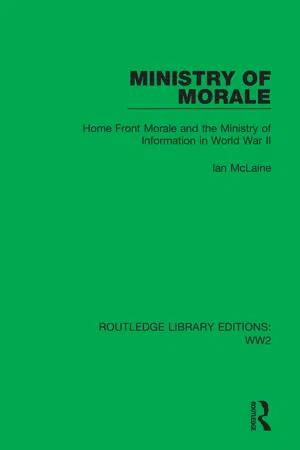
This book, first published in 1979, is an analysis of the wartime Ministry of Information, responsible for the maintenance of public morale. How was it that British morale remained high, yet the department responsible was so bad? This book examines the domestic work of the Ministry and offers an unprecedented insight into the mind of both government and people during the war. It answers key questions: How did a government department assess and set about maintaining morale? How did it handle the social and political questions associated with morale – post-war social reform, press freedom and censorship, the nature of the Soviet regime? How sound in fact was civilian morale, on the basis of the secret Wartime Intelligence reports then available? One of the most fascinating aspects of this book is the Ministry's constant internal debate on how its responsibilities should best be carried out. It is a key work of research on the political, psychological and mass communications problems facing a society at war.
eBook - ePub
Ministry of Morale
Home Front Morale and the Ministry of Information in World War II
- 336 pages
- English
- ePUB (mobile friendly)
- Available on iOS & Android
eBook - ePub
IPreparing for the Apocalypse
In October 1935 a subcommittee of the Committee of Imperial Defence (CID) was formed for the purpose of preparing broad guidelines for the establishment of a Ministry of Information on the outbreak of war.1 Nine months later the subcommittee had completed its report.2 The function of the Ministry would be to:
. . . present the national case to the public at home and abroad in time of war. To achieve this end it is not only necessary to provide for the preparation and issue of National Propaganda, but also for the issue of ‘news’ and for such control of information issued to the public as may be demanded by the needs of security.3
These functions were to be carried out by five principal divisions: News, Control (censorship), Publicity, Collecting (intelligence) and Administration. The Home Office was made responsible for overseeing the planning of the Ministry and for any pre-war legislative and executive measures that might be necessary.
No one is recorded in the documents as having said so, but the example of Goebbels’s Ministry of Propaganda clearly played a part in this early decision to create a Ministry of Information. Certainly no comparable body existed in the First World War. There were, rather, a diversity of agencies which – constantly merging and splitting – discharged the various functions relating to morale, news, censorship and propaganda. A Ministry of Information was created in 1918, under Lord Beaverbrook, in order to impose some order on the confusion but it was unable to widen its purview beyond the dissemination of propaganda to neutral countries, despite the strenuous efforts of Beaverbrook.4 In the records of the shadow Ministry between 1936 and 1939 there are to be found only the most oblique references to the German propaganda organisation, and no mention whatsoever of Goebbels by name, the reasons for which may be sought in a gentlemanly reluctance to appear to be emulating the Nazis. However, an uncomfortable awareness of the evident superiority of Nazi methods was betrayed by the Ministry’s chief planner when he stated that ‘war, if it came, would be against at least one totalitarian state, i.e. against a state which, by the possession of a fully equipped Ministry of Propaganda, developed in peace but organised in readiness for war, would enter a war against us with a long start in preparedness’.5 Such was the presumed success of Goebbels’s machine that it is scarcely conceivable that the British did not intend fighting fire with fire.
The obligation laid upon the Ministry to sustain civilian morale was not, for all its awesome implications, clearly set down. The CID failed to mention the word ‘morale’. It hovered ghostlike between the lines of the recommendations for the functions of the Publicity Division:
Broadly speaking, the functions of the Publicity Division will be to secure that the national cause is properly presented to the public . . . Various aspects of the national activities will have to be analysed and explained; enemy activities must be examined and criticised; and means must be devised to disseminate the national point of view in a guise which will be attractive and through channels which will ensure that it reaches persons who are likely to be influenced by it.
Since initially neither the CID nor the planners contemplated the creation of a division devoted solely to maintaining morale it seems clear that ‘propaganda’ was intended to perform the job.
The report was accepted in full and Sir Stephen Tallents, then in charge of public relations at the BBC, was appointed as Director-General Designate and made responsible for the detailed planning of the department.6 It was a wise choice. Tallents had been a pioneer in the field of government public relations, at first with the Empire Marketing Board and latterly with the Post Office and the BBC, and had created the Post Office’s film unit which, among other outstanding productions, made the deservedly famous Night Mail.
Tallents was going to need every ounce of his experience and ability. Very little information about the various propaganda, censorship and news agencies of the First World War could be found. The planners were grossly overworked and neglected by government and, worst of all, subject to highly disruptive Whitehall intrigue which led not only to Tallents’s dismissal early in 1939 but also to frequent changes in personnel. In the period that elapsed between the decision to set up the Ministry and the outbreak of war, a time of mounting nervousness on the part of government officials at the possible impact of total war on the population, such problems severely hampered preparations for the maintenance of civilian morale.
If the planners were to profit from the precedents of the First World War they needed to know in some detail what had actually happened at that time. This knowledge was not easily gained. And, as planning moved into the late 1930s, the series of international crises that characterised the period lent an edge of desperation to the search. In April 1938 one planner informed a colleague:
The Record Office tells me that (1) they know nothing of North-cliffe’s propaganda records; (2) the records of the Ministry of Information . . . were transferred to the News Department of the Foreign Office and have not yet reached the Record Office; (3) the Treasury have transferred to the Record Office the records of the National War Aims Committee ... I do not know what this committee did.7
Ignorance of this latter body was significant since it was chiefly responsible during the First World War for the maintenance of morale. The elusiveness of the documents persisted and another official, plaintively insisting that ‘there must be experts somewhere’,8 was reduced to consulting an article on propaganda in volume 32 of the 12th edition of the Encyclopaedia Britannica.9 ‘To produce anything coherent’, he told Tallents in September 1938, ‘has in many cases been rather like completing a Chinese puzzle, with the key pieces missing.’ And he added darkly that it was ‘more than odd’ that the Foreign Office could not produce documents relating to the old Ministry of Information.
For reasons best known to the government the planners were not released on a full-time basis for the creation of this new department of state and they were simultaneously carrying out work in their own departments. R. W. Leeper pulled out early in 1938, complaining that it was impossible for anyone like himself so busy at the Foreign Office ‘to give any real attention to these matters’,10 while another stuck it out but could not help exclaiming, ‘It can only be kept moving in present circumstances by a few of us putting in ghastly hours, risking their health, sacrificing leisure, and possibly prejudicing their position in their own Departments.’11 It is not surprising, therefore, that Sir Stephen Tallents should, in the course of emphasising to the CID the poor rate of progress, comment:
Our preparations for the conduct of wartime operations of great possible variety and extent in the field of public opinion have no comparable peacetime base, and their planning is dependent on a handful of men, all with one exception very fully employed on other work. Those who have been entrusted with the working of these plans have been impressed at every stage by these handicaps.12
Six months later he informed Lord Macmillan, who was to have the misfortune to be the first Minister of Information:
Not many people feel the urgency and importance of this fourth armament and recognise the severe and practical preparation which its effective use involve. That fact, and the secrecy in which this work has had to be done, have combined to make it an uncomfortably isolated job.13
With the exceptions of Tallents and J. H. Brebner, in charge of publicity at the GPO, none of the chief planners possessed specialist qualifications or experience in the field in which he was working. Of the four top men, J. B. Beresford was recruited from the University Grants Commission; another, G. C. North, was an Assistant Secretary at the Ministry of Health; a third, H. E. Dannreuther, was a retired admiral; while the fourth, W. P. Hildred, was Deputy General Manager of the Export Credit Branch of the Customs Department. Able administrators they may have been but expertise in the construction and running of elegant bureaucratic machinery, like patriotism, was not enough.
During a debate on the Ministry in July 1939 Sir Samuel Hoare said he was confident that ‘the Press side of the organisation would be able to operate quickly and efficiently’.14 That this did not prove to be the case is, for the moment, beside the point. Hoare’s statement reflected the governmental bias in planning towards press and censorship matters and the almost exclusive concentration upon these aspects of the Ministry’s functions exhausted the initiative of the few lonely planners. The speed of external events may have overtaken them, but the CID’s insistence on the setting up of the Administration, News and Censorship divisions before thought could be given to the Publicity and Collecting divisions worried Tallents from an early date: ‘Unless they [the propaganda and intelligence divisions] are so established, the Government of the day will be liable to charges of neglecting an obvious function and there will be a danger of alternative and improvised measures being forced upon them.’15
At the time of the Munich crisis in 1938 the first stage of the Ministry’s establishment was put into operation and the personnel earmarked for the Censorship, Administration and News divisions were told to stand by. Midnight on 29-30 September was chosen as the ‘zero hour’ and, according to Tallents, ‘the Divisions concerned would have been ready to function then, if they had been required to do so’.16 Lord Stanhope, President of the Board of Education and Minister of Information designate, congratulated Tallents on the smoothness of the operation and believed ‘we could have given a good account of ourselves’.17 In view of the fact that only three of the proposed divisions were mobilised, Tallents was unable to share Lord Stanhope’s confidence and the expression of his misgivings, as well as criticism of the Cabinet’s lackadaisical attitude towards the Ministry of Information, contributed to his dismissal on 2 January 1939.18
In a letter to Tallents after the war Lord Reith recalled, ‘It is tolerably clear that from the time you left nothing much was done, that is, in the nine months prior to war.’19 That nothing would be done was guaranteed by the choice of men who succeeded Tallents. Sir Ernest Fass, the Public Trustee, lasted until April 1939 and was replaced by Lord Perth who, said The Times somewhat pointedly, had just retired from a ‘remarkably long diplomatic career’.20 These men might or might not have been excellent directors-general if the Ministry had been fully formed and functioning according to well laid plans, but at a crucial stage of the department’s formation neither of them appears to have been suitable for the job. Reith, who might have imparted real drive to planning and who was to be appointed Minister of Information in January 1940, was offered the post in April 1939. A strong supporter of the idea was Lord Beaverbrook, who had been advising Sir Samuel Hoare about the shadow Ministry on the basis of his experience as Minister of Information in 1918.21 But Reith, for reasons not stated in his memoirs, did not accept the appointment and confined himself to writing a perceptive memorandum on the chaotic state of planning.22
Not surprisingly, the limits of responsibility between the Ministry and other departments were left in a blurred state, making conflict inevitable and denying the Ministry a foothold from which to defend its authority against powerful adversaries. By August 1939 the original five divisions had increased to thirteen. And although complexity is not necessarily a sign of confusion, especially in a department with so many duties, the absence of a guiding intelligence ensured that the Ministry would come to resemble a Heath Robinson contraption, whose imperfections defied removal until after Brendan Bracken became Minister in July 1941.
With good reason Duff Cooper remembered it thus:
A monster had been created, so large, so voluminous, so amorphous, that no single man could cope with it. Within the mind of the monster there lurked as much talent, as much experience, as much imagination and brilliance,...
Table of contents
- Cover
- Half-Title Page
- Title Page
- Copyright Page
- Original Title Page
- Original Copyright Page
- Table of Contents
- List of Illustrations
- Author’s Acknowledgements
- Frontispiece
- Ministry of Morale
- Introduction
- 1 Preparing for the Apocalypse
- 2 Morale and the Phoney War
- 3 The ‘Emergency’
- 4 Air Raids and Morale
- 5 ‘The Same Old Hun?’: Anti-German Propaganda
- 6 Morale and the Prospect of Reform
- 7 Stealing the Thunder of the Left
- 8 The Decline of Exhortation
- 9 ‘The British Public Shows a Very High Degree of Common Sense’
- Notes
- Bibliography
- Index
Trusted by 375,005 students
Access to over 1.5 million titles for a fair monthly price.
Study more efficiently using our study tools.
Frequently asked questions
Yes, you can cancel anytime from the Subscription tab in your account settings on the Perlego website. Your subscription will stay active until the end of your current billing period. Learn how to cancel your subscription
No, books cannot be downloaded as external files, such as PDFs, for use outside of Perlego. However, you can download books within the Perlego app for offline reading on mobile or tablet. Learn how to download books offline
Perlego offers two plans: Essential and Complete
- Essential is ideal for learners and professionals who enjoy exploring a wide range of subjects. Access the Essential Library with 800,000+ trusted titles and best-sellers across business, personal growth, and the humanities. Includes unlimited reading time and Standard Read Aloud voice.
- Complete: Perfect for advanced learners and researchers needing full, unrestricted access. Unlock 1.5M+ books across hundreds of subjects, including academic and specialized titles. The Complete Plan also includes advanced features like Premium Read Aloud and Research Assistant.
We are an online textbook subscription service, where you can get access to an entire online library for less than the price of a single book per month. With over 1.5 million books across 990+ topics, we’ve got you covered! Learn about our mission
Look out for the read-aloud symbol on your next book to see if you can listen to it. The read-aloud tool reads text aloud for you, highlighting the text as it is being read. You can pause it, speed it up and slow it down. Learn more about Read Aloud
Yes! You can use the Perlego app on both iOS and Android devices to read anytime, anywhere — even offline. Perfect for commutes or when you’re on the go.
Please note we cannot support devices running on iOS 13 and Android 7 or earlier. Learn more about using the app
Please note we cannot support devices running on iOS 13 and Android 7 or earlier. Learn more about using the app
Yes, you can access Ministry of Morale by Ian McLaine in PDF and/or ePUB format, as well as other popular books in History & Military & Maritime History. We have over 1.5 million books available in our catalogue for you to explore.