This book, first published in 1969, examines the achievement of Montgomery and the 21st Army Group in the campaign in Northwest Europe in 1944-45. The author observed the campaign first-hand, and has spent twenty years poring over war diaries and regimental papers to provide an in-depth analysis of Montgomery's generalship, personality, complex relations with his American allies, and his own subordinates. Looking at Montgomery's performance as a morale builder both for troops and civilians, this books also examines his difficulties with the diplomatic niceties of coalition warfare.
eBook - ePub
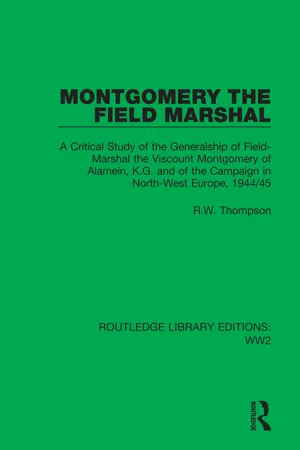
Montgomery the Field Marshal
A Critical Study of the Generalship of Field-Marshal the Viscount Montgomery of Alamein, K.G. and of the Campaign in North-West Europe, 1944/45
- 342 pages
- English
- ePUB (mobile friendly)
- Available on iOS & Android
eBook - ePub
Montgomery the Field Marshal
A Critical Study of the Generalship of Field-Marshal the Viscount Montgomery of Alamein, K.G. and of the Campaign in North-West Europe, 1944/45
PART ONE The Ground Force Commander
PROLOGUE Cross-Channel Assault and the Supreme Command
I
On Christmas Eve, 1943, General Sir Bernard Montgomery, commanding the British Eighth Army in the field on the River Sangro, was appointed to the command of the 21st Army Group of Armies for ‘Operation Overlord’, the cross-channel assault on North-West Europe. He was under the Supreme Command of the American General Eisenhower. It had been agreed that Montgomery would command all the ground forces in the initial assault, and until such time as a U.S. Army Group was established on the continent. At that point the Supreme Commander would take over, and Montgomery would revert to the command of his Army Group. This arrangement was a minor triumph of some importance to the British, and a concession to their ideas of the functions of a commander. It might represent the thin end of a wedge, for Montgomery might succeed in maintaining his position and retaining control of the ground forces. Such a result must depend on success, and on the willingness not only of the Supreme Commander and his Army Group commanders to accept Montgomery’s leadership, but on the agreement of the U.S. Joint Chiefs of Staff. Montgomery was not the man to relinquish any part of his power without a struggle.
The problems of Anglo-American command had not been easy to solve. They derived from different ideas of the functions of a commander. The Americans felt that the Supreme Commander ‘should in some way control the assaulting army . . .’1 but they had no clear conception of how this should be done. In British eyes the Supreme Commander would have his hands full with strategic and political problems of great complexity, combined with his function of co-ordinating the land, sea and air forces.
For Britain their choice of a commander for ‘Overlord’ was of great significance in the political, strategic and military context of the time. The realities of power had moved steadily out of British hands, to become little more than a shadow after the Quebec Conference in August, 1943. At Cairo and Teheran in the last days of November and the first week of December of that year even the shadow was gone, leaving no doubt that the United States and Russia would shape the future in war, and almost certainly in peace. It was an un-pleasing prospect, boding ill for the future of Europe.
Thus, on the field of battle alone, might there be a chance for Britain to affect final decisions, and by military ardour and skill to influence the course of events. Prestige might be won, and even upon so fragile a foundation a reality of power in Europe might be built in the aftermath of war.
General Montgomery, therefore, would be Britain’s champion.
Yet events had by that time developed a momentum of their own. It felt then, and it seems true now, that all that men could do would be to steer the ship of war as best they might. The engines were going, the gears engaged, the speed set. ‘As a practical matter,’ Richard Leighton observed, ‘the war in Europe had progressed beyond the point of no return.’ Even the date (for ‘Overlord’) was hardly any longer in the ‘realm of strategic decision.’1 In the end, as Churchill wrote, the date was fixed mainly by ‘the moon and the weather.’
Immediately after reporting to his Supreme Commander, General Montgomery flew to Marrakesh in North Africa, where the Prime Minister was recuperating after a severe bout of fever. Churchill’s condition had caused some alarm in his immediate entourage. Field-Marshal Smuts had wondered whether, for all his indomitable spirit, Churchill would stay the course. General Sir Alan Brooke, Chief of the Imperial General Staff, was gravely concerned.
Churchill had fought every inch of the way for his Mediterranean strategy at Cairo and Teheran, and the effort had cost him dear. He had thrived upon action and danger, and now, shorn of his power to shape the course of events, he suffered intolerable frustrations and anxieties. An Aide-Mémoire dated 11th November had expressed his views with force and clarity, while protesting his respect for the ‘Sanctity of Overlord’:
With the Germans in their present plight the surest way to win the war in the shortest time is to attack them remorselessly and continuously in any and every area where we can do so with superiority.1
These views, totally opposed to U.S. strategic thinking, aroused their worst suspicions that the British were ready to ‘ditch Overlord’. Only, some felt, the appointment of General Marshall, the U.S. Chief of Staff, to the Supreme Command would ensure the cross-channel assault.
Teheran marked the end of Churchill’s Mediterranean strategy, but not of his dreams. Anvil, a new plan for an attack on the South of France as a subsidiary to ‘Overlord’, made the British Prime Minister wince. He would fight such nonsense to the bitter end with bitter words. But now, convalescing at Marrakesh, he sent for his new champion. Montgomery was good for him, for the general lived in a much smaller world in which he would never admit defeat. Moreover the general neither drank nor smoked, and he went to bed early. He had the knack of making up his mind swiftly and expressing himself with absolute conviction. It sustained and soothed the restless spirit of the Prime Minister.
‘I had asked Montgomery to visit me on his way home from Italy to take up his new command in “Overlord”,’ Churchill wrote. ‘. . . I had offered him this task so full of hazard. . . . I was gratified and also relieved to find that Montgomery was delighted and eager for what I had always regarded as a majestic, inevitable, but terrible task.’2
It is a curious statement, reflecting Churchill’s love of rhetoric rather than the substance of his thoughts, for no one knew better than the Prime Minister that Montgomery, supported by every agency of government, and the power of the Press, had been long resolved that this great military prize should be his.
‘The immense labour expended by various authorities—not excluding Monty himself—had to be lived with to be believed,’ wrote one of Churchill’s principal aides.1
There were others with greater claims upon the succession than Montgomery, and there was also the man in possession. General Sir Bernard Paget, Commander-in-Chief Home Forces, and one of the Combined Commanders responsible for developing the basic information, material and plan for a cross-channel assault, had trained the ‘Liberation’ army for its task with unremitting zeal and foresight. He had produced the ‘Skyscraper’ plan upon which the Chief of Staff to the Supreme Allied Commander (Designate) had built ‘Operation Overlord’.2
‘It was with deep grief that I was replacing Paget with Montgomery,’ wrote the Chief of the Imperial General Staff, General Sir Alan Brooke. ‘. . . Paget, of course, took it all in a wonderful way.’3
Nevertheless General Paget was ‘upset and sad at being superseded’.
General Sir Harold Alexander, the obvious choice in American eyes for the command of ‘Overlord’ under Eisenhower, was quite unmoved by Montgomery’s triumph. Alexander was the perfect ‘amateur’, concealing his considerable military gifts beneath a serene and imperturbable exterior, and an air of easy nonchalance. Yet, contemplating Alexander I find it difficult to be sure of his toughness of fibre. Perhaps he was too patently a ‘gentleman’ for his day and age. Perhaps he would have benefited from a more difficult passage to the top, and something harder than a ‘golden spoon’ to bite on. Alexander had a natural distaste for the limelight, and all that that must entail. Moreover it must be doubtful if he could have been adequately replaced as Commander of the 15th Army Group in Italy. General Mark Clark, commanding the U.S. Fifth Army, might well have found Montgomery intolerable.
But to an enormous public, including the rank and file of the Army in Europe, the choice of Montgomery to command Britain’s armies in the last great throw, seemed natural and obvious. His prestige was enormous, his image, his words and deeds, engraved upon the mind of a Nation.
Montgomery’s performance in the Western Desert had won for him wide acclaim in the United States, but the American commanders and observers in the field had become progressively disenchanted. Montgomery’s readiness to pontificate upon all military matters, his remarkable self-assurance coupled with his equally remarkable caution, caused many to question his ‘genius’ as a commander in the field, while few would question his genius in public relations. As a ‘character’, if not as a commander of an army, he was unique.
It was undeniable, as General Sir Alan Brooke observed, that Montgomery had never lost a battle. His record of victory was unblemished, and yet, when the record was examined it was difficult to discover a ‘losable’ battle. He had inherited not only a winning position against a beaten enemy, but also an overwhelming strength never before at the disposal of a British commander. To know Montgomery at his best some would look back upon his handling of his troops in the retreat to Dunkirk, and it is ironical that this man, so gifted and resolute in defence, should have been given the conqueror’s attacking role.
In Sicily and in Italy Montgomery’s use of his enormous fire power had been disquieting, not only to many observers in the field, but to those at home whose task it was to maintain production with a diminishing labour force, to provide shipping space, and generally to feed this voracious appetite. The Americans had observed with amazement that Montgomery would not move without such a superiority in every arm as to render defeat impossible.1 Irrespective of the strength of the enemy confronting him, or the type of country, mountain, plain or desert, enormous supplies of ammunition were built up together with the transport to move them.2 At the same time bombing had become a British obsession.3
Nevertheless it was Montgomery’s failure to work in close harmony with the Americans that had been the greatest source of worry, especially to General Brooke. General Eisenhower made no secret of the fact that he had expected to continue to work with Alexander, and the appointment of Montgomery came as a shock. Senior to Montgomery, Alexander had shepherded his difficult army commander from Alamein to the Sangro, smoothing out many difficulties on the way, while content to remain always in the background. He had commanded the 18th Army Group for the assault on Sicily and the 15th Army Group in Italy. From the first difficult days in Tunisia, when the Americans had been finding their feet and licking their wounds after their severe reverse in the Kasserine Pass, Alexander had been a tower of strength to the alliance.
It may be that in the back of Churchill’s mind was the faint hope still that ‘Overlord’ would not take place, that a situation might develop which would render a cross-channel assault a virtual ‘walk-in’, planned for under the code name ‘Rankin’. ‘German strength in France next Spring may, at one end of the scale, be something which makes “Overlord” completely impossible and, at the other end, something which makes “Rankin” not only practicable, but essential.’1
In such a fortunate eventuality it might fall to Alexander to change the face of Europe and to forestall the Russian advance upon Vienna. British hopes for victory, and for peace, still lingered in the Mediterranean. The ‘soft under-belly’ had turned out to be more like the rugged back of a crocodile, but there, by way of the Ljubljana Gap lay a path to the heart of Europe which might still be opened to confound the dreams and ambitions of the Russian Dictator.
It is possible also that the choice of Montgomery was a symptom of British intransigence, for the cock-sure and plain-speaking general could be relied upon to argue every move with the Supreme Commander, and to maintain the course of the campaign for Europe on the lines most suitable for Britain. In a talk with Eisenhower at Carthage on 11th De...
Table of contents
- Cover
- Half-Title Page
- Title Page
- Copyright Page
- Original Title Page
- Original Copyright Page
- Acknowledgements
- Frontispiece
- Table of Contents
- Illustrations
- Part One: The Ground Force Commander
- Part Two: The Field-Marshal
- Epilogue
- Bibliography
- Appendix
- Index
Trusted by 375,005 students
Access to over 1.5 million titles for a fair monthly price.
Study more efficiently using our study tools.
Frequently asked questions
Yes, you can cancel anytime from the Subscription tab in your account settings on the Perlego website. Your subscription will stay active until the end of your current billing period. Learn how to cancel your subscription
No, books cannot be downloaded as external files, such as PDFs, for use outside of Perlego. However, you can download books within the Perlego app for offline reading on mobile or tablet. Learn how to download books offline
Perlego offers two plans: Essential and Complete
- Essential is ideal for learners and professionals who enjoy exploring a wide range of subjects. Access the Essential Library with 800,000+ trusted titles and best-sellers across business, personal growth, and the humanities. Includes unlimited reading time and Standard Read Aloud voice.
- Complete: Perfect for advanced learners and researchers needing full, unrestricted access. Unlock 1.5M+ books across hundreds of subjects, including academic and specialized titles. The Complete Plan also includes advanced features like Premium Read Aloud and Research Assistant.
We are an online textbook subscription service, where you can get access to an entire online library for less than the price of a single book per month. With over 1.5 million books across 990+ topics, we’ve got you covered! Learn about our mission
Look out for the read-aloud symbol on your next book to see if you can listen to it. The read-aloud tool reads text aloud for you, highlighting the text as it is being read. You can pause it, speed it up and slow it down. Learn more about Read Aloud
Yes! You can use the Perlego app on both iOS and Android devices to read anytime, anywhere — even offline. Perfect for commutes or when you’re on the go.
Please note we cannot support devices running on iOS 13 and Android 7 or earlier. Learn more about using the app
Please note we cannot support devices running on iOS 13 and Android 7 or earlier. Learn more about using the app
Yes, you can access Montgomery the Field Marshal by R.W. Thompson in PDF and/or ePUB format, as well as other popular books in History & Military & Maritime History. We have over 1.5 million books available in our catalogue for you to explore.